On Earth, every dance is a conversation with gravity. Dancers can resist it, seeking thrillingly brief moments in the air. Or they can root themselves in it, drawing strength from the inexorable pull of the ground. It is the partner that makes dancing as we know it possible.
So to be a dancer in a float tank — which uses the buoyancy of salt water to approximate weightlessness — is both bewildering and revelatory.
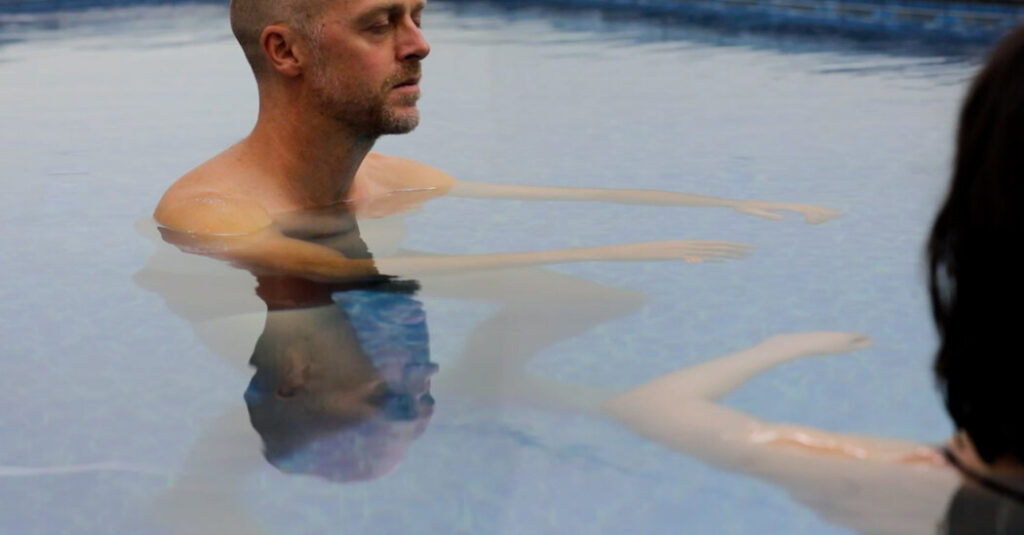
As I drifted in a tank in Brooklyn recently, I found my brain glitching. What did it mean to move not in relation to the floor, but only in relation to my own suspended body? Untethered by gravity, I entered a kind of physical stream of consciousness. The gentlest push of a finger against the tub could set me in indefinite motion. Virtuosity, in the dancerly sense, was turned inside out. Stillness became the most impressive feat of all.
There was I, floating ’round my tin can.
As a new commercial era of space exploration accelerates, scientists and engineers are considering the physical culture of outer space. But determining how humans can or should move without gravity is a philosophical as well as a logistical puzzle. Dancers, with their deep embodied knowledge, might be especially well positioned to find solutions. Some are already trying.
My float tank experience occurred during a “space camp” in March hosted by the Conference for Research on Choreographic Interfaces. The weeklong program brought about a dozen art- and science-minded movers into various altered-gravity environments.
Sydney Skybetter, the founder of the Choreographic Interfaces conference and a professor at Brown University, described the space camp crew as a “heterogeneous nerd gaggle.” Downtown dancers rubbed shoulders with experts in physics and astronomy, like Adam Dipert, who studies the mechanics of motion in microgravity, and Adeene Denton, a planetary scientist and choreographer.
In addition to the float tank sessions, Dipert led a workshop in a traditional pool to see how weightlessness transforms dance movement, especially in partnering. Dancers from the company Streb Extreme Action, known for stomach-flipping daredevilry, taught classes that incorporated trampolines and trapezes.
“How our bodies relate to space is, I think, the first, base line thought you should have when engaging in space exploration,” Denton said in an interview. “And relearning how your body works without gravity is a form of play that dancers understand better than anyone.”
Space campers also discussed the ethical conundrums of space travel, and why — or if — dancers should aspire to it.
Skybetter says he understands why people might be skeptical about space dance. “The idea of dancing in outer space,” he said, “on some level it’s laughable.”
Still, when it comes to bigger-picture conversations about bodies in extraterrestrial environments, he believes dancers should have a seat at the table.
“The engineers building the future of these technologies continue to forget that, you know, humans have bodies,” he said. “What daily life as a multi-planetary species could look like, who gets to move through the cosmos and how — those are questions that choreographers are trained to interrogate.”
Most astronauts aren’t trained in dance. But they are, inevitably, dancers. Denton — who has applied to NASA’s astronaut program — said she loved watching videos of daily life on the International Space Station, where microgravity turns even mundane tasks into strangely beautiful choreography. In his memoir “Endurance” (2018), the astronaut Scott Kelly described feeling something close to awe as he watched a fellow space station crew member brush her teeth, elegantly hooking her toes under a railing to steady herself.
Astronauts have also danced in space for fun. In 2021, the space station crew performed a “synchronized swimming” routine that included fluid flips — and the “Macarena.” Last year, space station astronauts Donald Pettit and Sunita Williams tried out a two-step that rotated gracefully through the air.
But professional dancers have imagined different possibilities in weightless environments. In the 1990s the French choreographer Kitsou Dubois took multiple parabolic flights, in which an aircraft accelerates steeply upward before entering a free-fall that creates about 20 seconds of weightlessness. In zero gravity, “everything was more interesting than what was happening on the ground,” she said on a podcast recently.
Dubois developed poetic, haunting choreographic phrases to perform on these flights — foundational research for dancers working in altered gravity today. She thought about becoming an astronaut, she said on the podcast. Instead, she brought the language of space back to the ground, creating earthly dances that echoed the slow, meditative serenity of movement in microgravity.
“We are different when we are up there,” Dubois said on the podcast, “and it is because we are different that we will become richer when we come back down to Earth.”
To get more dancers “up there” has been a goal of the Choreographic Interfaces team’s microgravity work. In 2025, the conference hosted a residency for four artists, helping them study choreography in weightless environments. The idea was to send the quartet on a parabolic flight this year.
That has proved more complicated than expected. Zero-G, the company that manages most of these flights in the United States, has temporarily paused them, citing routine maintenance on its website. And parabolic flights are extremely hard on the body, a particularly unnerving proposition for physical artists. (They’re nicknamed “vomit comets.”)
Other concerns arose, too. During the Choreographic Interfaces residency, the participating artists learned more about the high cost of space travel and the privatization of the sector by billionaire-run companies including SpaceX and BlueOrigin. Some of the dancers began to worry about the ethical implications of experiments in space. The conference’s annual gathering at Brown in June featured heated debates on the subject.
The choreographer Laila J. Franklin, who was part of the residency, said: “I’ve made it clear, at this point, that I do not want to go to space. There is so much need on Earth, so many systems that don’t work here, that it would feel to me like running away from the real problems.”
During space camp, Denton led a seminar on the complicated ethics of bodies in space. Most space exploration has been shaped by nationalistic and military interests. (“Rockets are just missiles aimed straight up,” Denton said.) In that context, outer space can become a frontier to conquer — an idea that also motivates today’s commercial space races.
Denton’s feelings about space travel are more complicated than they used to be. But she argues that artists can create different, more joyful narratives about space, countering the “final frontier” mentality. “That is something that I think dancers are uniquely prepared to do,” Denton said, “because of their ability to explore their own bodies and to connect to the world around them.” She said she still dreamed of dancing on the moon.
Whether or not they make it to space, the Choreographic Interfaces artists have found that learning about weightlessness has illuminated their earthbound work. Franklin said her choreography typically involves “a lot of throwing the body around and falling hard — like, bam!” But working in microgravity has fostered a fascination with falling “as a kind of infinite process,” she said. At the camp, she led a workshop that imagined what a club in outer space might look like: the flow state of a dance floor, with the ceaseless flow of weightless movement.
Weightlessness raises philosophical questions for artists to consider, too. “Gravity doesn’t just shape how we move, it shapes how we think,” Dipert said in an email.
Dipert, who has been on multiple parabolic flights, said “gravitational bias” can limit the human imagination. On Earth, for example, gravity means that when you stack objects in a pile, the pile goes up; over time, observing that phenomenon, our brains begin to conflate “up” with “more,” even in abstract contexts. (“Turn the volume up.”)
Eliminate gravity, and you might start thinking about the whole universe differently. That’s something curious artists are already primed to do — especially dancers, who understand the physical world’s power to transform the mind.
The Choreographic Interfaces team would still like to put dancers on a parabolic flight at some point. Sending willing dancers to space would potentially be a boon for the scientific world as well as the artistic one, Dipert said. “We need people trained to notice their bodies in detail,” he wrote in his email. For scientists trying to figure out how humans can live in weightlessness, “that sensitivity becomes data.”
Skybetter hopes that the conference’s space research will help create stronger alliances between dancers and scientists. His best-case scenario is a world in which dancers are standard partners in the design of habitats and training programs for extraterrestrial environments.
That may sound far-fetched. But in a domain as vast and ideologically charged as space travel, he argues, questions about how bodies move are not just scientific or academic — they are, fundamentally, artistic.
“Choreographers should be in the room where these decisions about the future get made,” Skybetter said. “I don’t think their expertise is decorative. I think it’s load bearing.”
The post Dancing in Space: Rethinking Bodies Without Gravity appeared first on New York Times.