When I was a girl, my dad would ride his bicycle to the local ration shop in Chennai with a large plastic container, which he would have filled with kerosene.
For decades, state-subsidized kerosene was an essential fuel for cooking in Indian homes. Not ours. We used it as a cheap way to boil the buckets of water needed by the three women in our house to wash their knee-length hair each week. I remember the glug-glug as dad poured the kerosene into our stove, fumes rising like a genie escaping its bottle.
I watched, fascinated and afraid. Kerosene was stigmatized as fuel for the poor. But its pungent fumes also bore a sinister association — it was the fuel of choice in bride burnings, the immolation of women by their husbands or in-laws for failing to bring a large enough dowry, produce male heirs or simply for talking back.
In 2014, the government began phasing out kerosene in favor of cleaner-burning liquefied petroleum gas. Dirty kerosene stoves disappeared, ushering in cleaner, safer kitchens, less drudgery for the poor and, probably, fewer dead brides. We were so done with kerosene.
President Trump’s war on Iran has turned the transition to L.P.G. into a vulnerability. Roughly 60 percent of India’s liquefied petroleum gas is imported — and until a month ago, most was shipped through the Strait of Hormuz. With the war slowing shipments to a trickle, millions of Indian families are scrambling to keep their kitchens running. It’s gotten so desperate that the government is even reviving use of the hated kerosene. This is what unhinged American power can do when exercised without regard for the consequences — it can reach into kitchens in countries that have no part in U.S. wars and switch off the stove.
What’s truly absurd is that it was Mr. Trump’s policies that made India so vulnerable to the war’s ripple effects. His administration slapped 50 percent tariffs on Indian goods last year to punish us for buying sanctioned Russian oil. India duly shifted to Persian Gulf supplies. Now, Mr. Trump’s war is choking that route. Washington has graciously issued a 30-day emergency waiver allowing Indian refiners to buy sanctioned Russian oil already loaded on vessels at sea — granting us temporary permission to do what we were earlier punished for.
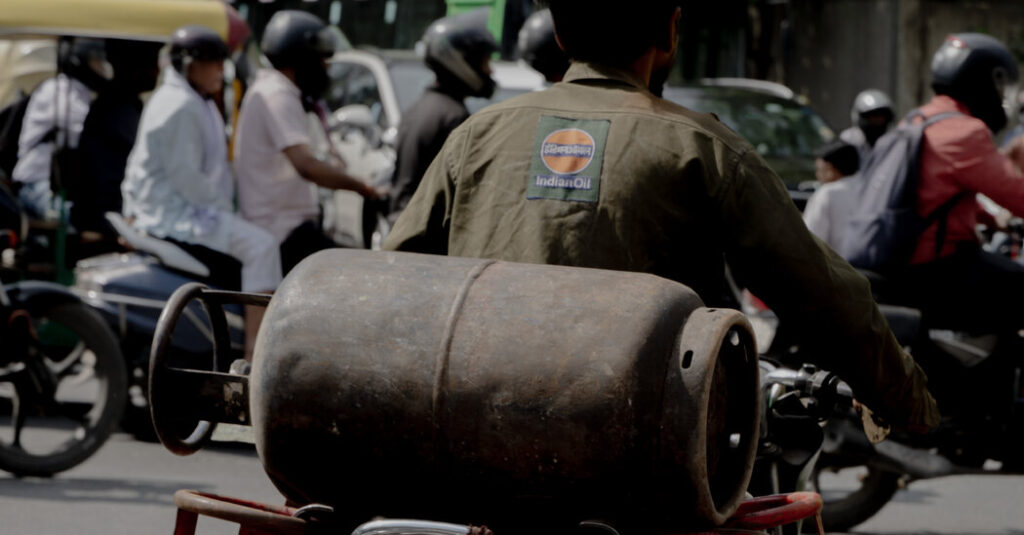
L.P.G. rationing has begun, triggering panic, hoarding and a flourishing black market. Roadside eateries and food stalls where the working classes eat — and which run on L.P.G. — are shutting down. Restaurants are reducing hours, modifying menus and laying off staff.
The government’s move to make more kerosene available collides with the fact that kerosene stoves are gone from many homes, and countless people in rural areas have cooked only with gas. We are being dragged back into a past for which we are no longer prepared.
Policymakers have pushed electric-powered induction stoves as an alternative for years, but that’s not the answer for the masses. India’s power grid is prone to outages, electricity bills are high and the multiple dishes served in Indian meals don’t lend themselves to cooking on a single, weak induction burner.
As I doomscroll, it becomes clear how dependent we are on petroleum-derived products or the fuel required to ship them — food, medicine, the packaging and plastics that countless necessities are wrapped in. Prices for our drinking water in Chennai, which is delivered in large plastic containers, have increased sharply. “Plastic comes from petrol,” the delivery boy told me curtly, impatient with my ignorance about supply chains.
One-third of the world’s fertilizers moves through the Strait of Hormuz, and global prices are spiking. In many countries like India, that’s not just an inflation problem — it endangers the next harvest. People are going into survival mode, hoarding supplies as prices soar and products disappear from stores. It’s easy to condemn such behavior, but I know how it feels. My young sons guzzle milk. Making sure we have enough at home is a primal, maternal instinct that fights with my ethics. People on the street are even sharing news about Indian ships stranded in the gulf as if tracking the flights of loved ones.
This month, Prime Minister Narendra Modi told an election rally in my home state of Tamil Nadu that Indians would overcome this crisis. To many of us, that sounded ominous — the last time we heard talk like that was during the pandemic, and that was followed by a lockdown that upended millions of lives.
And it’s not just us in India, of course. The vast majority of oil and gas that flows through the strait is bound for Asia, and the war’s collateral damage is spreading across the region. Households in South Asia that already struggled to get by are facing spiraling costs. Pakistan, which imports more than 85 percent of its oil from the Persian Gulf, and Sri Lanka have reduced office hours among other austerity measures. The Philippines has declared a national emergency, Australian gas stations are running dry and Asian currencies are plummeting, which will make imports of all goods more expensive.
South Asians working in the Middle East send home billions of dollars every year that are vital for millions of families. Remittances by Nepali workers — most of whom are in gulf states — account for about one-quarter of G.D.P. If the conflict worsens, what will happen when the many Nepali and Bangladeshi workers in the Middle East return home to their countries, which are both still unstable after popular uprisings in the past two years? And what about the many poorer countries across Africa and Asia that depend on affordable generic medications manufactured in India and which are now at the mercy of supply-chain disruptions? This war is dangerous for everyone.
Masks drop in wartime, and this war is no exception. For decades, America dressed its wars in the fiction of bombing women into freedom. It bombed Afghanistan in part to free its women and has invoked the plight of Iranian women to justify some of its sanctions on Iran. Yet America’s latest war is pushing millions of Indian women back to kerosene, even to collecting firewood, to keep their families fed.
This U.S. president is setting the world on fire, and the rest of us are choking on the fumes.
Meena Kandasamy is a writer based in Chennai, India. She is the author of the poetry collection “Ms. Militancy” and the forthcoming novel “Fieldwork As a Sex Object,” about incels, influencers and the far right in online spaces.
The Times is committed to publishing a diversity of letters to the editor. We’d like to hear what you think about this or any of our articles. Here are some tips. And here’s our email: [email protected].
Follow the New York Times Opinion section on Facebook, Instagram, TikTok, Bluesky, WhatsApp and Threads.
The post Trump Sets the World on Fire. India Chokes on the Fumes. appeared first on New York Times.