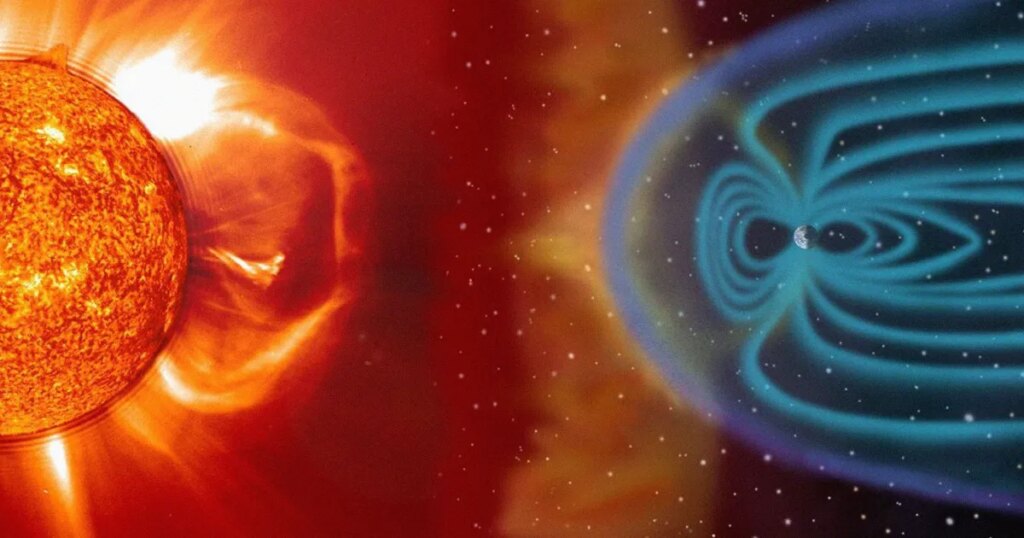
As NASA continues to push for a permanent presence on the Moon, future space travelers will face plenty of dangers, from micrometeorite showers battering the lunar surface to the unknown effects of spending prolonged periods of time in just one sixth of Earth’s gravity.
Deep space radiation also remains a major hazard. NASA’s Artemis 2 mission, which is slated to launch as early as next week, will see astronauts venturing far beyond the Moon, reaching the furthest mankind has ever been away from home, and likely exposing them to significantly higher levels of radiation.
The fear: such cosmic rays could penetrate astronauts’ bodies and damage DNA or increase the risk of developing cancer.
But thanks to recent research by an international team of researchers, there may be a peculiar “cavity” of reduced cosmic radiation that could provide them with shelter. This cavity includes Moon and extends far beyond it into space, and only appears at a specific moment of time in the Moon’s orbit around the Earth, at which point cosmic rays die down significantly.
As detailed in a paper published this week in the journal Science Advances, the team analyzed data collected by China’s Chang’e-4 lander, which became the first spacecraft to land and explore the far side of the Moon in early 2019.
They found a surprising “region of reduced [galactic cosmic ray] flux in the prenoon sector of the lunar orbit,” challenging the presumption that radiation is “uniformly distributed over the Earth-Moon distance.”
A handy illustration by the researchers explains when and where this cavity forms. The white dotted circle illustrates the Moon’s orbit around the Earth. Just before dawn on the Moon, the “galactic cosmic ray [GCR] cavity,” as illustrated by the brighter streak of light, forms thanks to the Earth’s magnetic field — sheltering the Earth’s natural satellite from the Sun’s radiation.
The implications for future space travel could be considerable, since the findings suggest that our planet’s protective magnetic field is far more extensive than previously thought.
“This cavity indicates that the influence of Earth’s magnetic field within the space environment extends unexpectedly up to and far beyond the lunar orbit,” the paper reads.
The cavity appears a few Earth hours after lunar sunrise. A single lunar day lasts for approximately 29.5 Earth days, which means it’s not as fleeting a moment as it sounds, stretching the window to “roughly 2 [Earth] days during each lunar revolution.”
The conclusion could help inform future activities on the lunar surface. The paper’s corresponding author and Kiel University professor Robert Wimmer-Schweingruber told Live Science that lunar morning is the best time for excursions, given the roughly 20 percent reduction in the amount of radiation hitting the astronauts compared to average levels.
The researchers examined data from Chang’e-4’s Lunar Lander Neutron and Dosimetry instrument, which measured the number of protons from cosmic rays throughout the Moon’s orbit around Earth, which eventually led them to identify a recurring dip in radiation. They posit the Earth’s magnetic field may continue to block some of these energetic protons.
“I had not expected to see this ‘shadow’ or cavity,” Wimmer-Schweingruber told Live Science. “It makes absolute sense in retrospect, but I was very skeptical when I first saw this result.”
As the US and China continue to ramp up their efforts to send astronauts to the Moon, the research could have profound implications.
“This finding provides a potential strategy for mission planning, especially for manned lunar missions and extravehicular activities, as operations could be timed to coincide with these lower radiation periods to reduce exposure risk,” the researchers concluded.
“Future studies with extended datasets could further clarify the spatial extent and behavior of this cavity, offering deeper insights into potential radiation protection strategies, not only for the Earth-Moon system,” they added, “but potentially for missions near other magnetized bodies within the Solar System.”
More on cosmic radiation: Scientists Propose Injecting Astronauts With Tardigrade RNA After Finding It Prevents Radiation Damage
The post Data From Chinese Moon Lander Shows Signs of Peculiar Radiation “Cavity” appeared first on Futurism.