One thought kept going through Tijuanna Fisher’s mind as she lay on the elevator floor in her Northwest Washington apartment building for what seemed like forever last fall:
“Please, God, don’t let me die.”
Fisher, then 58, had just returned from taking her dog for a short walk on Sept. 26. They entered the elevator and rode to the third floor, Fisher wearing a bright pink T-shirt and Shadow, her small and steadfast companion, a bright pink harness.
Video from a security camera inside the elevator, obtained by The Washington Post through a Freedom of Information Act request from the D.C. Department of Buildings (DOB), captures the moments that followed.
The door opens and Shadow, whose leash handle was looped on Fisher’s arm, steps into the hallway. Two seconds later, as Fisher backs her motorized wheelchair toward the door, it closes quickly on the leash, leaving Shadow in the hall.
Inside the elevator, the video shows, Fisher is dragged from her chair by the leash and then is yanked sharply to the ground as the elevator starts to ascend. Her left arm appears to be pulled through the closing door, which momentarily buckles.
According to the timer on the video, a total of nine seconds elapsed from the moment Shadow stepped out of the elevator until Fisher lay on the floor. Those few moments changed her life forever. The closing door severed her arm just below her shoulder.
Paola Beristain, a resident on the fourth floor of the nine-story building, received a text from a friend that someone was stuck in the elevator. When she walked into the hallway, she could hear Fisher crying out in pain and asking for help. When firefighters arrived, Beristain said, they were initially unable to open the elevator door and were forced to use an electric saw and other tools to pry it apart.
“It was all just terrifying,” said Beristain, who has since helped organize tenants in Dorchester House on 16th Street NW to demand safety and health improvements in the building.
To reach Fisher, the first responders had to descend through the elevator shaft and drop into the car through the rescue hatch. Once inside the car, the firefighters treated Fisher immediately and then extracted her from the elevator. About 40 minutes had gone by from when the incident began, according to her lawyers. As she was being taken to the ambulance, Fisher said, she asked one of the firemen about her arm.
“I told him not to talk soft around me,” she said.
“It’s gone,” she recalled the fireman telling her.
Fisher dabbed at tears rolling down her face with a tissue as she recounted the traumatic night in a recent interview. “I said, ‘Yes, yes, I already knew.’”
Other elevator scares
Dorchester House, built in 1941, was for many years a prized residence in the District. A young Navy ensign named John F. Kennedy lived in Apartment 502 for a short time soon after the building opened. But in recent years, tenants have complained about upkeep of the historic property.
Residents of the building were horrified when they learned what happened to Fisher. But many say they weren’t surprised. The three small elevators in the 395-unit, 85-year-old building, have long been a source of fear and frustration for tenants who say they have complained repeatedly to the building’s management company, Borger Residential, and to the D.C. Department of Buildings.
They say they have documented close calls before with elevator doors closing rapidly and safety sensors not responding to objects or people in the doorway. They have also endured elevators lurching or getting stuck between floors. And, they say, the elevators are often shut down altogether, creating a major inconvenience for tenants ranging from young parents with children to people in wheelchairs to senior citizens with mobility issues.
Almost all of their complaints go unheeded, they say.
“It’s like we don’t exist,” said Anne Pasmanick, a longtime resident and a member of the building’s reactivated tenant association. Pasmanick says the building’s management has been dismissive of claims, fails to communicate about safety issues and often blames tenants for “user error” whenever there’s an incident with the elevators.
Days after Fisher’s arm was severed in the door, Borger placed posters in the two operable elevators instructing residents on how to control pets in the elevator. It read in part, “Elevator sensors can miss leashes, creating a risk if doors close between you and your pet.”
A number of tenants said they saw the poster as blaming the victim and an attempt to avoid responsibility for the long-standing elevator malfunctions.
Timothy Taylor, president of Borger Residential, said the company could not comment for this story because of ongoing legal proceedings.
Many who live in the Dorchester are also critical of the D.C. Department of Buildings, the agency charged with regulating inspections and safety for approximately 9,900 elevators in the District. D.C. law requires that elevator inspections be done twice a year, but those inspections are outsourced. Building owners are responsible for arranging the inspections with companies approved by DOB to conduct them. Those companies are then required to send copies of the inspection to DOB.
There are only two full-time elevator inspectors employed by DOB and their primary role is reviewing third-party inspection paperwork, an agency spokesperson confirmed. This has led some critics to say the department is unable to meet demand for attention from owners, tenants and builders. Earlier this year, residents of the 10-story Museum Square apartments near Chinatown went more than six weeks without a single elevator working in the building despite a court order to make at least one operable.
When DOB inspected the Dorchester following the incident involving Fisher, it found that the building did not have the required elevator certificate and the past year of elevator inspection reports were not provided, according to a DOB spokeswoman. DOB issued an Emergency Notice of Infraction and fined the building’s management $2,499.
In a statement, the Department of Buildings said it continues to track the status of the Dorchester’s elevator operations. During its last inspection of the building, on Feb. 27, it said “all required elevator inspection certificates were current, the elevators were operating normally, and no irregularities were observed in door function or general performance.”
A DOB spokeswoman said that as part of its review of the Sept. 26 incident that resulted in Fisher losing her arm, the property management shared videos “that showed the item detection and door opening/closing cycles were within their normal ranges.” DOB said it advised the property management team to provide instructions with tenants on how to enter and exit an elevator.
“DOB is conducting a thorough investigation of the September 2025 incident to ensure both the safety of tenants and that the building elevators meet legal standards under DC law,” the spokeswoman said in an email Friday. “To date DOB’s investigation has not found that a mechanical elevator malfunction occurred.”
The DOB said it was informed by the property management team that “a comprehensive elevator modernization project” is scheduled to begin in April. “DOB does intend to visit the property again this week to confirm the elevators are still operating normally,” the spokeswoman wrote in a March 24 email.
Pasmanick is not counting on DOB’s oversight to make sure that adequate repairs are made.
“I don’t find them acting with integrity. They don’t have any intention of doing a serious inspection,” she said. “There’s just a laxness of enforcement in this city.”
Fisher’s injury is by far the worst elevator incident to have occurred in the building, but not the only one.
“The elevators were just notoriously awful,” said Karmen Fox who lived in the Dorchester for nine years before moving out in 2024. “They were repeatedly having problems with them and they never did enough to fix them.”
In February 2024, Fox was using a dolly to take packages on the elevator, she said. Her dog Ruthie followed her but as soon as Fox stepped inside the elevator, she said, the door closed on the leash and her dog was stuck outside. Fox frantically pushed the “open door” button but the elevator went up immediately, pulling Ruthie with it. The incident occurred on a different elevator from the one in which Fisher was injured.
“It was such a horrifying experience,” Fox said. “I screamed, ‘Someone help my dog, someone help my dog!’”
Fox said the leash snapped and other residents still in the lobby were able to undo Ruthie’s harness and stay with her until Fox was able to ride the elevator back down. Fox moved out of the building two months later.
On Dec. 31, 2025, three months after Fisher’s injury, Malinda Fravert was in the Dorchester lobby and saw a woman in a wheelchair stuck in the elevator doorway. Fravert, a resident of the building for more than a decade and president of the Dorchester Tenants Association, said she was terrified that what happened to Fisher would happen to this woman.
Fravert described the incident later that evening in an email to members of the tenants association.
“She had not had an appropriate amount of time to pivot her wheelchair fully into the elevator, and the door kept trying to close on her legs,” she wrote “Fortunately, I was able to wedge myself in next to her and maneuver her wheelchair fully into the elevator while she kept pushing the door open button every time the doors tried to close on her legs.”
Fravert also addressed the email to the building’s management, D.C. government officials and D.C. Council members.
“I am emailing you all because the lack of response from both the city and our building management nearly resulted in another serious elevator injury tonight,” she wrote.
Fravert says the response was “subpar at best.” Council member Brianne K. Nadeau (D-Ward 1) emailed to put the tenant association in contact with her constituent services office but, Fravert says, there was little follow through.
In an email, Nadeau disputed Fravert’s characterization of her office’s response. “My office followed up many times directly with DOB and with a particular constituent who had initiated the emails to me, in order to monitor progress and report back on our efforts,” she wrote.
On Jan. 6, Taylor, Borger’s president, responded to Fravert’s email saying the company was in the process of applying for permits to install new elevators. The residents say they have heard nothing since.
In February, Fravert testified at a D.C. Council oversight hearing on DOB and criticized the department’s response time. She recounted calling DOB to find out how to report an incident to the correct division and being placed on hold for 90 minutes before she finally gave up and attempted to reach the agency online. That went nowhere, she said.
Fravert urged the council to investigate DOB’s staffing and expertise and also questioned the system of having building owners hire private inspectors to conduct elevator inspections for their city certification.
“Inspectors know where their bread is buttered,” she told the council members. “We strongly recommend this practice be brought in-house with dedicated city experts who can’t so easily connect their paychecks to building ownership.”
Eight surgeries later
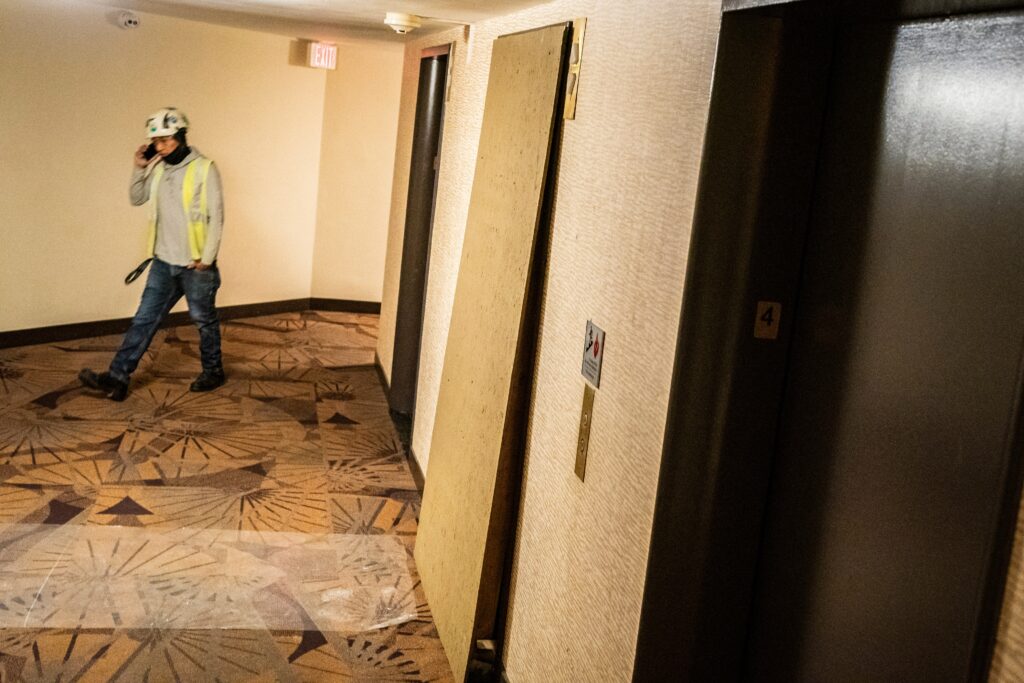
The elevator Fisher used the day she lost her arm has remained shut down. The building’s residents now rely on two elevators, both of which they say continue to have problems. D.C. regulations state that a building with multiple elevators is compliant if at least one elevator is in operation.
Following eight surgeries and 35 days in the hospital and a rehabilitation center, Fisher is back in her tidy one-bedroom apartment that she shares with Shadow. Two prior hip replacement surgeries have left her mostly reliant on her wheelchair but she is able to walk, slowly, to do some chores.
She takes the trash down the hallway. She mops the parquet wood floor and is relearning how to cook, clean and bathe. Figuring out how to tie a trash bag with one hand was harder than she expected.
The residents in the building have been kind and generous with offers of help, Fisher said, but she is fiercely independent and doesn’t want others to feel like they need to take care of her. A physical therapist comes twice a week and Fisher has been fitted for a prosthesis.
Kenneth Trombly and Daniel Singer, Fisher’s attorneys, said they are pursuing a civil lawsuit on her behalf. Their goal, Singer said, is “to ensure that she has the care and support she will need for the rest of her life. And to hold those responsible fully accountable for the profound harm she has suffered.”
The additional purpose of the lawsuit, “is deterrence so that a building like this one knows that they can’t cut corners,” Singer said.
Sitting in a chair in her apartment, Fisher said she is trying to move forward. “I’m not completely whole,” she said softly as Shadow sat on her lap. “I have a long way to go and I’m taking it one day at a time.”
Perhaps the most difficult thing for her to do is take the elevator when she needs to go shopping, take Shadow for a walk or just get some fresh air. Every time she approaches the elevator doors, her anxiety can feel overwhelming.
“There’s nothing I can do about that now,” she said. “I just try to block it all out.”
Razzan Nakhlawi contributed to this report.
The post Before an elevator door severed her arm, tenants complained about safety appeared first on Washington Post.