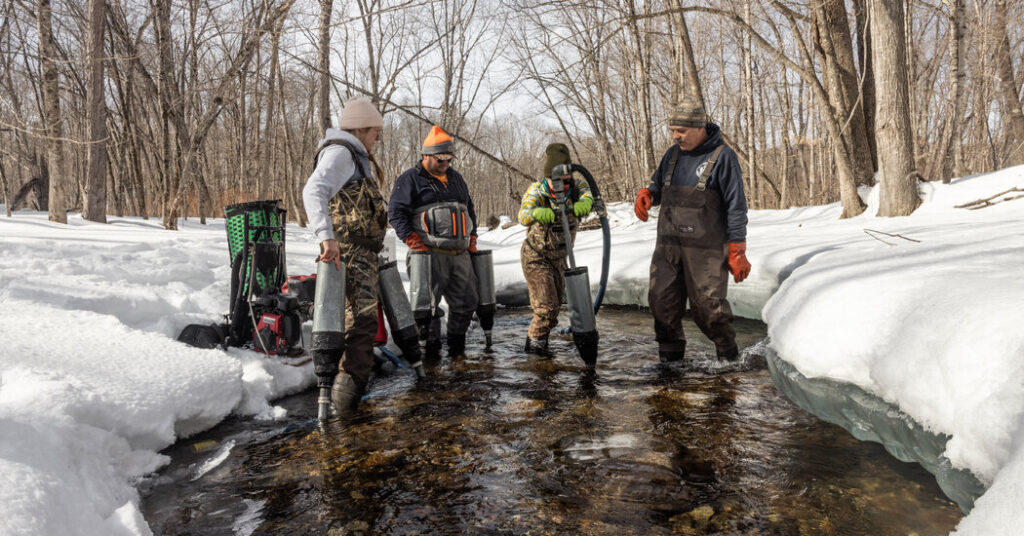
On a bright March morning, Paul Christman hiked through deep snowdrifts on the bank of Avon Valley Brook in the western Maine mountains, leading a crew wearing waders and shouldering unwieldy backpacks.
One crew member carried a pack basket loaded with battered funnels crafted from stovepipes, duct tape and plumbing pipes. Another lugged a water pump. The last brought a cooler full of thousands of fertilized Atlantic salmon eggs.
The stream was mostly iced over, but Mr. Christman, a marine scientist with the Maine Department of Marine Resources, found some open water on the brook, a tributary to the Sandy River.
“This is a really good spot,” Mr. Christman said. “The river is picking up velocity and shoving that water into the gravel, so we’re going to set up right here and do it.”
For 20 years, Mr. Christman has been working to restore salmon to this Sandy River watershed, where they were eradicated after dams built in the 1800s blocked their passage.
The strategy is producing thousands of juvenile salmon that migrate to the North Atlantic, but just a handful that return to Maine to spawn as adults.
Now, a $300 million project to remove or modify four dams downstream on the Kennebec River is infusing the work with new hope, possibly clearing the way for salmon to swim freely up to the Sandy River within a decade.
Hundreds of thousands of Atlantic salmon once flooded rivers in New England. For millenniums, the fish have been valued by Native Americans in the region as sustenance and cultural touchstones.
But marine survival rates for Atlantic salmon have plummeted over the last 35 years, for reasons that are complex and interwoven, including changing prey, shifting currents and warming waters.
More recently, they’ve been regarded by anglers as the “king of fish.” But by 2000, their numbers had fallen so low that federal regulators listed them for protection under the Endangered Species Act.
Early recovery efforts focused on the last remaining populations of Atlantic salmon in the United States, all in Maine, in the Penobscot River, and the Mid-coast and Down East regions.
But Mr. Christman became intrigued with the Sandy River, which flows east from the mountains along the Appalachian Trail to the Kennebec River, and he believed the forested watershed, with cool, clean water, to be excellent habitat for salmon.
Most of the Maine salmon populations are supported by stocking juvenile salmon from hatcheries. But in 2006, inspired by a prototype egg-planter used in Alaska, Mr. Christman began reintroducing salmon to the Sandy River system using fertilized eggs instead.
On that morning in early March, Avon Valley Brook was quiet except for the rippling water, calling blue jays and the whining chain saw from a distant logging operation.
“It’s so beautiful out here in winter,” Mr. Christman said, wading in the stream. “There’s a peace and tranquillity. It’s almost prettier than it is in summer.”
Then Gretchen Ramlo, a contractor with the state’s marine resources agency, yanked a pull cord to fire up the water pump.
Working together, crew members wriggled several pipes down a foot into the gravel, used the pump to clear a cavity at the base of the pipes and dropped a scoopful of orange salmon eggs into each.
As they removed the planting rigs, gravel covered the eggs. The process replicates salmon redds, where spawning salmon use their tails to dig depressions in the gravel to deposit their eggs.
This technique allows juvenile fish to hatch from the gravel on their own schedule in the spring months, minimizing the hatcheries’ influence on the fish.
After living in the freshwater for two or three years, the fish migrate seaward and spend two or three years maturing near Greenland. When they return to Maine as adults, Mr. Christman’s team captures them at the first dam they encounter on the Kennebec River and trucks them upriver around three more dams to the Sandy River.
He has shared his egg-planting technique with fisheries biologists in Alaska, California, New York, the Canadian Maritimes and Norway.
It’s a long process with a lot of uncertainty. Mr. Christman estimates that the 25,000 eggs he planted that March day will produce 10,000 juvenile fish. Of these, one adult might return in the summer of 2029 or 2030. In all, the 495,000 eggs he and his colleagues planted this year could lead to the return of just about 20 adults.
But the work is slowly paying off. Dozens of the adults returning from the ocean in recent years are the progeny of egg-planting or natural reproduction.
A newer program to stock juvenile salmon below the dams, led by the Maine Department of Marine Resources and the U.S. Fish and Wildlife Service, is adding more adults that return — there were 102 in 2023. It’s all leading to more salmon spawning on their own in the Sandy River system, and biologists have counted more than 100 redds some years.
Andrea Gomez, a spokeswoman for NOAA Fisheries, said the federal recovery plan for Atlantic salmon envisioned self-sustaining runs in three regions of Maine: Down East, Penobscot and Merrymeeting Bay. In that latter region, Dr. Gomez said the Sandy River stands out.
“It is the most significant source of naturally reared salmon in the southwestern part of the species’ range,” Dr. Gomez said.
The dams made it highly unlikely that the Sandy River would ever host a self-sustaining run of salmon, but the odds improved in September. The Nature Conservancy, a global nonprofit environmental group, agreed to buy the four dams between the Sandy River and the ocean for $168 million from Brookfield Renewable Partners, one of the world’s largest publicly traded renewable power companies.
Alex Mas, deputy director of the conservancy in Maine, will lead the new Kennebec River Restoration Trust that is managing the project.
Mr. Mas said the goal was “to restore free-flowing conditions on the Kennebec for the benefit of all of the native sea-run fish and all of the communities that are connected to and dependent on the river.” He said it could take 10 years, and cost an estimated $308 million.
The project could include a mix of dam removal and other efforts in collaboration with those communities and businesses, including a large paper mill, Mr. Mas said.
This would free the Kennebec River from tidewater to the confluence of the Sandy River and beyond. For the first time in more than a century, Sandy River salmon would be able to swim from the Gulf of Maine to their spawning grounds under their own steam. The project would continue the undamming of the Kennebec River and its tributaries that began in 1999 with the demolition of the Edwards Dam in Augusta.
The deal has drawn opposition from the Sappi paper mill in Skowhegan that uses one of the dams for its water supply, and some lawmakers and business groups have lined up to support the mill’s position. The Federal Energy Regulatory Commission will have to approve the deal, and opposition could stall the project.
John Burrows, vice president for U.S. operations of the Atlantic Salmon Federation, a nonprofit conservation group, has been closely following the recovery of Sandy River salmon.
“To get back a self-sustaining, wild population with four dams in place was never going to happen,” Mr. Burrows said.
The abundant cold-water habitat in the Sandy River is considered increasingly valuable because of global warming.
“It’s a climate-resilient landscape, high elevation and heavily forested,” Mr. Burrows said. “It’s an area that’s going to remain supportive of Atlantic salmon well into the future.”
The fish still face a steep uphill climb.
In the early afternoon at the last egg-planting site of the day, on Mount Blue Stream, Mr. Christman acknowledged the difficulties in trying to replenish the salmon’s numbers. But he mentioned how he was encouraged by the sight of a dozen large salmon finning in a deep pool of the Sandy River on a summer day.
“One of the greatest pleasures is to see the adults,” he said. “Everything we do is to get the adults to spawn on their own. That’s the endpoint of everything.”
The post The Fragile Hope for Salmon Recovery in Maine appeared first on New York Times.