Kraft Heinz is getting squeezed on all sides.
There are heated national debates over the amount of processing and the types of ingredients in our food. Inflation-weary consumers are spending less on name-brand products. Weight-loss drugs are altering snacking habits.
At Kraft Heinz — the owner of Oscar Mayer, Philadelphia cream cheese, Jell-O and many other household brands — sales have declined for nine straight quarters. Wall Street has shunned its stock, which is languishing near the lowest level since H.J. Heinz merged with Kraft Foods in 2015, in a deal engineered by Warren Buffett’s Berkshire Hathaway.
To shake things up, Kraft Heinz said last fall that it planned to break itself up, separating its fast-growing sauces and condiments business from a slower-growing collection of grocery staples.
It was a job that Steve Cahillane had done before. Mr. Cahillane, 60, a food industry veteran who stepped into the chief executive role at Kraft Heinz in January, had previously led the split of the Kellogg Company into separate snacks and cereal businesses in 2023. The snacks unit, which was renamed Kellanova and run by Mr. Cahillane, was then bought by Mars for $36 billion.
But, less than six weeks into the job, Mr. Cahillane put Kraft Heinz’s breakup plans on hold, redirecting the company’s 35,000 employees to a new mission. He said the brands were “fixable.”
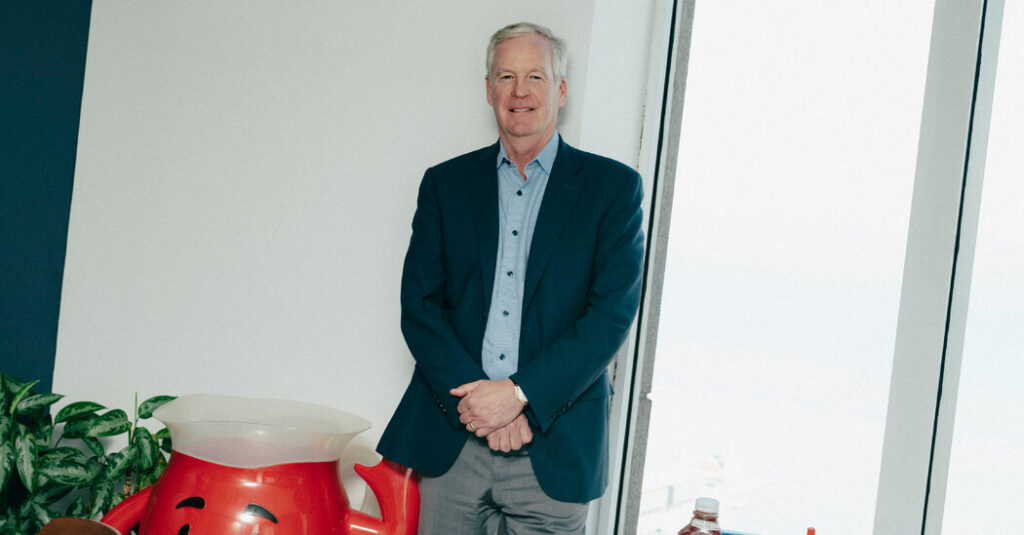
In a recent interview at the Chicago boardroom where Mr. Cahillane persuaded the Kraft Heinz board to rethink the split, he explained how he planned to bring the company back to growth. Paraphernalia celebrating brands like Kool-Aid, Capri Sun and Heinz ketchup lined the walls.
The company’s mainstay brands have instant name recognition among consumers, often established at a young age, but nostalgia alone does not drive sales. “You might want to buy the T-shirt but not the product,” Mr. Cahillane said. “We need them to do both.”
And like any other chief executive trying to run a global business right now, Mr. Cahillane also faces ever-shifting tariff policies and the daunting geopolitical risks arising from the war in Iran.
This interview was edited and condensed.
You were hired to do one job: oversee a split of the company. Tell me about what you saw when you arrived that made you think that wasn’t the best way to go.
I wouldn’t say I came here just to do the separation. Clearly I have that in my background, having just done a pretty massive one that was very successful.
But the business wasn’t as strong as it needed to be to have a successful separation. Do we separate and then have potentially two companies that are not as strong as we would like them to be? Or do we fix the business, and then we have options to separate in the future?
It was clearly a better decision to keep it together and fix it, and to start to look for those areas where the scale of what we have is an advantage.
Had you done anything like that before?
I’ve taken lots of big decisions before. The one at Kellogg to spin off the North American cereal business was monumental: telling your board that Mr. Kellogg’s crown jewels were going somewhere else.
How did you make the case to the Kraft Heinz board?
It was a bit like being a prosecutor in a courtroom. I made the case for why this was the best answer.
I’ve been around for a long time, so it would be easy to think that my bias would be to separate, because that’s what I had just done. I think the fact that I came to a different conclusion was credible because of that.
The board was all ears. We had a very vigorous discussion.
Warren Buffett had said that he didn’t like the idea of separating the company. Did you call him when you were deciding what to do?
I called Greg Abel. Greg and I started our jobs on the same day: He took over as C.E.O. of Berkshire Hathaway on Jan. 1. I had discussions with Greg when I was entirely committed to doing the separation. Then, I let him know when I had come to the conclusion that we were not going to separate.
Given worries about affordability, consumers have shifted to cheaper store brands. Do you see that as a response to inflation or as Kraft Heinz falling behind on recognizing consumer habits?
I think we fell behind.
That’s been well documented over the last 10 years. When the two companies came together, there was a lot of cost cutting. There was a lot of focus on financial engineering and profits and not enough focus on the consumer and reinvesting.
There’s no such thing as a “forever brand.”
Weight-loss drugs are obviously affecting how people are eating and snacking. How does that affect Kraft Heinz?
To say it’s not a headwind would be disingenuous. How big a headwind? Hard to say. We need to innovate.
When people are on GLP-1 drugs, they still need to eat. They eat differently. They eat more protein. They’re worried about muscle mass.
We’ve got a lot of folks in R&D who are working on this right now.
Robert F. Kennedy Jr., the health secretary, is very focused on ultraprocessed food. As the leader of a big food company, do some of his directives make your job harder?
I think people can agree that we want people to eat healthier, that cleaner labels are better, that removing artificial ingredients is important. It may be the last bipartisan thing in this country right now.
Before I got here, the company was well on the track to remove artificial colors, artificial ingredients. We have a great added incentive because that’s what consumers want.
What makes my life more uncomfortable is when 50 states start to think about things in 50 different ways. We want to give consumers what they want, but we always want to be efficient as we do it.
San Francisco has sued food companies, including Kraft Heinz, and called ultraprocessed food a public nuisance. What is your defense for processed food?
The world would be a very, very hungry place if there weren’t processed and packaged foods. You go to a grocery store and you’d be removing, I don’t know, 80 percent of what’s available. Things would become very expensive.
How is the war with Iran, which is pushing up energy prices, impacting your business?
It’s not meaningful right now, because we have a good hedging program. That could all change.
Say oil stays up at $119 a barrel. When does that really start to bare its inflationary teeth in ways that we have to plan for how things move around the world? One thing we learned in Covid is that, all of a sudden, containers are all stuck in one area of the world and you can’t get them around.
Let’s take a step back. Tell me about your childhood.
I was born in New York City, in the Bronx. When I was very young we moved 50 miles north to a town called Monroe.
The interesting thing about that town is that virtually everybody’s dad was a fireman or a cop. When somebody’s dad did something different, you were like, what is that? Most of the women were stay-at-home moms and raised families.
My mother immigrated from Ireland when she finished high school. She was a real inspiration, because when I was probably in seventh or eighth grade, she went to college. She got her degree, and then she encouraged my dad, who was a full-time fireman, to go back part time. He got his college degree. My siblings and I watched our parents raise four kids, work and go to college. It was amazing.
You’ve worked at Coca-Cola, Nature’s Bounty and InBev. What was a “Sliding Doors” moment in your career?
My father-in-law, who was a vice president at General Foods, helped me get a job after my junior year in college packing out Kool-Aid in grocery stores in New York and New Jersey for the summer.
Without that on my résumé, I probably wouldn’t get noticed by the recruiter for E. & J. Gallo Winery, which was a really well-known training ground for consumer goods people. There, I got promoted multiple times. I had this great job running the sales organization in Southern California.
I was 24 years old, and my father-in-law convinced me that I should leverage that moment to go to business school. I went, and it was life-changing.
This is your third time being a chief executive. What have you learned from your previous stints?
Third time’s the charm. The one thing that’s been constant is surrounding yourself with the best possible people. The C.E.O. role is hugely important, but you get everything done through other people. Everything.
It’s time for the lightning round. What’s your favorite snack?
It would be an Oscar Mayer hot dog with Heinz ketchup, Heinz mustard and Heinz relish on it.
My next question was going to be about whether you put ketchup on your hot dogs.
I do. I know I’m in Chicago, but I’m from New York, so I can do whatever I want.
How often are you checking Kraft Heinz’s stock price?
I worked for a C.E.O. once who said that he never looked at it except for once a quarter. I found that to be the most disingenuous thing I’d ever heard anybody say. I don’t want to tell you how many times a day, but it’s more than once a day.
How many hours do you sleep, and which hours do you usually sleep?
I’m a good sleeper, but 10:15 p.m. to 5:15 a.m. is kind of the goal.
I’ve read that you’re a fitness enthusiast. What’s tougher: a 5 a.m. HIIT session or a three-hour board meeting?
No comment.
What’s the last thing you asked A.I.?
What are some of the coolest flavors in the world today?
And what did it tell you?
It had all sorts of stuff that I couldn’t even pronounce. It made me go do some homework.
Anything that you could pronounce?
Jalapeño, but I thought that was a generic answer.
How do you sign off your emails?
Usually I say thanks, and sometimes I don’t know why I’m saying thanks. But I say thanks.
Jordyn Holman is a Times business reporter covering management and writing the Corner Office column.
The post He Was Supposed to Break Up Kraft and Heinz. He Changed His Mind. appeared first on New York Times.