After a 19-month closure and top-to-bottom overhaul, the Park Hyatt Tokyo reopened in December. On its own, that wouldn’t be particularly remarkable. Hotels close for refurbishment all the time. But this specific property has a certain mythology, says Colin Nagy, a Los Angeles-based marketing executive who has stayed there dozens of times.
“It’s one of those rare hotels that crossed over into collective memory,” Nagy says. “Even people who’ve never stayed there feel like they know it somehow.”
I understood what Nagy meant the moment I exited the elevator doors onto the 41st floor of the Park Hyatt and was greeted by a Tokyo skyline shimmering at golden hour. Beyond the floor-to-ceiling glass, I could even get a glimpse of Mount Fuji. It felt familiar, despite being my first visit.
Long before that, director Sofia Coppola’s 2003 film “Lost in Translation” had already etched those spaces into my imagination — and the imagination of an entire generation of travelers.
For a hotel to go beyond hospitality and enter the cultural zeitgeist, it often takes a defining moment. For the Park Hyatt, that came via Bill Murray and Scarlett Johansson. In “Lost in Translation,” their characters first lock eyes at the New York Bar, on the hotel’s top floor.
The black-and-chrome jazz lounge is said to draw inspiration from the grand performance halls of Manhattan, among them Radio City Music Hall and Carnegie Hall. In the film, it is a space where two strangers find a fleeting connection in a foreign land. Coppola uses the Park Hyatt to help evoke a sense of beautiful, aching dislocation.
Anthony Bourdain felt it, too. The chef-turned-travel-documentarian, who arguably did more than anyone to shape how a generation thinks about food and travel, opened his “Parts Unknown” Tokyo episode at the New York Bar, musing on the spell Japan had always held over him.
“You can’t manufacture that kind of permanence,” Nagy says. “After ‘Lost in Translation,’ the hotel became shorthand for a certain mood — of isolation, glamour and Tokyo at night.”
The Park Hyatt Tokyo is not the only hotel to achieve such a crossover. The beloved “Eloise” books, by Kay Thompson, turned the Plaza Hotel in New York into a playground of the imagination. And more recently, HBO’s “The White Lotus” has woven Four Seasons resorts into its storylines, turning them into essential characters.
But few hotels have managed to hold that cultural relevance for decades. The Park Hyatt Tokyo’s first full-scale renovation carried unusually high stakes.
A hotel that helped define modern Tokyo
Long before it became a cinematic landmark, the Park Hyatt was reshaping hospitality in Japan.
When it opened in July 1994, it rewrote the rules of what a premium hotel in Tokyo could be for international travelers. Until then, the top Japanese hotels, such as the Imperial Hotel and the Hotel Okura, were defined by old-world luxury: grand and ceremonial but not particularly modern.
“Most of Tokyo’s high-end hotels at the time were traditional, formal and rooted in a classic style of hospitality,” says Leslie Overton, director of travel operations at Fora Travel, who spent the 1990s advising clients on luxury travel throughout Asia.
The Park Hyatt, “absolutely marked a turning point in signaling that Tokyo was ready for globally branded luxury,” Overton adds.
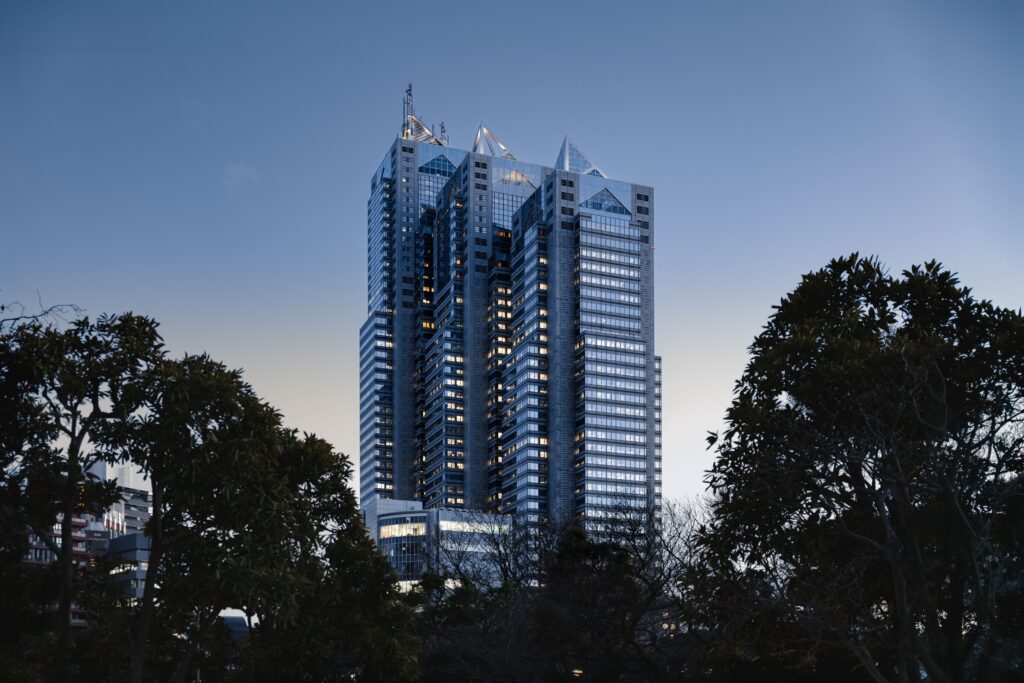
Occupying floors 39 through 52 of the Shinjuku Park Tower, a three-tower complex designed by architect Kenzo Tange, the hotel was placed high above the city rather than at street level. The idea of a serene refuge floating over Tokyo was radical at the time.
For the interior, designer John Morford conceived the hotel as a private residence in the sky, with an abundance of dark walnut and a signature palette of deep greens throughout the property. Even the beds were designed low to the floor so that guests lying down could take in the Tokyo skyline at eye level. “There’s a drama to it all that feels very different from some of the newer luxury hotels now,” Overton says.
I walked through the corridors leading to check-in, a warmly lit path lined with books on art, culture and history. The 2,000 volumes were personally selected by Morford and are still meticulously arranged exactly as they were more than 30 years ago.
“When you layer this design onto the omotenashi, the Japanese hospitality and precision, it creates this subconscious feeling of ‘I’m in a truly special place,’” Nagy says.
Time, however, had caught up with the Park Hyatt. Infrastructure needed modernization. Guest expectations had shifted. And few luxury properties operate for three decades without a comprehensive refresh, says Fredrik Harfors, the hotel’s general manager.
“Travel has changed dramatically since 1994,” Harfors says. “The experience had to evolve, while still protecting what makes this hotel unmistakable.”
French designer Patrick Jouin and architect Sanjit Manku led the renovation. Certain spaces, most notably the New York Bar, the Japanese restaurant Kozue, and the Club on the Park fitness center and spa, were treated as sacred ground — too woven into the hotel’s identity, and into guests’ memories, to meaningfully alter.
“Guests should feel a strong, immediate reaction,” Jouin says, “not because everything is different, but because the spirit is still there, alive, and ready to carry the next chapter of the story.”
The New York Bar was stripped to bare concrete to meet updated seismic standards, then rebuilt to look nearly identical to how generations of guests remember it. Or, in my case, how I remembered it from countless viewings of “Lost in Translation.”
One evening, as a singer crooned amid the glow of the city lights, I enjoyed an L.I.T., a pink-hued sake-based cocktail named for the film, and took in the skyline. Waitstaff moved with quiet precision, and a low hum of conversation blended with piano chords. The room felt suspended in time.
Elsewhere at the hotel, changes are more noticeable, though subtle. The 171 guest rooms were fully updated, with new bathrooms inspired by a Japanese onsen, the centuries-old tradition of communal hot springs, creating a meditative, spa-like quality. USB-C ports and modern climate controls replaced outdated switches, but the walnut paneling, expansive windows that frame the Tokyo skyline and signature deep soaking tubs remain.
The view from the bar on the 52nd floor, or from any other floor, is unobstructed — the skyline sweeping outward in every direction. You feel as though you are hovering above the chaos of the city. Perhaps more than anything, that intangible sensation is what has allowed the Park Hyatt Tokyo to endure.
“Iconic status isn’t about one thing,” Nagy says. “It’s the amalgamation of design, service, intention and positioning, and this hotel has nailed it.”
The post Three decades later, Tokyo’s ‘Lost in Translation’ hotel remains cinematic appeared first on Washington Post.