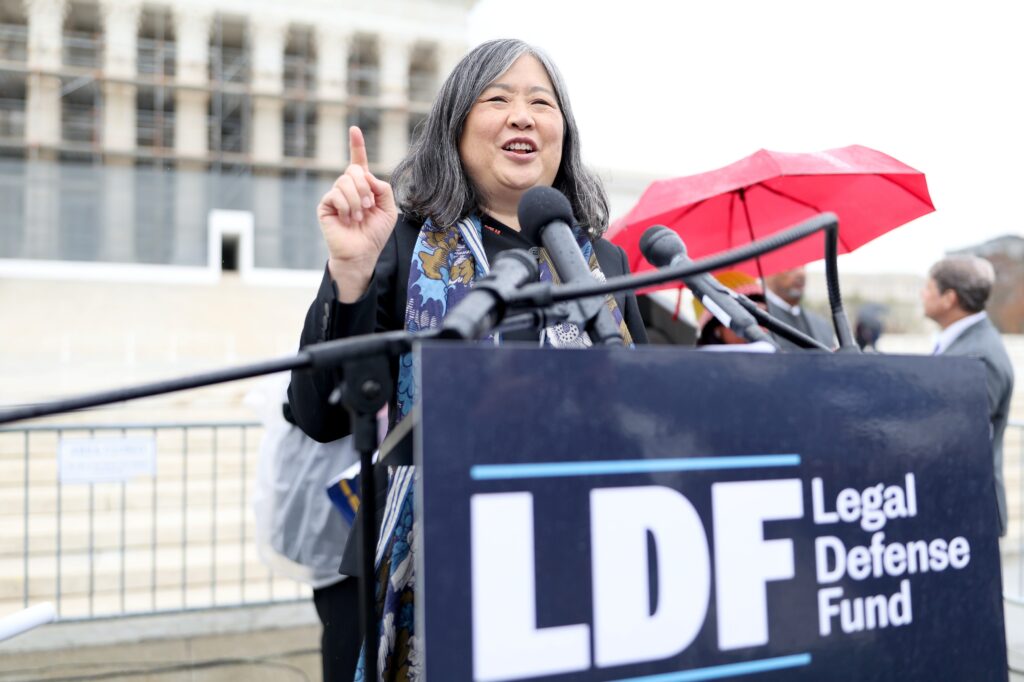
American Civil Liberties Union Legal Director Cecillia Wang has filed lawsuits challenging racial profiling, illegal arrests and mandatory detention for undocumented immigrants. But when she appears before the Supreme Court on Wednesday, she will be arguing against the Trump administration over a question that is fundamental not only to the nation but also to her own family.
Who deserves to be an American?
Wang, 55, was born in Oregon, three years after her parents emigrated legally from Taiwan as graduate students, making her a U.S. citizen by birth even though they were not naturalized at the time. She credits changes in federal immigration law in the 1960s that eliminated national origin quotas on Chinese immigrants for providing her family a path to succeed.
That path has animated her work over two decades at the ACLU, where she oversees a legal staff of more than 200, and this week it will help inform her arguments against President Donald Trump’s executive order to end birthright citizenship for the children of undocumented immigrants and foreign visitors — including international students, like her parents. Opponents of the president’s order say it could deny citizenship to an estimated 250,000 newborns per year.
“This is an extraordinary claim the president is making that is at odds with what everyone has understood about American citizenship,” Wang said in a brief phone interview from San Francisco, where she is based, to focus attention on the importance of the case. “Our team is defending an American tradition.”
Now, it will be up to the nine justices to decide a matter that for 128 years has stood as a bedrock principle of immigration law — that those born on U.S. soil are citizens, no matter the status of their parents.
The Trump administration, backed by conservative lawyers and immigration hard-liners, says that view is grounded in a misinterpretation of the Constitution’s 14th Amendment, which guarantees that those born here and subject to U.S. “jurisdiction” are citizens.
In the government’s Supreme Court brief, U.S. Solicitor General D. John Sauer argued that Congress in 1866 did not intend for the amendment to cover the children of immigrants who are not lawfully, and permanently, present in the country. Rather, he wrote, it was strictly aimed to protect freed enslaved persons and their descendants.
“In the context of the Citizenship Clause, ‘jurisdiction’ refers to ‘political jurisdiction,’ a concept that turns on whether a person owes sufficient allegiance to and may claim protection from the United States,” Sauer wrote.
The Trump administration contends that the guarantee of birthright citizenship acts as an incentive for immigrants to enter the country illegally, though studies have found that economic opportunity has historically been the biggest draw.
The Justice Department did not respond to a request for an interview with Sauer, a conservative lawyer who served as Missouri’s solicitor general before joining the Trump administration.
Wang has not delivered a courtroom argument since taking over as national legal director in October 2024, focusing on overseeing the staff and managing its Supreme Court cases. But she has extensive experience in immigration cases, having successfully brought a class-action lawsuit in 2012 over racial profiling and illegal detentions by the Maricopa County, Arizona, sheriff’s office under the direction of Joe Arpaio.
In 2018, Wang argued before the Supreme Court in a case challenging the federal government’s attempts to enact mandatory detention for migrants with criminal records, without a bond hearing, even if their detention occurred years after they were released from criminal custody. The court ruled 5-4 in favor of the government, with the four liberal justices dissenting.
Despite that loss, Wang expressed confidence about her return to the high court.
“Everybody is nervous because the stakes are high when you get to the Supreme Court, and in this case, the stakes couldn’t be higher,” she said. “But I couldn’t be more confident in the correctness of our argument. I don’t like to predict how cases come out, and I’m not trying to guess what the justices are thinking, but …”
She stopped herself: “Well, I’ll just leave it there.”
Her team has spent months preparing, along with its legal partners, including the NAACP, the Democracy Defenders Fund and the Asian Law Caucus. Cody Wofsy, the deputy director of the ACLU Immigrants’ Rights Project who served as the lead attorney on the case in the lower courts, has helped manage the effort to ensure that Wang will not be surprised by questions from the justices.
Their team has held a half-dozen moot courts — practice sessions, in which Wang fielded questions from colleagues acting as justices — including sessions at Stanford, Howard and Georgetown universities.
They also have reviewed a wide variety of case law, including the nuances of English common law doctrine on birthright citizenship in the 1600s; rhetorical debates around ratification of the 14th Amendment; the treatment of Japanese Americans who were incarcerated during World War II; and the text of what has long been considered the landmark ruling on birthright citizenship — the Supreme Court’s 1898 decision that affirmed citizenship for Wong Kim Ark, the San Francisco-born son of Chinese immigrants.
“Ultimately, what the government is saying here is that Wong Kim Ark should be disregarded,” Wofsy said. But, he added, “regardless of what a justice might feel about Wong Kim Ark, they may want to know about some of those broader questions.”
Supporters of Trump’s executive order say the conventional legal wisdom is misguided. Wong’s parents had immigrated legally and established residency — or permanent “domicile,” in legal jargon — and, thus, his citizenship would not have been denied by a presidential order like Trump’s, said John C. Eastman, a prominent opponent of birthright citizenship who founded the Claremont Institute’s Center for Constitutional Jurisprudence.
The Supreme Court’s three liberal justices — Sonia Sotomayor, Elena Kagan and Ketanji Brown Jackson — expressed clear opposition to Trump’s birthright citizenship order in May, when the court weighed whether federal judges had overstepped their authority in issuing nationwide injunctions to temporarily halt its implementation. (In June, the court ruled 6-3 to limit the use of such injunctions, prompting the ACLU to refile its separate challenge to the birthright order as a class-action case.)
But Eastman, who plans to attend the Supreme Court hearing, held out hope that the six conservative justices would support Trump’s position. “They are holding their cards close to the vest,” he said.
Eastman and Wang clerked at the Supreme Court at the same time in the mid-1990s — Eastman for Justice Clarence Thomas and Wang in the office of then-Justice Stephen G. Breyer, though they do not know each other well. They tangled over the birthright citizenship issue in 2011, during a panel discussion for the National Constitution Center.
During that debate, Wang won applause from the audience when she declared that Eastman was “absolutely wrong” for suggesting undocumented immigrants are subjected only to “limited” and “partial” jurisdiction of federal government and are not protected by the 14th Amendment.
“The framers of the 14th Amendment had an inclusive and expansive view that fundamentally changed the original document to embrace anyone born in this country,” she said then. “And because of the framers’ wisdom in doing that, all of us sitting here in this room — whether we are the children of an immigrant, grandchild, great-grandchild, if your ancestors came on the Mayflower — we are all equal before the law and the Constitution.”
In the interview, Wang said her parents, after arriving on students visas, secured lawful permanent residency and, later, became naturalized citizens.
In past forums, she has recounted speaking Mandarin, Cantonese and Toisanese, a local Chinese dialect, to her parents as a child but losing those language skills as the family began communicating with one another in English.
She attended the University of California at Berkeley as an undergraduate and then Yale Law School, and she has expressed admiration for California’s history of welcoming immigrants, saying it helped create a diverse and vibrant culture. She also has credited the Black-led civil rights movement for paving the way for Congress to ease strict immigration laws in the 1960s.
Catherine Lhamon, a high-ranking civil rights official in the Obama and Biden administrations, met Wang at Yale and recalled conversations between them about the importance of race and diversity.
The Supreme Court case “could upend her life’s work,” Lhamon said. “It has potentially devastating consequences for the country. The stakes couldn’t be higher, and she’s eyes wide open about what that means. And, to her credit, this is not just academic for her.”
The ACLU brought the class-action lawsuit on behalf of parents, including pregnant mothers, and their children who would be denied citizenship if Trump’s order takes effect. One of the mothers, whom the lawsuit identifies by the pseudonym “Susan,” is a Taiwanese citizen who has lived in Utah for 13 years and was lawfully in the country on a student visa when the lawsuit was filed in June.
Since then, Susan has gained lawful permanent residency, the ACLU said. But her daughter “Sarah,” who was born in April, could have her U.S. citizenship revoked if the Supreme Court sides with Trump, because his executive order, which could be retroactively applied, affects those born after Feb. 19, 2025, and focuses on parental status at the time of the child’s birth.
Wang said she has exchanged emails with Susan and shared that her own parents, who are deceased, also came from Taiwan.
“I’m a civil rights and civil immigration lawyer in large part because of my family’s immigration history,” Wang said. “This case and others are about standing up for the constitutional rights of everyone, including noncitizens.”
The post Lawyer brings her own immigration story to birthright citizenship fight appeared first on Washington Post.