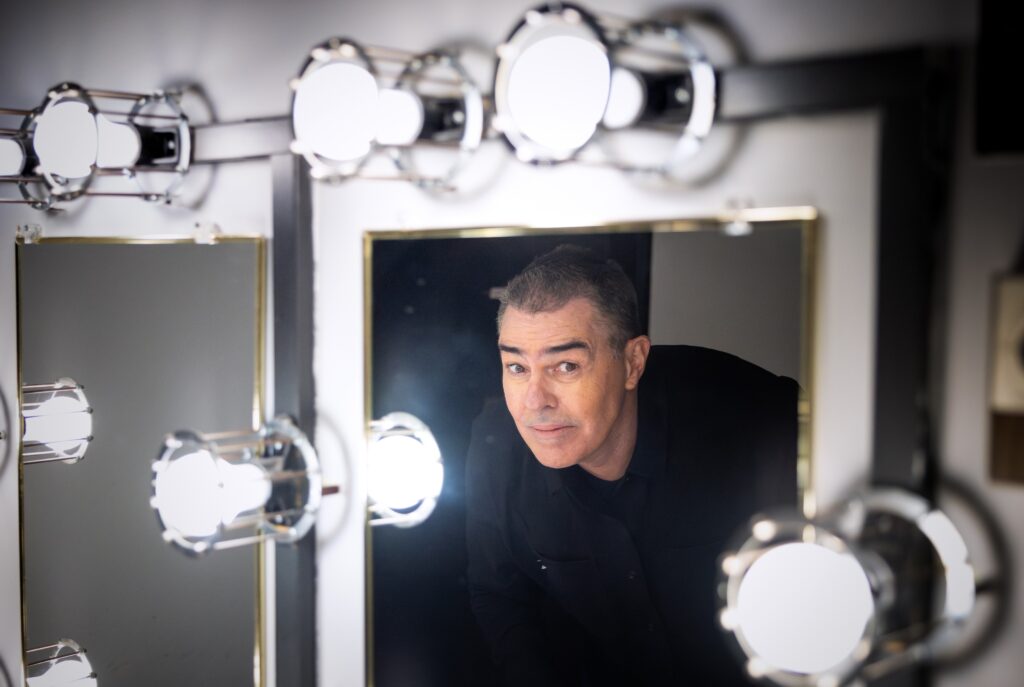
A few years ago, in the thick of covid, Judd Apatow reached out to his friend Adam Carolla and politely suggested he try to pipe down a bit. As the nightly news reported on the latest wave of deaths, Carolla on Twitter and his podcast was maintaining steady attacks on Anthony Fauci (calling the health official a “compromised liar”) and denouncing the shutdown of schools.
The A-list comedy director had liked Carolla since his early days offering hilarious responses on the radio call-in advice program “Loveline” and, later, clanging beer steins with Jimmy Kimmel on Comedy Central’s intentionally offensive “The Man Show.” He also admired Carolla’s lesser-known talents as a documentarian. Apatow texted out of courtesy. He knew how Hollywood worked.
“He was basically saying, ‘You know, you’re going to destroy whatever career you might have with this kind of s—, so you’ve got to take it back,’” Carolla recalled.
Carolla didn’t want to be rude. He appreciated Apatow’s advice. He simply didn’t care what the industry thought of him. He never has. For those who considered his views on covid too harsh, Carolla had a direct and profane response: “You guys are p—ies. You got fooled.”
He told this story from a cramped coach seat on the Amtrak Regional heading south from New York on the last day of January. The night before, Carolla, 61, had recorded an episode of his daily podcast in front of a live crowd in the Hudson Valley with former Fox News TV host Megyn Kelly. Now, he was headed to Washington for two sold-out stand-up shows at the John F. Kennedy Center for the Performing Arts — a place that had been struggling to fill seats.
A largely Republican crowd would cheer him on, the same folks who watch his frequent appearances on Fox’s “Gutfeld!” or tune in as he chats up fellow showbiz conservatives Joe Rogan and James Woods on podcasts.
The D.C. shows came in the thick of the controversy over President Donald Trump’s takeover of the Kennedy Center and the wave of artist cancellations and audience boycotts that followed. To Carolla, though, it was just another gig.
As he told the crowd when he took the stage, “I’m from L.A. so people ask me what my thoughts were about playing the Trump Kennedy Center. I don’t give a s—. Tell my jokes. Get paid. Go home.”
But Carolla does actually care. A lot. He has strong political views, and they typically target the left. During his Kennedy Center gig, he called former president Joe Biden a “doddering old fool” and Democratic nominee Kamala Harris “a f—ing idiot.” His fans nodded, laughed and applauded, leaving no question where they stand on the political spectrum.
After his performances, as Carolla stood in the lobby at a meet-and-greet, a woman waiting in line declared she was sick of liberals and didn’t find any of them funny. A guy behind her grumbled about Somali refugees in Minnesota. A recent college graduate compared Carolla favorably to Bari Weiss, the conservative commentator hired to shake up CBS News.
All of which Carolla brushes off. If he’s been embraced as American comedy’s conservative darling, it’s not his fault. He could do without the labeling.
“When they talk about Sarah Silverman, they don’t say ‘progressive comedian,’” Carolla said. “They just go, ‘Sarah Silverman.’”
Carolla does not consider himself a conservative. Like Bill Maher and Rogan, he prefers to say he’s libertarian, though during his stand-up and on social media, he’ll regularly rant against “woke” culture and prominent Democrats. But Carolla notes that he does not conform to any sort of traditional platform. He has no use for religion. He doesn’t own guns and rarely thinks about abortion.
“I’m not really strong on the tenets of conservatism,” Carolla said. “I’m very much like, ‘Smoke your pot, get your hookers.’”
Carolla’s close friends say that his politics are beside the point. They view him as a kind of blue-collar poet laureate for the Archie Bunker set.
“He was a cranky young guy,” said Kimmel, who has known Carolla for decades. “Now he’s a cranky old guy.”
Bill Simmons, the podcaster and cultural critic who is also a close friend, can’t say whether Carolla’s political views have shifted since they first met. They don’t discuss immigration or tax cuts. When he and Carolla worked together closely in 2003 on the first “Jimmy Kimmel Live!” writing staff, they talked about movies, TV and sports.
“Anytime he was really complaining, it was about real-life stuff that he talks about on his podcast,” said Simmons. “Parallel parking and, you know, kind of the minutiae of life.”
On the rare occasion political subjects come up these days among Carolla and his friends, everyone generally agrees to change the subject.
Why bother, said his onetime producer, Daniel Kellison, a self-described Bernie Sanders liberal: It’s not like one is going to change the other’s mind. And Carolla’s politics are beside the point, he said. What matters is that Carolla is “a comedic genius.”
On his podcast and onstage, Carolla isn’t afraid to profess his admiration for Health and Human Services Secretary Robert F. Kennedy Jr., for whom he did a comedy fundraising gig during his presidential run, or Trump, whom he appreciates as a builder who “just wants to do stuff.” (He did take issue with Trump’s nasty attacks on Rob Reiner after the director was killed.)
“A conservative life is a better life,” Carolla said. “But I feel the same way about the Amish people. I don’t do it, but it is a good life.”
What has driven the Carolla brand further right has less to do with a shift of his own philosophy and everything to do with how the world has changed. He would love to appear on more shows, on channels other than Fox News, and talk to a wide range of people. But in the polarized Trump era, he finds that he has been cut off by one audience and embraced by another.
Carolla would prefer to argue with people on all sides of the political spectrum, to employ his fast-twitch comedy chops in open debate. In today’s climate, he’s largely cut off from and increasingly unwanted in liberal circles. As covid hit, as the Supreme Court swung right, as ICE moved in, his peers seemed less interested in his views on current events or even having him around.
In 2019, Carolla noticed David Alan Grier, longtime pal and a frequent guest on “The Adam Carolla Show” podcast, wasn’t returning his producer’s calls. Then DAG, as friends call him, went on Howard Stern’s show.
Stern asked the actor and comedian whether he had lost any friends because of politics. Grier brought up Carolla, with whom he had worked and socialized for years.
“Adam and I were quite close,” said Grier. “Not anymore.
“What happened?” asked Stern.
“He’s a right-wing troll now,” Grier said.
Marc Maron, who had been on Carolla’s podcast and hosted Carolla on his own “WTF,” also went public. It started in front of a crowd one night in West Hollywood. Carolla did a set at the famed Comedy Store, and Maron, taking the stage after, bashed him in front of the crowd. Later, on a podcast, Maron explained himself. He said he resented that Carolla, a relative newcomer to stand-up, was granted a spot on such a prestigious stage without properly paying his dues like other comics — but when pressed, Maron admitted he just hated Carolla’s politics.
Then there were Phil Rosenthal’s pizza parties. The “Everybody Loves Raymond” producer hosted them most Sundays, inviting entertainment friends over for wood-fired pizza and a movie. Carolla had been a regular, rubbing elbows with Hollywood elites, until suddenly he wasn’t. (Rosenthal, Maron, and Grier declined interview requests.)
Carolla said he doesn’t sweat over broken relationships. But Drew Pinsky, his partner for a decade on “Loveline,” says the split with Grier really did bother Carolla.
“We loved that guy,” he said, “but Adam, because he is such a harsh realist, goes, ‘Well, if he doesn’t want to be my friend, I don’t want to be his friend.’”
The professional slights can be harder to track than the social ones. These are the tiny papercuts of exclusion that can hinder a career. While Carolla used to appear regularly on the late-night shows of Jay Leno, Conan O’Brien and David Letterman, he’s never been on with Seth Meyers or Jimmy Fallon, the new generation of network mainstream.
Carolla also notes that his car-racing documentaries, on actor Paul Newman and pioneering Black driver Willy T. Ribbs, were boxed out of Sundance and other prestigious festivals.
“I mean, people have careers where they’re calculated and they’re smart, too,” said Carolla. “To be on the right side of this issue or that issue, covid or Black Lives Matter — my sort of semi-arrogant but, I would argue, realistic opinion is I’m good, so I don’t have to do that part of it, the political part of that. I mean, I’ve been doing this for 31 years. I haven’t missed a day.”
Growing up in Los Angeles’s San Fernando Valley, Carolla didn’t dream of doing stand-up or a showbiz career. He was a standout football player and spent the rest of his time just trying to get by.
His parents, he said, treated him with a blend of neglect and disinterest. Carolla described Kris Carolla, his mother, as a “broken hippie” in his 2012 memoir, “Not Taco Bell Material.” His father, Jim, just seemed broken.
For a time in high school, Carolla lived in a garage with no running water and used a popcorn can for a toilet. His parents did not go to his sports games or care enough about his intellectual development to notice he never learned to read.
Without college as an option, Carolla went to work as a laborer and spent most of his 20s hammering nails, digging foundations, bouncing between cheap apartments. That might have been his destiny if he hadn’t been listening to KROQ-FM’s popular morning show, “Kevin & Bean,” on the way to work one day in Los Angeles when they said they were looking for somebody to train one of their on-air pals for a boxing match.
Carolla knew how to box and gave lessons in his spare time. He drove over to the station to volunteer and met “Jimmy the Sports Guy” in the hallway. That was Kimmel, a slightly younger guy trying to get a foothold in radio. Before long, they were doing bits on the air together.
That led to Carolla’s first big break not long after he turned 30. In 1995, he was hired to join Pinsky on “Loveline,” just as the KROQ show went national.
The weeknightly radio program was a wildly entertaining, highly unconventional twist on the standard advice show. Young adults and teens called in with questions about drug addictions, heartbreak, toxic relationships, anxiety. They encountered Pinsky, with a gentle but serious demeanor, doling out advice gleaned from his medical training, and Carolla, countering with flippant, improvised riffs.
Unfazed by anything, the comedian deployed a teasing, big-brotherly attitude that helped lighten emotionally fraught conversations. The teenage boy frustrated that his temper led him to punch a wall? No big deal, Carolla assured him — at least he didn’t hit a stud. Now that could hurt! A young woman reported that her boyfriend was throwing up blood after doing heroin. Pinsky urged them to seek immediate help; the bleeding could signal a life-threatening rupture of some kind. Carolla, meanwhile, seemed in awe: How, in all his years of debauchery, had he never managed to vomit blood?
“I’ve heaved so hard my g–d— toenails shot out of my mouth on about the fifth try,” he said. “But, nothing.”
“There was nothing that was more of a guilty pleasure than Adam,” said Alec Baldwin, who listened to the show in his car and later became friends with Carolla. “‘Loveline’ was one of the most outrageous things I’ve heard in my life. A guy would call up and go, ‘I want to have sex with my half sister,’ and Adam would say, ‘Well, it depends on what half is your sister.’”
“Loveline” grew so successful it eventually spawned a televised version on MTV, and Carolla and Pinsky remained a team until 2005.
In 1999, Carolla launched another project, this one with Kimmel. Frustrated with KROQ, the friends helped create “The Man Show.” The weekly episodes, on Comedy Central, featured Kimmel and Carolla, in their sloppiest bowling shirts, delivering a series of sketches meant to poke fun even as they celebrated the Cro-Magnon tendencies of the male sex. Every episode ended with the self-explanatory segment “Girls on Trampolines.”
Kellison, the show’s producer and co-creator, quickly noticed a difference between his two stars.
Kimmel’s family seemed to revel in his success, flying in from Arizona for every weekly taping. “Not just his mom and dad,” said Kellison. “The siblings, cousins, everybody. Adam’s parents lived less than five miles away in North Hollywood and never came to one taping.”
His friends believe this remoteness within the Carolla family shaped his view of the world.
“A lot of conservatives think of liberals as lazy people who don’t work, who would rather get public assistance than get a job,” Kimmel said. “Sadly, Adam’s parents, for the most part, were those people. And nobody did anything for him as a kid, and he somehow managed to overcome that. So he believes that anyone can succeed if they just work hard enough. And I think he forgets that he’s got this very rare gift that got him to where he is.”
Once, Carolla seemed destined for the same level of stardom as his “Man Show” partner.
“He was probably, pound for pound, our most productive writer of all time,” said Kimmel, who hired him onto his writing staff the moment he got his own late-night show in 2003. “What he comes up with off the cuff is so polished, it’s remarkable.”
“We’d have, like, the writers’ table coming up with jokes every day, and we’d go around, and his stuff was just always the funniest,” said Simmons, who was also on the staff.
After leaving Kimmel’s writing staff, Carolla launched his own nightly talk show on Comedy Central, hosted a syndicated radio program, and teamed up with Kimmel and Kellison to create “Crank Yankers,” a weirdly entertaining series that featured puppets re-creating phony phone calls conducted by, among others, Silverman, Dave Chappelle and Wanda Sykes. In 2007, Carolla co-wrote and starred in “The Hammer,” an independent film in which he played a washed-up boxer turned construction worker who makes an unexpected comeback in the ring.
But as his projects fizzled, Carolla settled on the one thing he could control. In 2009, just ahead of the celebrity podcast boom, he started his own production company, installing a studio in a Los Angeles warehouse he owned. Since launching “The Adam Carolla Show,” he has released more than 4,000 episodes. At one point, Guinness World Records named it the most downloaded podcast.
Simmons, who started his career as a fledgling writer focused on Boston sports before turning himself into a new media mogul at ESPN and beyond, wonders whether Carolla could have been more ambitious.
“If anything, watching from afar, maybe he didn’t challenge himself,” said Simmons. “You get older, you get comfy — I don’t want to say you get stuck doing the same things, but sometimes that’s where you end up.”
But Carolla seems more interested in speaking freely than jockeying for another big break on network television. He has blasted his ex-wife, Lynette Paradise, aggrieved that he has to pay her $32,000 a month in spousal support after she supposedly tried to “destroy my life through the divorce” proceedings. (Paradise told The Washington Post that, despite her efforts, she could not find happiness with him. “He’s a very hard-to-explain person,” she said. “He doesn’t really accept affection the way normal people do. Affection for him is going and cleaning out his garage or organizing his office. Which I was happy to do, but that’s not a realistic, sustainable marriage.”)
On X, Carolla’s feed is a steady stream of recirculated posts blasting Democrats, protesters, Barack Obama, Bruce Springsteen, Zohran Mamdani, Chuck Schumer and his favorite target, California Gov. Gavin Newsom.
His liberal fans — and he does have them — simply ignore this side of Carolla because they’d rather enjoy his comedy.
“How many major league ballplayers over the years were probably virulent Republicans that I could never get behind?” said Baldwin. “I’m not going to let that ruin my watching a ballgame. Adam’s politics… I couldn’t give a damn about that at all.”
The comedy chops his friends praise once saved his neck at a military event.
Carolla had agreed to host the charity fundraiser and was standing at the microphone when it was time to do the Pledge of Allegiance, with a drink in his hand. He did not put his glass down, and this upset a general, who was in charge of helping veterans deal with addiction.
Instead of yelling back, Carolla made a joke. The audience laughed, and a tense moment was defused. Kevin Costner, watching from the audience, was impressed and invited Carolla to his oceanfront home. A few months later, they tossed around a football and became friends.
“He’s just a joy to be around,” said Costner. “I had watched his boxing film before that, and I told him how much I liked it, how smart it was, and he’s just so quick, and he almost can’t help himself being quick.”
Carolla started doing stand-up only about five years ago. He does not hold a reverence for the art like Leno or Jerry Seinfeld. “You write jokes, memorize jokes, and tell jokes,” Carolla said.
In his set, he delivers material that ranges from personal observation to political. He even embraces his inner “Man Show.”
Ever see the Hoover Dam, Carolla asked the audience? “It’s really incredible what men and women could do back… — well, really just men.” That got a laugh. “But when women stayed home, it was incredible what guys could do.”
He went on to joke about how he couldn’t imagine how long it would take for “Gavin Newsom’s California” to build the Golden Gate Bridge today. “People who wanted to commit suicide would die of natural causes.”
He joked about Tesla-driving “virtue-signaling a– wipes” in Los Angeles trying to save face by slapping “I bought this before Elon Musk went crazy” stickers on their cars.
“So I went and got a sticker and I put it on my Volkswagen,” Carolla said, pausing for effect: “I bought this after Hitler went crazy.”
Megyn Kelly — who spent a chunk of her post-Fox career juggling controversies, including her comments referencing wearing blackface on Halloween and remarks seeming to downplay Jeffrey Epstein’s offenses — said she is in awe of Carolla’s work.
Onstage, he didn’t grill the conservative commentator about Roger Ailes or Salvadoran prisons. Relaxed, she ended up discussing her struggles to get back in shape after giving birth. When she deflected his compliments with a self-deprecating remark about her C-section scar, he shot back:
“I’m the kind of guy who, when I go looking for refrigerators or washing machines, I’ll buy the one with the dent in it. I’d rather have a Sub-Zero with a dent than a Whirlpool that was cherry.”
Kelly rolled her eyes. “I’ve never felt more attractive,” she groaned. The crowd roared.
After her abrupt 2019 breakup with NBC, Kelly went to Carolla for advice about starting a podcast. Just be yourself, he told her. You’re funnier than you think.
She found his path inspiring, the way he’s not obsessed with climbing the ladder of late-night TV or scoring a $500 million podcasting deal with Spotify. What seems to matter more to Carolla is freedom — and not having a boss telling him what to do.
“He is un-cancelable,” Kelly told The Post. “Can you imagine Adam actually getting worked up that somebody said something nasty about him?”
The post Adam Carolla never wanted to be the conservative comedian. Yet here he is. appeared first on Washington Post.