They were two young pilots from Canada, still early in their careers, and two firefighters from Queens and Long Island, 18-year veterans in a specially trained unit of the Port Authority Police Department.
They were two air traffic controllers early in their overnight shift, and two flight attendants on their last run of the day.
They were two planes from different airlines, one bound for Chicago but grounded with a strange odor, the other arriving from Montreal, carrying 72 passengers on a route traveled more than 200 times a month.
There was a specialized fire truck built for airport emergencies, but lacking a tracking device that is standard at many airports.
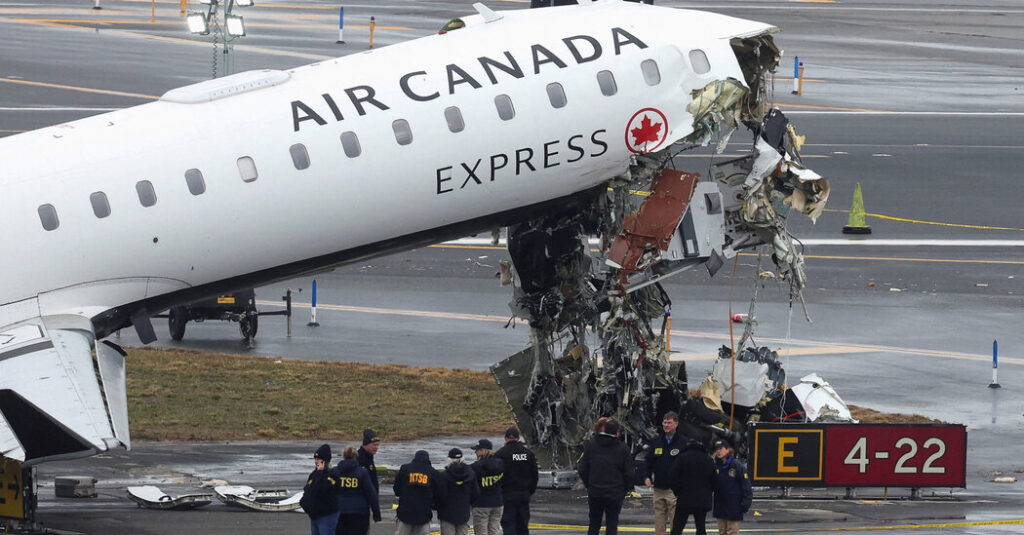
Late Sunday night, amid rainy and foggy conditions, fates came together at LaGuardia Airport in the first deadly crash at the airport in more than three decades. In the screeching collision of metal on metal, the two pilots lost their lives and another 41 people were taken to the hospital with injuries. A flight attendant, still belted to her seat, was thrown more than 300 feet.
Yet for all the wreckage, no passengers were killed, and by week’s end, only five remained in the hospital — an astounding result after such a high-speed collision of heavy machinery.
For days after, federal investigators, delayed by the partial government shutdown, searched for clues to what went wrong.
This is the story of the men and women involved in the crash, and the cascade of failures that led to it. As Jennifer Homendy, chairwoman of the National Transportation Safety Board, said afterward, “When something goes wrong, that means many, many things went wrong.”
It is the story of an urgent call to “Stop, stop, stop, stop” that appeared to go unheeded.
The Pilots
For Antoine Forest and Mackenzie Gunther, the 7:59 p.m. Air Canada Express flight from Montreal-Trudeau International Airport to LaGuardia promised to be an easy hop between two cosmopolitan cities, a route that flight crews seek to get on.
Mr. Forest, 30, who grew up in Coteau-du-Lac, a city of about 7,800 residents in southwestern Quebec, loved the outdoors, and he trained as a bush pilot, flying small aircraft into remote areas without runways or infrastructure.
The training prepared him for challenging flight conditions, said Steeve Noreau, director of the Quebec Aeronautical Training Center in Chicoutimi, Quebec, where Mr. Forest graduated in 2018. “A bush pilot doesn’t have a control tower or a runway with lights,” Mr. Noreau said. “You learn to read the wind on lakes and you have to figure out where you’re going to land. A bush pilot is resourceful.”
In 2022, Mr. Forest joined Jazz Aviation, which operates regional flights for Air Canada Express.
Mr. Gunther, the first officer on the flight, grew up in Riverside South, a quiet suburb on the south end of Ottawa. His passion for the skies was evident even in high school, said Wahab Ghafari, a local landscaper who hired him as a teenager and bought him a drone to take pictures of their work. “And he would always say, ‘I want to fly,’” Mr. Ghafari said.
Mr. Gunther realized that ambition after graduating in 2023 from the aviation technology program at Seneca Polytechnic in Toronto. As he took off last Sunday, he was just 24.
The plane was a 118-foot-long Bombardier CRJ900 jet, a model with a good safety record.
Because of delays, it ultimately took off at 10:12 p.m., more than two hours behind schedule. The pilots had rooms booked for the night at the Aloft Hotel at LaGuardia.
The Flight Attendant
Solange Tremblay was a seasoned professional, with 25 years of experience, recently married and living in Quebec, said Tracy Bowden, 55, a former flight attendant and friend of Ms. Tremblay.
Ms. Bowden described her friend as a “people pleaser, very friendly, a dog lover. Loved kids. Just a great friend, a great person. She would do anything for her friends.” Ms. Tremblay had an adult daughter.
On Flight 8646 last Sunday, Ms. Tremblay was one of just two flight attendants to manage 72 passengers, typical for a plane of that size.
The LaGuardia run was coveted among flight attendants, because it was “so much fun,” Ms. Bowden said. Veterans like Ms. Tremblay often got the assignment by virtue of their seniority. She sat directly behind the pilots, with her back to the cockpit, in a jump seat that, unlike regular passengers’ seats, included a shoulder belt.
The Passengers
Rebecca Liquori, 35, a registered nurse from North Baldwin, Long Island, was returning from a cousin’s baby shower in Montreal. She was to be the child’s godmother. Her own two sons, who were waiting at home, had to be back in school the next day. She was in seat 19A, by the left exit door. Joseph Capio and his fiancé, Peyton Northrop, a lawyer and private school teacher who live in Greenpoint, Brooklyn, sat behind Ms. Liquori, returning from a trip to Montreal to visit two restaurants that had been rated among the world’s best.
Rachel Mariotti, 36, a psychotherapist from Greenpoint, Brooklyn, was returning from a quick day trip to drop off her 3-year-old daughter with her husband, who was traveling to Portugal. She was seated next to Ms. Liquori.
Ariella Blank, 20, a graduate of the Frisch School, a modern Orthodox Jewish high school in Paramus, N.J., was sitting in seat 1A, at the very front of the cabin, according to local media.
“It was supposed to be an easy peasy,” Ms. Liquori said of the trip. At the airport in Montreal, the flight kept getting delayed by 15 or 20 minutes, until the passengers finally boarded a little before 10 p.m. “I sent my husband a text just to let him know that the flight was delayed, because I didn’t want him to be waiting for me,” Ms. Liquori said.
Once they were in the air, the flight was smooth and the attendants offered free wine and beer and extra snacks to the delayed passengers, Mr. Capio said.
As the plane approached New York City, it ran into turbulence. Then the passengers received an odd instruction from one of the flight attendants, Ms. Liquori said. “She said to us, if we do an emergency landing, don’t take your luggage,” Ms. Liquori said. “And I just thought, that’s odd.” (A representative from the Association of Flight Attendants-CWA union said that this language was becoming more common in cabin announcements before landing.)
Around 11:35 p.m., the flight was cleared to land at LaGuardia on Runway 4.
The Firefighters
“It’s dangerous work, it’s intense work — just operating those trucks is difficult,” said Bobby Egbert, a spokesman for the Port Authority Police Benevolent Association, the union representing the many of the more than 200 firefighters at the area’s three major airports. Shifts are 12 hours long, and the work can toggle quickly from calm to emergency response across an obstacle course of moving planes and other vehicles.
The job is also highly coveted, with salaries that can top $200,000 a year. Sgt. Michael Orsillo joined the Port Authority Police Department in 2008; his partner last Sunday night, Officer Adrian Baez, joined the force the same year. Unlike at many airports, which have separate police and fire departments, at New York’s airports the firefighters are part of the Port Authority Police Department.
Officers, who go through training at John F. Kennedy International Airport, talk about the challenges of operating the oversized fire trucks in a tight environment like LaGuardia, where planes and cars must navigate a small, contested space. The trucks can weigh as much as 90,000 pounds, more than the fully-loaded Air Canada plane that flew into LaGuardia Sunday night. “The tires are taller than most people,” Mr. Egbert said.
In 2013, the Federal Aviation Administration fined the Port Authority $3.5 million for “egregious” violations of federal requirements for training its officers. After that, the Port Authority reorganized its airport rescue operations.
Yet pilots and regulators say that for all its challenges, LaGuardia does not stand out as a dangerous airport.
The F.A.A. reports two close calls on runways since 2001, and none since 2016. “As far as the runway safety areas, I wouldn’t characterize LaGuardia as any better or any worse than a whole lot of other airports,” said John Cox, an aviation safety consultant who flew to and from the airport hundreds of times when he was a pilot for US Airways.
Around 11:30 p.m. last Sunday, officers in Police Building 137 on the western edge of LaGuardia got the call that a United Airlines flight crew had been sickened by a strange odor while preparing for takeoff. Sergeant Orsillo and Officer Baez, in a distinctive neon yellow “crash truck” designated Truck 1, led a convoy of five other trucks through the drizzle toward the airport’s busy runways.
Truck 1 had a high-tech control panel and futuristic glass cab that provided a wide field of vision.
What Truck 1 did not have was a transponder, or Vehicle Movement Area Transmitter, a communications device that would allow air traffic controllers to track its exact location. Last year, the F.A.A. recommended them for all vehicles operating on airport grounds.
The United Plane
United Airlines Flight 2384 was bound for Chicago, with a scheduled departure time of 9:15 p.m., but was delayed because of a mechanical issue. It taxied around the airport for more than an hour before trying to take off at 10:40, but abandoned the effort because of what passengers were told was a “transient issue,” according to a passenger who requested anonymity in order to protect her privacy.
The pilots tried to take off once more at 11:17 p.m., but aborted again.
At 11:31 p.m., a pilot on the plane declared an emergency and requested help from the fire team, reporting an odor that was sickening members of the flight crew. For the Port Authority Police Department’s Aircraft Rescue and Firefighting unit, known as ARFF, it was by all accounts a routine request.
The pilot also requested a gate assignment to let the passengers off the plane.
Around 11:37 p.m., Sergeant Orsillo and Officer Baez requested clearance to cross Runway 4 to get to the United plane. An air traffic controller responded: “Truck 1 and company, cross 4 at Delta.” The firefighters repeated the message back to the tower to ensure that they had received it correctly.
By then, Air Canada Flight 8646 had already been cleared to land on Runway 4.
There were two air traffic controllers in the LaGuardia tower, in line with standard procedure for the overnight shift, said Ms. Homendy of the N.T.S.B. Safety officials have long worried about this staffing arrangement, but she stressed that it was too soon to know whether staffing may have played a role in the communications failures.
Critical Seconds
What followed happened in the time it takes to tie a pair of shoes.
As the control tower cleared the firefighters to cross Runway 4, Air Canada Flight 8646 was about 100 feet above the airport, with its landing gear down. It was cleared to land on the same runway.
Eleven seconds later, a controller in the LaGuardia tower started yelling over the radio, “Stop, stop, stop, stop, Truck 1, stop, stop, stop,” and repeating the command a few seconds later.
The truck continued across the path of the incoming plane.
With Mr. Gunther battling turbulence, Flight 8646 touched down, moving around 130 miles per hour. Mr. Forest, the more experienced pilot, assumed control of the plane.
“The landing was a bigger impact than what I’m used to,” but nothing too far out of the ordinary, Ms. Mariotti, the passenger in seat 19C, said.
Then the pilot hit the brakes.
“As soon as the brakes happened, I’m like, ‘OK, there’s something, you know, something’s happening,’” Ms. Mariotti said. Ms. Liquori, in the next seat, put out her arm to hold Ms. Mariotti from lurching into the seat ahead of her. Ms. Mariotti wondered, “Is this plane going to spin out of control?”
Ms. Liquori described the screech of the brakes as like nothing she had ever heard.
Seven seconds after touchdown, the plane smashed into the side of the truck behind the cab area, flipping it onto its side. The plane’s nose collapsed.
Earbuds, phones and tablets went flying through the cabin, Mr. Capio said. Some passengers hit their heads on the seats in front of them.
The crash killed the two pilots and injured the two firefighters, whose position in the cab, ahead of the point of impact, saved them from worse harm.
Ms. Tremblay, the flight attendant, was thrown from the plane, but somehow survived.
“It’s a complete miracle,” her daughter Sarah Lépine told TVA Nouvelles, a Quebec broadcaster. “At the moment of impact, her seat was ejected more than a hundred meters from the plane. They found her and she was still strapped into her seat. She had a guardian angel watching over her. It could have been much worse.”
According to a crowdfunding campaign created by Ms. Lépine and a cousin, Ms. Tremblay suffered two shattered legs, a fractured spine and multiple skin abrasions that required grafts.
“She is in New York for the foreseeable future for her recovery, where she remains in constant fear of sustaining further damages than she has already suffered,” they wrote.
As of Saturday evening, the campaign had nearly reached its target of 90,000 Canadian dollars, or about $65,000.
The other flight attendant, Francois Grenier, also suffered injuries, for which colleagues started a crowdfunding campaign, which by Saturday evening had raised more than 20,000 Canadian dollars.
Ms. Mariotti described a scene of relative calm inside the airplane after the crash. “People might see this crash and think it’s just pure chaos and everybody’s screaming and trying to get off the plane,” she said. “But it was actually some moments where, like, we were talking to each other.”
Ms. Liquori, the nurse, said that even at that calamitous moment, when many passengers were clearly hurt, “everyone on the flight really worked together. Nobody was stampeding over anyone.”
Drawing on the crew’s instructions at the beginning of the flight, Ms. Liquori pushed out the exit door and moved onto the wing.
Passengers made their way onto the wings, where they slid or jumped four or five feet to the ground. Passengers still did not know what had happened, Mr. Capio said. Then they saw the damage.
“There’s this green hunk of metal,” he said. “It looked like it was split in half. It was completely destroyed, just like the front of the plane.”
The most seriously injured were taken away on stretchers; others walked or rode in one of three buses to a nearby hangar, where they waited for hours until everyone on the plane could be accounted for.
Ms. Northrop, Mr. Capio’s fiancé, had some cuts from her seatbelt, so the firefighters recommended she go to the hospital to get checked out. Around 3 or 4 a.m., the couple were both placed on a large ambulance bus that took them to Elmhurst Hospital, Mr. Capio said. In all, 41 were taken to nearby hospitals.
Ms. Mariotti had to get home to Brooklyn. She had a flight to Japan in three days.
What Went Wrong?
Much remains unknown about what caused the crash. N.T.S.B. officials, who are responsible for investigating, typically take several weeks or a month before issuing their preliminary findings; until then they release only general information.
Were there enough air traffic controllers on duty that night? Were they distracted from the Air Canada flight by the emergency call from the United plane and the mysterious odor?
After the crash, recordings captured a controller telling another pilot, “I messed up.” It was not immediately clear what he was referring to.
Using air traffic control audio, flight data and surveillance footage, The New York Times was able to reconstruct in detail the seconds before the incident. But it remains to be determined whether the firefighters heard the tower’s calls to stop, and what roles equipment failure or human error may have played in the fire truck’s fatal passage onto the runway.
Ultimately, it is the responsibility of the air traffic controllers to clear any vehicles for moving on all the surfaces where planes operate.
“They’re God,” Mr. Egbert of the firefighters’ union said. “You have to listen to their instruction. It’s sacrosanct. They control everything. Even if a truck is responding to a life-threatening emergency, he still has to wait to get clearance to go from Point A to Point B.”
While some firefighters use headphones inside trucks to listen to communications from the air traffic control tower, and to reduce the sounds of other radio transmissions, it is not clear whether the officers in Truck 1 were using them.
Kit Darby, an aviation consultant and retired airline pilot and instructor, suggested that the team in Truck 1 may have thought the order to stop was directed at a taxiing Frontier airplane that was also directed to stop.
“Part of communications at the airport is a rhythm,” he said. “They were talking to the airplane, telling it to stop, and then to the truck, and you’re not anticipating another call. The only thing unique to hear was ‘Truck 1.’”
Mr. Darby said the truck driver might not have realized that the order to halt was for him: “You don’t get cleared to cross and then told to ‘stop, stop, stop’ — that never happens.”
By Thursday, as investigators continued to search for answers, crews reopened Runway 4 at LaGuardia, returning the airport to full operation. The destroyed plane lay in an American Airlines hangar.
Officer Baez was released from the hospital on Monday and Sergeant Orsillo was released on Thursday. Ms. Mariotti made her flight to Japan.
As of Friday morning, four passengers and one flight attendant remained in the hospital. Ariella Blank, the woman seated in the first row, remained hospitalized with a serious head injury but was improving, preparing to begin physical and occupational therapy, a family friend said.
Members of her community were joining together, the friend said, to recite tehilim, or prayers from the Hebrew Book of Psalms, a traditional practice meant to offer strength in times of distress and illness.
The Air Canada flight carrying the bodies of Mr. Forest and Mr. Gunther back to their families and home bases left on Thursday for Ottawa, after being transferred to Newark Liberty International Airport, 17 miles from LaGuardia.
An air traffic controller, on a radio call to the plane’s pilots, noted the occasion.
“You have precious cargo on there, right?” he asked.
“Yes,” a pilot answered.
Additional reporting contributed by Vincent Alban, Ian Austen, James Barron, Anusha Bayya, Susan C. Beachy, Kitty Bennett. Olivia Bensimon, Victor J. Blue, Axel Boada, Mark Bonamo, Gabe Castro-Root, Niraj Chokshi, Stella Raine Chu, Christine Chung, Monika Cvorak, Karoun Demirjian, Bora Erden, Claire Fahy, Emma G. Fitzsimmons, Lazaro Gamio, Paul Geitner, Emma Goldberg, Christine Hauser, Vjosa Isai, Mike Ives, Debra Kamin, Kate Kelly, Max Kim, Rylee Kirk, Aaron Krolik, Emmett Lindner, Christopher Maag, Chelsia Rose Marcius, Patrick McGeehan, Sheelagh McNeill, Hurubie Meko, Claire Moses, Sarah Maslin Nir, Norimitsu Onishi, Shawn Paik, Aritz Parra, Anushka Patil, Alexandra E. Petri, William K. Rashbaum, Francesca Regalado, Raj Saha, Rex Sakamoto, Dakota Santiago, Nate Schweber, Liam Stack, Matina Stevis-Gridneff, Tara Terranova, Daniel Victor, Dan Watson, Davaughnia Wilson, Ceylan Yeğinsu, Jin Yu Young and Yan Zhuang.
John Leland is a reporter covering life in New York City for The Times.
The post The Air Canada Crash: Before and After the Frantic Call to ‘Stop, Stop, Stop’ appeared first on New York Times.