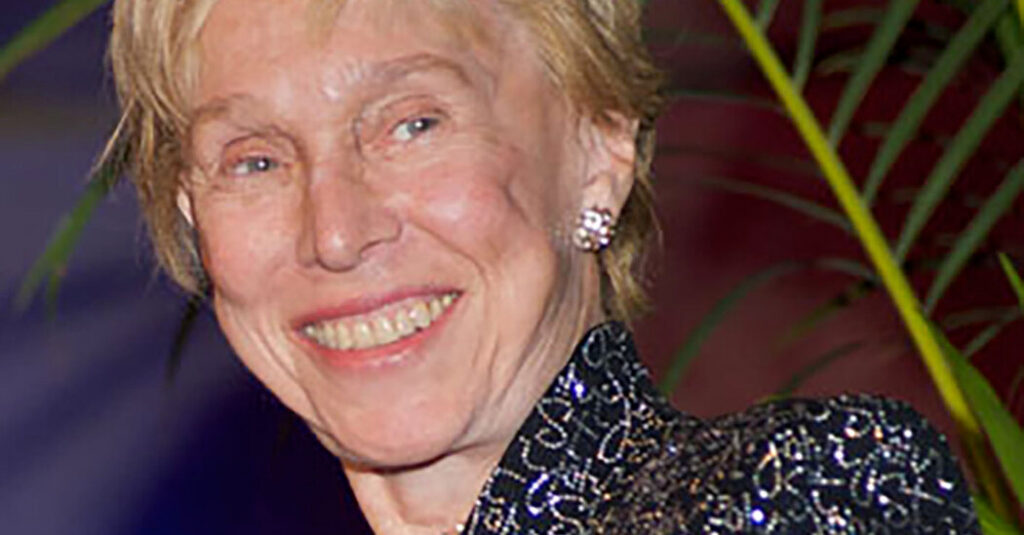
Dr. Judith L. Rapoport, a child psychiatrist who brought public awareness to obsessive-compulsive disorder with her best-selling 1989 book, “The Boy Who Couldn’t Stop Washing,” based on her groundbreaking research into the condition’s causes and treatment, died on March 7 in Washington, D.C. She was 92.
Her death, at a retirement home, was from lung cancer, her husband, Stanley Rapoport, said.
Dr. Rapoport’s book about obsessive-compulsive disorder, written in an engaging style for nonscientific readers, clarified that the condition was far more common than generally thought, affecting some 1 to 3 percent of the population.
The disorder had long remained in the shadows because of the shame that surrounded its symptoms, which could include habits like checking and rechecking that appliances were off, performing counting rituals before doing something as simple as walking through a doorway, or scrubbing hands with soap and water until the skin was raw — any of which, uncontrollably repeated, might waste hours of the day.
Dr. Rapoport showed that there was a neurological basis for obsessions, or intrusive repetitive thoughts, and also for their linked compulsions, or pointless rituals of behavior.
Along with other researchers in the 1980s, she upended the received psychiatric wisdom that the disorder could be traced to emotional traumas like overly strict toilet training. Dr. Rapoport showed that obsessive-compulsive disorder is not a neurosis, but a neurological disease.
She demonstrated that it ran in families, suggesting a biological origin, and she oversaw double-blind drug trials that in 1989 led the Food and Drug Administration to approve the first medication to treat the disorder, Anafranil.
“People would stop her on the street and say how much she helped them,” Dr. Francisco X. Castellanos, a child psychiatrist who worked under her, said in an interview. “Her book alerted people that they could get help, that it was not their fault. It was a gigantic leap in science and also in public health.”
For 33 years, from 1984 until her retirement in 2017, Dr. Rapoport served as chief of the child psychiatry branch at the National Institute of Mental Health in Bethesda, Md. Only a few women at the National Institutes of Health, the mental health institute’s umbrella agency, had as much authority as she did.
She was a leading figure in a paradigm shift that psychiatry underwent starting in the 1960s, as it threw out models of behavior that dated to Freud and were based on supposed conflicts within the unconscious. Those abstract constructs were replaced with an understanding of the mind as a biological organism.
Where childhood psychiatric conditions were once blamed on bad parenting — in the case of autism, for example, on so-called refrigerator mothers — Dr. Rapoport and others promoted neurological explanations and treatment based on empirical research.
“She focused on the biology of mental illness; it was something she taught us from the day we got there,” Dr. Susan Swedo, a retired child psychiatrist who worked under Dr. Rapoport at the federal mental health institute, said. “She started in the 1960s, when mothers were the ones having to go through analysis to see what they’d done to their children. It was criminal.”
In addition to doing research on obsessive-compulsive disorder, Dr. Rapoport oversaw influential studies that shed light on attention deficit hyperactivity disorder and childhood-onset schizophrenia.
Her studies on schizophrenia in childhood, a rare disorder, were also influential in moving psychiatry away from speculation about patients’ upbringing. One multiyear study of the brain scans of severely ill children showed that schizophrenia was a progressive brain disorder: All of the adolescents in the study experienced some loss of gray matter in their brains as they aged, but children with schizophrenia lost much more.
Dr. Rapoport’s research also demonstrated that the drugs clozapine and olanzapine were effective antipsychotic medicines.
And a paper she published in 1978 showed that two groups of boys, those considered hyperactive and those in a control group, reacted the same way when given an amphetamine: Their powers of concentration improved. The finding upended the common belief that only hyperactive children are calmed by stimulants.
Dr. Rapoport “completely flipped the dogma that was being taught everywhere,” Dr. Castellanos said.
As it happened, two of the boys in the control group were Dr. Rapoport’s sons, Erik and Stuart, who lived with the others on a hospital ward during the study.
“Our kids have always complained about that,” her husband, a retired neuroscientist, said. “In a humorous way.”
Judith Helen Livant was born on July 12, 1933, in Manhattan, the second of two daughters of Lewis Livant, a businessman, and Minna (Enteen) Livant, a schoolteacher.
Her maternal grandfather, Joel Enteen, was a literary critic for The Jewish Daily Forward and a scholar who translated Ibsen’s play “Ghosts” and other classics into Yiddish.
Judy, as she was known, attended the private Walden School in Manhattan and then went on to Swarthmore College, earning a bachelor’s degree in experimental psychology in 1955. The same year, she entered Harvard Medical School, where she met her husband. They graduated in 1959, and married two years later.
After interning at Mount Sinai Hospital in New York, Dr. Rapoport trained as a psychiatrist at the Massachusetts Mental Health Center and at St. Elizabeths Hospital in Washington.
She continued her studies at the Karolinska Institute in Stockholm, where she was introduced to the idea that the brain could be understood through empirical, biological study, rather than solely through psychoanalytical theory, as was commonly accepted in American psychiatry.
Back in the United States, she joined the pediatrics faculty of the Georgetown University School of Medicine and trained at the Washington Psychoanalytic Institute.
She became a researcher at the National Institute of Mental Health in the 1970s and was named head of its newly established child psychiatry branch in 1984.
In addition to her husband, she is survived by her sons and four grandsons.
“The Boy Who Couldn’t Stop Washing” spent 10 weeks on the New York Times best-seller list. In it, Dr. Rapoport wrote that obsessive-compulsive disorder “affects some of the most able, sensitive and talented people I have met.”
She gave an account of a patient she called Tim, a law school graduate whose obsession with cleanliness had led him to stay up most of the night, washing for hours, when he was young. In law school, he would clean his apartment so compulsively that he could not get out the door before noon. To avoid the need to clean it, he would stay at motels — he was kicked out of one for showering for 12 hours straight — and even slept on park benches, where he was sometimes harassed by police.
Under Dr. Rapoport’s care, he began taking the drug Anafranil and undergoing behavioral therapy, and his symptoms started to improve.
“It’s been a few years now,” she wrote, “but the last time I saw Tim, he told me that he volunteers some time for Legal Aid, and never turns down a case if it involves defending a street person.”
Trip Gabriel is a Times reporter on the Obituaries desk.
The post Dr. Judith L. Rapoport, Pioneer in Understanding O.C.D., Dies at 92 appeared first on New York Times.