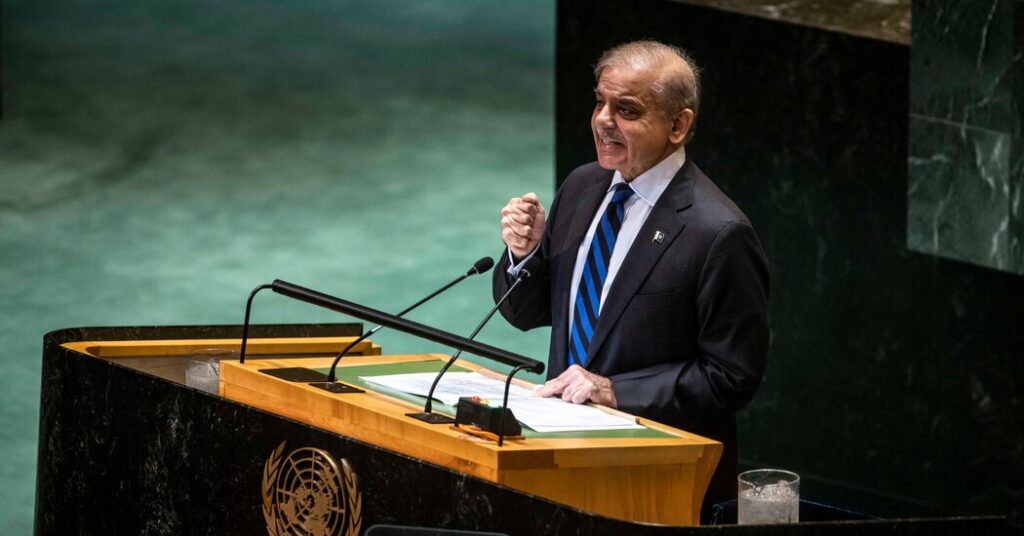
Pakistani officials will host talks beginning Sunday with the foreign ministers of Saudi Arabia, Turkey and Egypt, the Pakistan’s foreign ministry said on Saturday, in the country’s latest efforts to mediate the war in the Middle East.
Prince Faisal bin Farhan Al Saud of Saudi Arabia, Hakan Fidan of Turkey, and Badr Abdelatty of Egypt are expected to hold “in-depth discussions” on regional tensions over two days in Islamabad, the capital, the foreign ministry said. They are also scheduled to meet Prime Minister Shehbaz Sharif of Pakistan.
Pakistan has its own stake in the regional crisis, including an energy crunch, and it has recently intensified efforts at shuttle diplomacy between the United States and Iran.
Pakistani leaders, who are close to both President Trump and President Masoud Pezeshkian of Iran, have passed messages between the two countries and engaged in a flurry of telephone calls.
Field Marshal Syed Asim Munir, the country’s Army chief, has been focusing on Mr. Trump, while Pakistan’s top two civilian leaders, including Mr. Sharif, have spoken with at least 20 world leaders over the past week, according to the foreign ministry.
On Saturday, Mr. Sharif spoke by phone with Mr. Pezeshkian for over an hour, according to a statement from Mr. Sharif. Mr. Sharif condemned “continued Israeli attacks on Iran, including recent strikes on civilian infrastructure,” the statement said. It did not make any direct reference to the United States.
Mr. Sharif also briefed Mr. Pezeshkian on Pakistan’s outreach to Washington and to countries in the Persian Gulf and elsewhere in the region, “to facilitate dialogue and de-escalation,” the statement said.
The diplomatic outreach comes even as Pakistan is in a state of open conflict with Afghanistan, where it has carried out dozens of airstrikes that have killed at least 200 civilians, according to the United Nations.
Pakistan shares a roughly 560-mile border with Iran. The chaos there threatens to spill over into Balochistan, a resource-rich province in southwestern Pakistan along that border, where the Pakistani government is battling a separatist insurgency.
Pakistan is home to one of the largest Shiite populations outside Iran, and many of them look to Tehran for religious guidance. The Pakistani government must navigate differing priorities among its Middle Eastern partners, particularly Saudi Arabia, which it signed a defense pact with last year.
Analysts say a prolonged conflict could fuel sectarian tensions, further disrupt fuel supplies and deepen economic pressure in Pakistan.
“By advocating de-escalation and serving as a messenger, Pakistan has signaled it does not want to be drawn into a broader conflict,” said Farhan Hanif Siddiqi, an international relations professor at the Institute of Business Administration in Karachi.
The post Pakistan Set to Host Top Regional Diplomats for Talks on Iran War appeared first on New York Times.