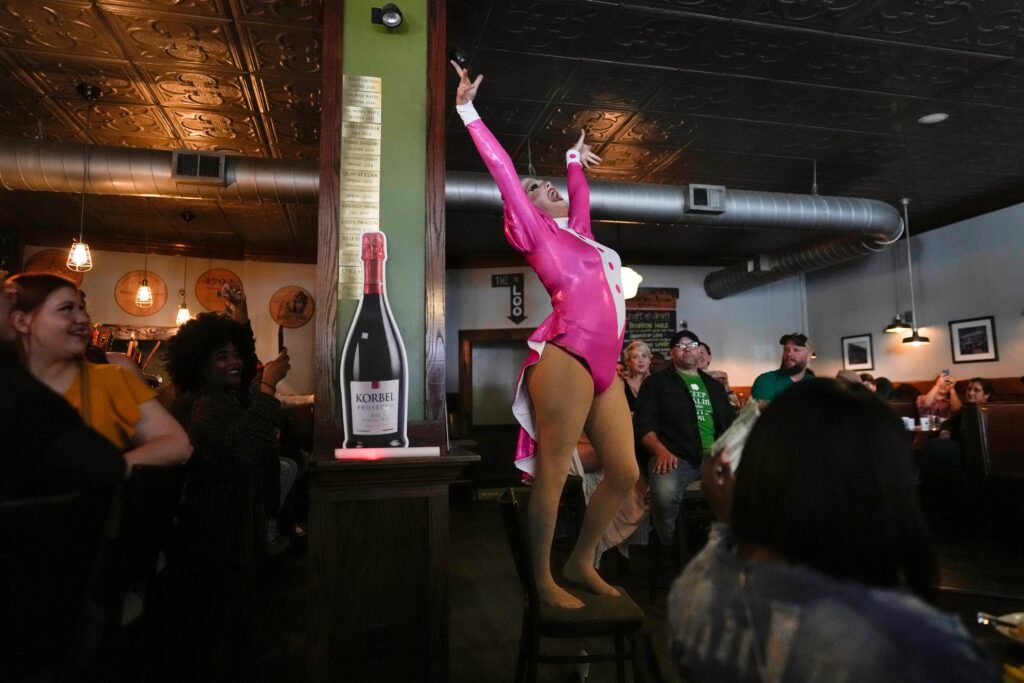
Ohio Republicans are racing to protect the public from a sinister threat: men in wigs and sequined dresses. In reality, it’s a heavy-handed attempt to chill constitutionally protected expression.
The state House of Representatives passed a bill on Wednesday to criminalize drag shows that take place outside specified venues. The legislation’s sponsor, state Rep. Angela King (R), argued that the purpose of the legislation is to protect children from “premature sexualization” and “the erosion of their innocence.”
Ohio law already prohibits the dissemination of obscene materials or performances to minors. The bill would expand those restrictions to performances outside an “adult cabaret,” such as a nightclub or sex shop, that features “performers or entertainers who exhibit a gender identity that is different from the performer’s or entertainer’s biological sex using clothing, makeup, prosthetic or imitation genitals or breasts, or other physical markers.”
Violations could result in a felony charge and up to 18 months in prison.
Defenders of the law insist that it leaves wiggle room for “appropriate drag” — that is, performances that they do not consider “obscene.” But what that would mean in practice is unclear because Ohio’s obscenity law is extraordinarily vague: It includes anything whose “dominant appeal is to prurient interest” or whose “dominant tendency is to arouse lust.”
Giving the government far-reaching power to punish speech that crosses some arbitrary line inevitably means people will shy away from going anywhere near that boundary. That’s censorship, plain and simple.
It’s also paternalistic. Any reasonable person understands that drag shows are inappropriate for children — not just because they are usually sexually explicit but also because they include crude humor and lots of alcohol. Parents are entirely capable of keeping their kids away from those events without the government’s help. They’re also capable of making their own decisions about bringing their kids to public events that might feature drag performers, such as Pride parades.
Ohio would not be the first red state to enact restrictions on this form of entertainment. Tennessee, Texas, Florida and Montana have passed similar laws, though the latter two are currently blocked by courts. Last month, a federal appeals court in Texas ruled that the state can enforce its law. The U.S. Supreme Court recently refused to take up a challenge against Tennessee’s statute.
However someone feels about drag queens, those are unfortunate losses for the First Amendment. If performers think they can make a living by cross-dressing in settings that aren’t funded by taxpayers, why should the government have any say in the matter?
The post Ohio’s drag on free speech appeared first on Washington Post.