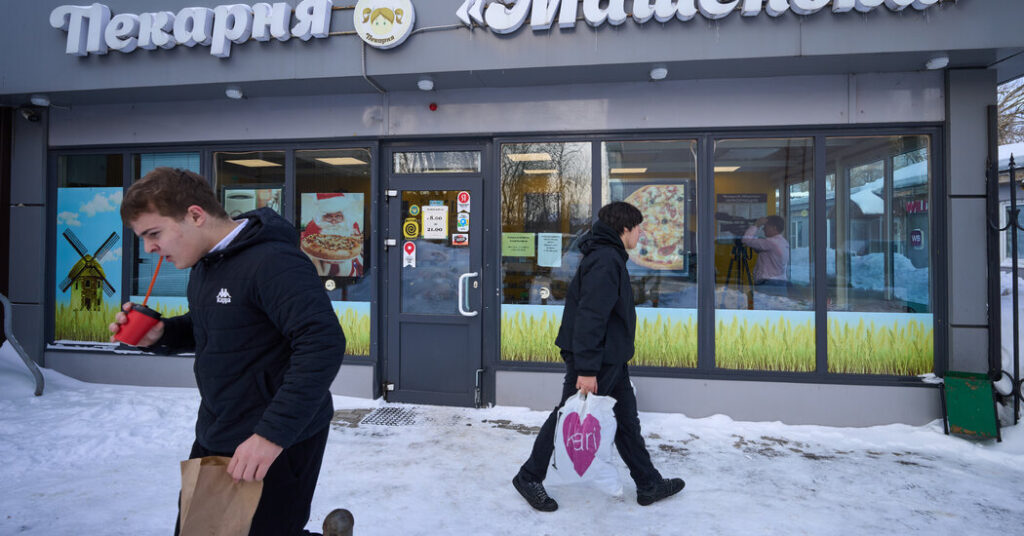
Denis V. Maksimov says he accepts that small businesses like his three bakeries in a working-class town near Moscow will have to chip in more as Russia struggles to pay for the war in Ukraine.
But a 35-fold increase in his taxes? His bakeries, named Mashenka after his eldest daughter, would not survive, he feared. He and his manager counted “everything, down to the paper clips,” to see if they could make the numbers work.
Then Mr. Maksimov complained directly to President Vladimir V. Putin.
The baker submitted a question to Mr. Putin’s annual call-in show, a rare occasion when the Russian leader appears within reach of his people. It was selected, and days later Mr. Maksimov stood with his two daughters in front of one of his bakeries and appealed live to Mr. Putin. The publicity brought in a wave of customers.
By last month, the boost had faded, and Mr. Maksimov found himself confronting the same threats to his businesses’ survival. The Russian economy has hit a wall, and the Kremlin is resorting to higher taxes to keep up its immense military spending.
“I have friends fighting at the front; their parents are retirees. Who is going to pay their pensions?” Mr. Maksimov said recently over coffee at his biggest bakery, an unpretentious space between a Soviet-era apartment building and a beer store. “It turns out, that’s up to me.”
The economic news for Russia has been brighter in recent weeks as Moscow has reaped billions of dollars from a spike in oil prices caused by the U.S.-Israeli war on Iran. Depending on how long the Middle East conflict lasts, the windfall could help ease a rapidly mounting budget deficit that by February had exceeded 90 percent of what the government had planned for the entire year.
But Mr. Putin himself, during a meeting with Russian business leaders on Thursday, warned that the economic bonus was likely to be temporary. Analysts say that the country will continue to face problems like demographic challenges, an economy overly reliant on energy exports and excessive spending on the war.
With the economy rapidly cooling, signs of crisis began to emerge all over Russia late last year. Empty storefronts now dot central Moscow as falling demand has squeezed many restaurants and boutiques catering to middle-class Russians. The city government said this month that it would need to cut 15 percent of its work force and delay some signature construction projects like new subway lines.
Away from the capital, in places like Kraskovo, where Mr. Maksimov has his bakeries, those with less money have begun to see his pastries as a luxury, he said.
“Some people stopped coming altogether, viewing us as a nonessential service, so to speak,” he said.
After years of overheated growth juiced by government spending on the war, Russia is now in a bind.
Oil and gas revenues fell by more than 40 percent last year, pushed down by declining global prices, Western sanctions and Ukrainian attacks on Russian energy infrastructure.
The Kremlin could not drastically cut expenditures in response because of the cost of the war, which reached about $165 billion last year. Nor could it easily increase revenues.
Russia’s borrowing is limited to the domestic market because of its international isolation. Taking on more debt also risks increasing inflation, which has been elevated since the start of the war in 2022.
The Kremlin has tried to bring inflation down by raising interest rates, going as high as 21 percent last year. They now stand at 15 percent after the latest round of easing last week.
To help bridge the gaps, the government has increased taxes on ordinary Russians, large corporations and smaller enterprises like Mr. Maksimov’s bakeries. That has brought the war home for many Russians after four years of efforts by the Kremlin to keep it mostly out of people’s minds.
Any move to raise additional revenue for what Russia calls the “special military operation” in Ukraine “will lead the civilian sector of the economy into a deep recession and significantly reduce the real income of the population,” said Oleg V. Vyugin, a former first deputy finance minister who now teaches at the Higher School of Economics in Moscow.
Despite these challenges, the Russian economy is far from a collapse resembling the post-Soviet transition that plunged roughly 40 percent of the population into poverty. Real wages in Russia surged to record highs in recent years, driven by a severe labor shortage and state spending on the war.
At the largest of Mr. Maksimov’s three bakeries, traditional Russian cakes and buns line the shelves. The bakery serves as a hub for the local community, and residents praise its affordability and service. A poster on one of its windows says, “Once, our bread made its way to the Kremlin, all because it was baked with heart and soul.”
It got there in a moment of desperation.
The steep tax increases for small businesses like Mr. Maksimov’s went into effect in November. Before then, he was paying a flat tax of about $1,500 per year, a figure so low that Mr. Maksimov said he paid it little mind. That has been replaced with a cumbersome system in which he pays a 5 percent value-added tax plus 6 percent of the bakery’s income.
That was the backdrop for the question he submitted to Mr. Putin’s call-in show. In the live video, Mr. Maksimov told the Russian leader that he fully understood “that the country is in a difficult situation at the moment and that raising taxes is necessary.” But, he said, “as things stand, the situation is tough, and honestly, we don’t look to the future with much optimism.”
In response, Mr. Putin said the increase was related to tax evasion, but added, “This does not mean that production businesses should face difficulties.”
Mr. Putin also asked if Mr. Maksimov would send him some of his “tasty stuff.” The next day, the Kremlin published a video of Mr. Putin eating a pastry from Mashenka. The Kremlin sent a basket of sparkling wine and chocolate as well as a painting of a religious icon to Mr. Maksimov, who said he would preserve it as a family treasure.
After Mr. Putin’s intervention, government officials scrambled to rescue Mashenka. The economy minister solicited Mr. Maksimov’s advice. In late January, the bakery’s situation was discussed at an economic policy meeting with Mr. Putin, and the government instituted an adjustment period for the tax increases. Federal lawmakers went to the bakery to talk and eat pastries, and the regional government offered help.
Customers streamed into Mr. Maksimov’s bakeries. Some traveled to try his pizza and take a selfie with him.
Once the publicity faded, reality returned. Sitting in his main bakery, he said that he had brought home only about $2,000 after taxes in January. Before, he could make up to $5,800 in a month, he said. He has no other income to feed his family of six.
Mr. Maksimov’s plight has resonated with small-business owners across Russia. In St. Petersburg, Lyalya Sadykova started a campaign on social media under the slogan, “We are all Mashenka.” She opened her first beauty salon as a university student with only $500 in her pocket and now owns eight of them.
“All these ministers and governors rushed in to save this one person just to show the president that they saved Mashenka,” Ms. Sadykova said in an interview. “Even if it were dying, they would somehow force it to live now — just this one Mashenka alone.”
While one bakery might be saved, Ms. Sadykova said, other small businesses “will simply die off, quietly.”
When the new tax regulations hit, Darya Demchenko, who owned three beauty salons in St. Petersburg, had to close one and sell another, she said. Thirty people lost their jobs.
“It was a very difficult decision,” she said. “It was very painful.”
Her businesses and others are not just struggling with higher taxes, she said. They have also been contending with lower demand, higher prices for services such as security and internet, and the Kremlin’s tightening control over communication channels, including a ban on platforms like WhatsApp and Instagram that businesses used for marketing.
“I don’t have a wealthy husband who supports my business,” she said, adding that she had “two children, a mortgage and a car loan.”
“The scariest part,” she said, “is that I don’t understand what to do next.”
Ivan Nechepurenko covers Russia, Ukraine, Belarus, the countries of the Caucasus, and Central Asia.
The post Can This Russian Bakery Survive a 3,500% Tax Increase? appeared first on New York Times.