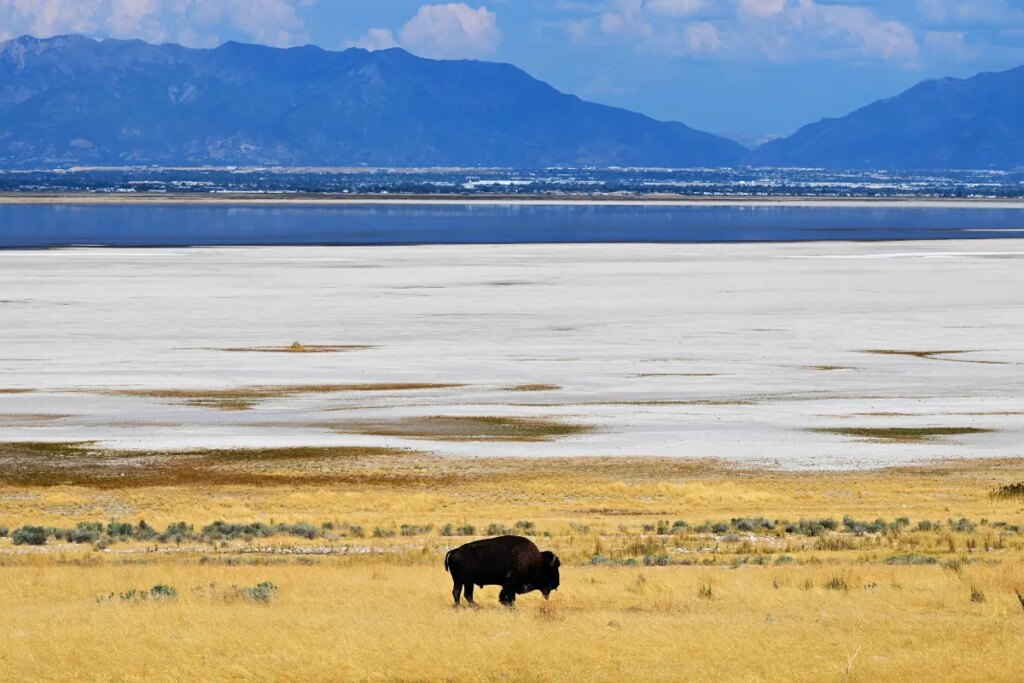
The Great Salt Lake is harboring an unexpected secret: a huge stash of water that’s decidedly not salty.
A team of researchers who x-rayed its subterranean structures discovered that lurking below its briny surface is a vast and miles-deep reservoir of freshwater.
The findings, detailed in a new study in the journal Scientific Reports, upend expectations that any freshwater presence would be small and relegated to the lake’s outskirts, dumped there by nearby mountains. In reality, it appears that possibly the entire saltwater lake is undergirded by freshwater.
“We were able to answer the question of how deep this potential reservoir is, and what its spatial extent is beneath the eastern lake margin. If you know how deep, you know how wide, you know the porous space, you can calculate the potential freshwater volume,” said lead author Michael Zhdanov, a geophysicist at the University of Utah, in a statement about the work.
Scientists had a sneaking suspicion that there was a hidden freshwater presence with the sudden appearance in the past few years of large mounds of reeds popping up in regions of dry exposed lakebed called playa.
To probe the depths beneath the lake, the researchers conducted what’s known as airborne electromagnetic surveys by flying over the saltwater body in a helicopter and pointing instruments that measure the electrical conductivity on the ground. The resulting signals help distinguish between salt and fresh water — salt makes the liquid it’s suspended in far more conductive — and tease out the composition of the rocks and soils.
Some 154 miles of flying later, the team had collected the data they were looking for. After using it to create a map of the lake, they found that spikes of resistive fresh water were turning up everywhere.
That clued them in to an even bigger find: a sudden drop in the lake’s subterranean layer called a basement, going from just a few hundred yards deep to over 2.5 miles. The freshwater appears to be saturating sediments trapped in this region, forming a deep reservoir.
Bill Johnson, a UT hydrologist and coauthor of the study, called the findings “unexpected.”
“What we would normally expect as hydrologists is that the brine would occupy the entire volume underneath that lake,” he explained in an interview on KPCW’s Cool Science Radio show, cited in the university release. “It’s denser than the freshwater. You’d expect the freshwater from the mountains to come in somewhere at the periphery.”
“But we find it’s coming in towards the interior,” he added. “And there’s what appears to be a deep volume of this freshwater coming in underneath that saline lens.”
The aerial survey spanned only a fraction of the huge lake’s area, making it difficult to draw hard conclusions of this reservoir’s true size. That it’s there at all, however, has scientists hooked.
“This is why we need to survey the entire Great Salt Lake,” Zhdanov said. “Then we’ll know the top and the bottom.”
More on geology: There’s a Perfectly Reasonable Explanation for Antarctica’s Waterfall of Blood
The post Scientists Detect Something Bizarre in Subterranean Structures Under the Great Salt Lake appeared first on Futurism.