Across more than half a century in the ring, Rick Young was a happy warrior of rodeo, a Cal Ripken Jr. in clown’s makeup. The Hall of Fame rodeo clown and bullfighter endured broken ribs, a broken leg and a broken jaw. Once, he said, he was knocked down while wearing a hula skirt. The bull started chomping on his outfit, thinking he was a bale of hay.
“If I ever felt good when I woke up, I’d go to the hospital,” he said. “I hurt every dang morning with something. But it’s just pain. You just put it out of your mind. I don’t pay attention to it. If you can’t do that here, you’re in the wrong business.”
Mr. Young, who died March 20 at 92, was one of the longest-working clowns in rodeo, appearing at events from Hawaii to Connecticut and from Alberta to Louisiana, where he was raised. Affectionately known as the Ragin’ Cajun, he took to calling himself the Agin’ Cajun for his longevity: By the time he retired in 2019, at age 85, he had been working in rodeo longer than most of his peers had been alive.
He hadn’t gotten any slower, he joked. They were just raising faster bulls.
“Rick was the total package,” said rodeo clown Justin Rumford, who joined Mr. Young for his last hurrah in the ring. Mr. Young, he told The Washington Post, was a dual threat: a brilliant entertainer who could tell jokes and engage the crowd, and a gifted protection man (a bullfighter, in rodeo parlance) who could keep riders out of harm’s way whenever they were thrown to the ground.
While those roles are now distinct at most rodeos, Mr. Young did both for decades. He stepped away from bullfighting only in his 70s, when he began working exclusively as an entertainer — an old-fashioned clown who, in Rumford’s judgment, “could make you laugh whether you were 6, 66 or 96.”
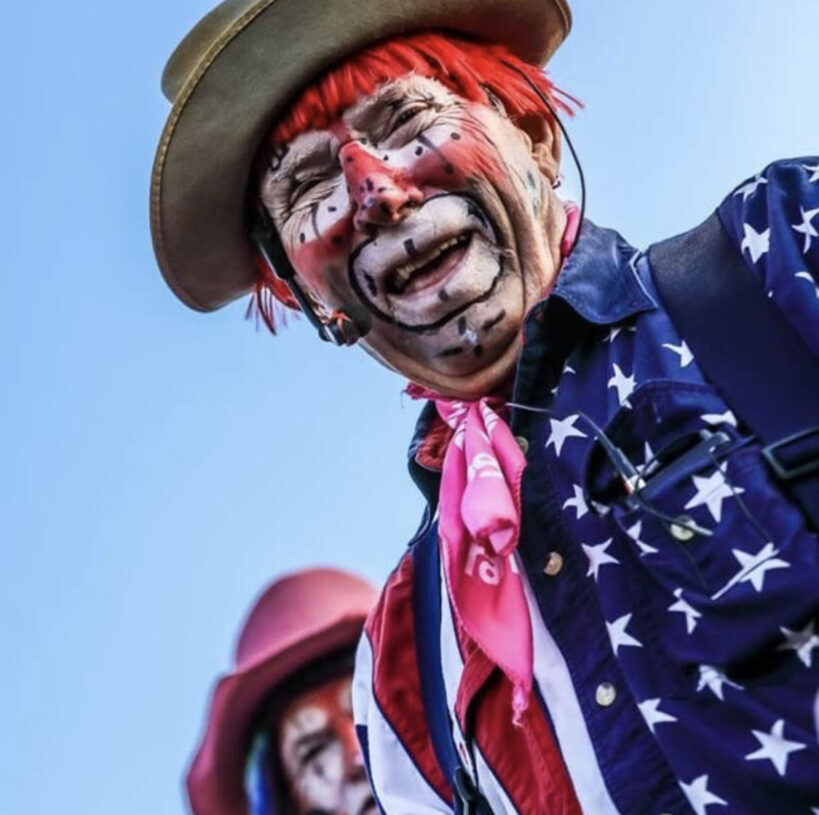
In his heyday, Mr. Young could distract an angry bull and steer it toward the exit gate, at times stepping between the animal and a downed rider. He used a barrel as a barricade, a shelter and a prop, dancing around it like a cabaret star or rolling it on its side to guard against the bull. His costume was traditional, comprising bright makeup and loose-fitting clothes: a polka-dot shirt, oversize Wrangler overalls, maybe a bowler hat for kicks.
Experience proved crucial, he said, and instinct was key.
“If you ever hesitate, you’re caught. They’re gonna run over the top of you,” he told the Longview (Texas) News-Journal last year. “My legs never did let me hesitate. When I took off, I took off.”
As a clown, Mr. Young leaned into music, props and self-deprecating jokes. Asked about his hometown, he would explain that he grew up in tiny Tickfaw, Louisiana, which proved difficult to locate on a map. “You know where Shreveport is?” he deadpanned. “It ain’t nowhere around there.”
Mr. Young was named clown of the year in 1980 by the Professional Rodeo Cowboys Association, the sport’s de facto governing body. He won its Coors Man in the Can award four times; was enlisted to wrangle bulls for Hollywood westerns including “Alvarez Kelly,” starring William Holden and Richard Widmark; and was a fixture of the Sikeston Jaycee Bootheel Rodeo in Missouri, where he worked for some 60 years, most recently with Rumford by his side.
“Rick was a part of that community,” Rumford said. “He was not just a personable guy — he was the kind of guy who if you knew him for 10 minutes, you felt like you’d known him for 10 years.”
“What made him so good was he didn’t have to put on an act. When Rick was in the arena, he just used his natural humor. There wasn’t a script. There wasn’t a different personality. It was just Rick being Rick.”
Born in Houston on March 3, 1934, Richard Thomas Young never set out to become a rodeo clown. Raised outside New Orleans and on his family’s Appaloosa horse ranch near Tickfaw, he grew up with a love of animals and starred on his high school football and basketball teams.
Although he hoped to play football at Louisiana State University, he was deemed too small at 5-foot-9. He joined the rodeo team instead, competing for LSU — and later Southeastern Louisiana College (now a university) — in bareback riding, bull riding, roping and steer wrestling, according to the ProRodeo Hall of Fame.
His rodeo earnings helped him pay his way through school, and Mr. Young later supplemented his income by working in the oil fields and getting jobs in construction. When a bullfighter failed to show up at one rodeo, Mr. Young filled in, discovering a new career path. Eventually he became a free agent, booking his own shows while also breeding and training Appaloosas with his wife, Bernie Lee Young.
In 1974, he was enlisted to work as a bullfighter at the sport’s premier event, the National Finals Rodeo. He said he was given strict orders from the organizers: “This is a cowboy’s rodeo. No jokes, no clowning.” Mr. Young let it rip anyway. “I’m the only one that ever took a dummy out in the middle of the ring at the NFR,” he told the News-Journal.
When rodeo leaders complained, he argued they were missing the point: “People laughed, didn’t they?”
Mr. Young was inducted into the National Rodeo Hall of Fame in 2004 and the ProRodeo Hall of Fame in 2022. His family said he died in Hammond, Louisiana, not far from his home in Independence. They did not cite a cause.
In addition to his wife, survivors include four children, Denise Young Doucet, Rhonda Clare Zimmerman, Gerard “Rod” Zimmerman Jr. and Laura Jean Zimmerman; eight grandchildren; and eight great-grandchildren. He was predeceased by his son Dennis Young.
When it came to injuries in the ring, Mr. Young said he sometimes pushed it too hard, working on a hobbled leg that only caused him “to get more broke ribs.” But the risks of rodeo clowning only offered him material for more jokes.
“There’s only two people knew how scared I was: That’s me and her,” he told the News-Journal last year, pointing to his wife. “She done my laundry.”
The post For late rodeo clown Rick Young, angry bulls were just part of the show appeared first on Washington Post.