The Toronto Blue Jays played their first opening day 50 years ago in the snow.
Not a flurry, but snow that collected on the brims of people’s hats and accumulated on the field so much that groundskeepers used a hockey rink Zamboni to clear the turf. The Blue Jays’ third baseman Dave McKay, a Canadian, said that April 7, 1977, was the coldest day he had ever played baseball in his life.
Spring in Toronto, and much of Canada, is a paradox. There are a few warm days in March, when rain washes dirty snowbanks into the sewer. Some insane people start wearing shorts. But then it gets cold again. Then warmish. It always snows in April. On Friday, it was arrogantly winter. The roof of the stadium many Canadians still call the SkyDome won’t open until May.
It’s been the Rogers Centre since 2005, when the telecom giant took full ownership of Canada’s only Major League Baseball team. But the old name, the SkyDome, still suits the bowl with the retractable roof that opened in 1989, even with its recent renovations.
On Friday night, the Blue Jays walked in where they left us last. The sellout crowd stood and roared. We haven’t seen them in forever. That Game 7 World Series loss against the Los Angeles Dodgers feels like yesterday.
Ahead of their 50th season opener, against the Athletics, a crisp blue banner to mark Toronto’s American League pennant was unfurled. It begged for additional context: within two outs of upsetting the defending champions in 11 innings.
It’s difficult to describe how pleasurable — and indelible — last October was, in Toronto and so much of the country, to someone who wasn’t here. In the same way, it’s impossible to adequately explain what it was like in 1977, a new Toronto M.L.B. team playing at windswept Exhibition Stadium in a snowstorm. I know men who were there, and they carry that day inside them.
Everyone in the United States who cared about baseball predicted a Dodgers sweep. But Canadians weren’t having it. Love for the scrappy Blue Jays — a team whose players repeatedly said was built on friendship — overran Toronto. By the time the Blue Jays flattened the Dodgers, 11-4, in Game 1 of the World Series, they had seized the country’s autumn heart.
Sports are not that important. They are so important. It’s just baseball. People are deeply stirred by it. In the grocery store, at the doctor’s office or waiting to cross the street, strangers talked excitedly. There were only two types of days: game days, or waiting-for-the-game days. And Canadians were longing for something to throw their arms around.
It had been a fraught stretch for Canada-U.S. relations. In the preceding 10 months, President Trump had at times suggested that Canada should become the 51st state, called the border an arbitrary line and applied punishing tariffs. Canadians were angry and hurt, and in large numbers, they stopped traveling to the United States and buying American products. The Blue Jays became a natural unifier.
The joy of winning baseball has also come to magnify how agonizing Canada’s national winter game has recently felt.
The men’s and women’s Olympic hockey teams lost gold medal games. The Canucks are the worst team in the N.H.L. Some of the loudest cheers the Maple Leafs have heard all year came on Wednesday night when a half-dozen Blue Jays players attended the game. Only the Oilers and the Canadiens have Stanley Cup hopes.
The Blue Jays won championships in 1992 and 1993, but most years were far from that. When a disappointing regular season concluded, that was it. We wouldn’t have more baseball, but we still had late summer and fall. We had hockey. We leaned gently into winter. This year, when I left the stadium hours after Alejandro Kirk had grounded into the double play that ended Game 7, it was a freezing November night. Baseball was over. Winter was on the doorstep.
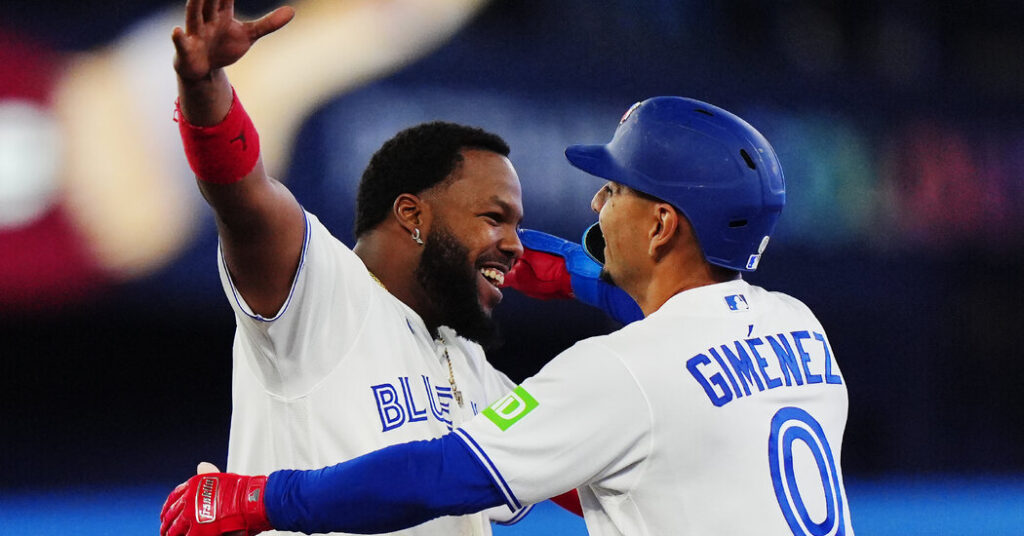
Outside the stadium on Friday, it was a few degrees below zero. Inside, the temperature was October. And around 7 o’clock Eastern time, the Blue Jays still had 162 games to win or lose. Three hours later they had a walk-off 3-2 victory.
Opening day was “a little bit different this year,” said John Schneider, the Toronto manager. “You tie in the 50th anniversary and excitement around the team and unveiling some stuff tonight, yeah.”
The Blue Jays aren’t favorites to make the World Series, but they weren’t last year either. It’s as likely as anything, but it won’t feel the same. And I wouldn’t want it to.
More on the Toronto Blue Jays from The Athletic
A few bold predictions for the Blue Jays season. The club president Mark Shapiro on the team’s payroll plans, and hopes of hosting an All-Star Game and World Baseball Classic games. How to watch Blue Jays games in 2026: TV updates for the reigning American League champions. World Series 2026 odds: The Dodgers are big favorites, but history is against them. Vladimir Guerrero Jr.’s 14-year extension has supercharged the Blue Jays for the long haul. How the manager, John Schneider, figured it out, earning his extension to stay with the Jays. And finally, how playing piano helped the pitcher Max Scherzer recover from a lingering thumb injury.
Trans Canada
This section was compiled by Shawna Richer.
-
Last Sunday night, Air Canada Express Flight 8646, traveling from Montreal to New York, was landing at LaGuardia Airport when it collided with an airport fire truck that was crossing the runway. Both pilots were killed, and 39 people were admitted to the hospital. The Canadian pilots, Antoine Forest and Mackenzie Gunther, were early in their flying careers. See how the crash unfolded and went from routine to disaster in 20 seconds. Passengers recalled a rough landing. Why didn’t the fire truck stop? This article details the breakdown in communications in the control tower. In Montreal, the Air Canada C.E.O. drew criticism for delivering his condolence message in English only, but later apologized. And, as my colleague Ian Austen reported, the crash exposed shortcomings in air traffic control at American airports, giving Canadians another reason to avoid traveling to the United States.
-
My colleague Norimitsu Onishi traveled to Cambridge Bay, Nunavut, to report on the military assigned to Canada’s frozen north. He also wrote that as Arctic threats rise, Canada may have no choice but to lean on the United States.
-
Ian Austen reported that Canada met its NATO military spending target for the first time in decades.
-
Quebec’s ban on religious symbols — and a measure that suspends constitutional rights — are being tested in a case with far-reaching repercussions.
-
Cade Metz, a technology reporter at The Times, wrote about Gilles Brassard, a professor at the University of Montreal, who was given the Turing Award alongside Charles Bennett, an American, for their work on quantum cryptography and related technologies.
-
The Netflix romance series “Virgin River” has become a guilty pleasure. The addictive show is filmed in Vancouver and British Columbia’s Fraser Valley.
-
Emma G. Fitzsimmons, who reports on New York City and public policy at The Times, wrote that the number of Canadian visitors to New York City plunged by 19 percent in 2025 because of the displeasure Canadians are feeling about President Trump.
-
From The Athletic: Inside Canada’s World Cup goalkeeper battle, and is the Maple Leafs’ tank still on?
-
And because it still feels like winter in much of the country, keep an eye on the Canada Cold Weather Tracker from the weather team at The Times.
Shawna Richer is an editor on the International desk at The Times. She lives in Toronto and has been editing and writing about sports for more than 25 years.
How are we doing? We’re eager to have your thoughts about this newsletter and events in Canada in general. Please send them to [email protected].
Like this email? Forward it to your friends, and let them know they can sign up here.
Shawna Richer is an editor working on coverage of sports in America.
The post Winter’s Gloomy Spirit Lifts as Baseball’s Blue Jays Land appeared first on New York Times.