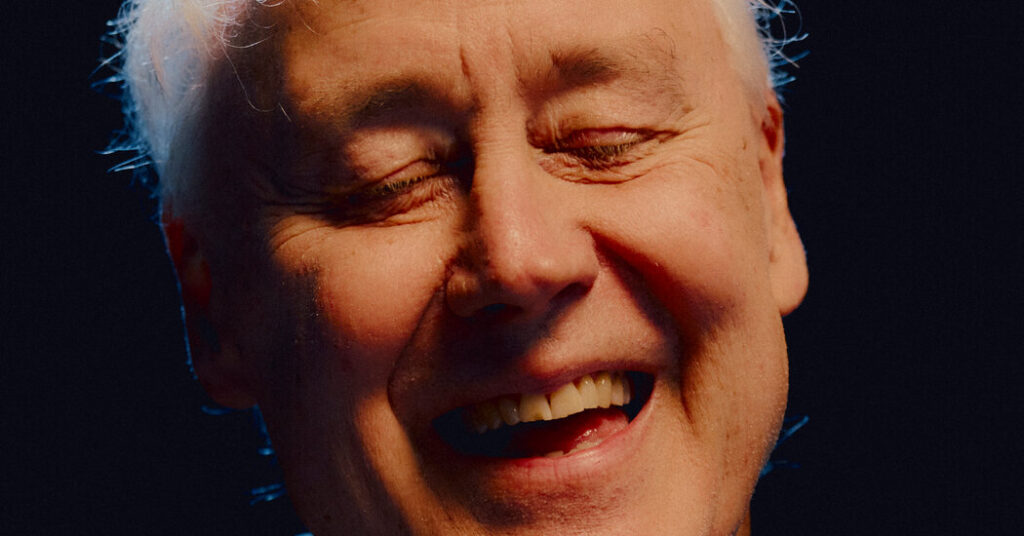
Resonant, thickly harmonized, slow-rolling piano chords wafted into the lobby of National Sawdust, a Brooklyn venue devoted to adventurous music, when I arrived to interview Bruce Hornsby there in early March. Tall and lean, wearing a flannel shirt and black pants, he had gravitated to the club’s Bosendorfer 225 grand piano, an imposing instrument with extra keys for richly rumbling bass notes. He had a folder full of sheet music: new songs, classical pieces he was determined to master, a few lyric sheets with chords.
For the next few hours, our conversation was sprinkled with his virtuosity: two-fisted stride piano, glimmering dissonant clusters, a blues vamp with peculiar twists, angular 20th-century classical compositions. They all had musical links to “Indigo Park,” the album he’s releasing on April 3.
Hornsby’s new songs ponder memory, creativity and time, mingling thoughts on science and eternity with rare bits of autobiography: his shock in elementary school after learning John F. Kennedy had been assassinated, or the joy of a song taking shape. “This is the first record where I’ve really dealt with looking back,” said Hornsby, 71. “On a lyrical level, I’ve always been kind of pushing forward. But this time I thought, OK, you’re 70, [expletive].”
The album has guest appearances from multiple generations of musicians, among them Bonnie Raitt and Vampire Weekend’s Ezra Koenig. It also refreshes Hornsby’s longstanding ties to the Grateful Dead, for whom he played keyboards on tour from 1990 to 1992. “Indigo Park” includes two songs with lyrics by the Dead’s longtime wordsmith, Robert Hunter. For the jaunty “Might as Well Be Me, Florinda,” Hornsby was joined by the Dead’s singer and guitarist Bob Weir, in one of his last recordings.
Over a four-decade career, Hornsby has had a sweeping array of collaborators across rock, jazz, country, bluegrass, classical music and beyond. He wrote “The End of the Innocence” with Don Henley of Eagles. He backed Bob Dylan on the album “Under the Red Sky.” He has shared vocal duets and songwriting with Justin Vernon of Bon Iver, and he has recorded full albums with the bluegrass musician Ricky Skaggs, the jazz musicians Christian McBride and Jack DeJohnette and the contemporary chamber group YMusic. He was the studio pianist on Raitt’s “I Can’t Make You Love Me,” which became one of her signature songs.
“I think he made all the difference,” Raitt said in a phone interview. “The reason that song is the heartbreaker it is, is because of the way that he interprets those chords. That’s not how the demo sounded. Even in the intro alone, it already breaks your heart.”
They became occasional tour mates and lifelong friends; on “Indigo Park,” she joins him to sing “Ecstatic,” which she called “the most challenging vocal I’ve ever done.” Backstage on her own tours, Raitt said, she plays a live recording of Hornsby performing “Dreamland” before going onstage each night. “The guy is just still diving deep and improving and playing hours a day and stretching,” she said. “He’s the one musician I would have if I could only have one on a desert island.”
Hornsby’s commercial peak — his only No. 1 pop hit — was the title track of his 1986 debut album, “The Way It Is.” A five-minute song about racism, with two jazzy piano solos, it was a long way from any pop formula. “Because of that, nobody knew what a Bruce Hornsby hit, quote unquote, was supposed to be,” he said. “I never felt the pressure to play it safe, so I didn’t.”
“The Way It Is” has turned out to be durable. Tupac Shakur used it as the foundation of his hip-hop hit “Changes”; Polo G borrowed its chords, perhaps via Tupac, for his “Wishing for a Hero,” and enlisted Hornsby for a live version. Hornsby’s other early hits thrived on the soothing adult-contemporary FM radio format, which paid little attention to lyrics (like the ones in “The Valley Road,” about a farmhand who gets the plantation owner’s daughter pregnant).
But Hornsby was never content to provide audio pabulum. Through decades of touring, his concerts have been spiked with explorations and improvisations that he springs on what he fondly calls his “poor, unsuspecting audiences,” despite occasional pushback.
“Some people just hate it. I get nasty letters all the time or nasty social media screeds,” he said. “They’re always saying, ‘I didn’t hardly recognize even the hits you were playing.’ And my answer is, ‘Look, I’m trying to stay interested.’
“Coming to a concert for your stroll down memory lane, I understand it completely,” he added. “That’s popular music. You’re hoping to hear the good old songs. But for me, it’s a creative prison, so I’ve never allowed myself to be shackled by that notion.”
Koenig, who shares vocals with Hornsby on the new song “Memory Palace,” said via video, “Sometimes people who write a timeless hit search for their next hit, well past the time when it’s feasible to have a hit. With Bruce, obviously, he’s proud of the work he did, but it doesn’t define him. That kind of bravery — to push into territory that has very little in common with your best-known work — is inspiring.”
Hornsby chose National Sawdust as the site for an interview because his concerts there in 2019 were “the opening salvo,” he said, in what has turned out to be a lasting and vital phase of his labyrinthine four-decade career. “I love this space,” he said, gesturing to the spider web-patterned walls. “It feels creative.”
Those concerts — where he was joined by YMusic — introduced his 2019 album “Absolute Zero,” his leap into a new, untrammeled phase of songwriting that now extends through “Indigo Park.”
“I’m trying to push the notion of what’s allowed harmonically and melodically in popular music writing,” he said. “A lot of the modern pop music — it’s four chords, and it’s the same four. Those are nice chords. But there are others. There are many, many, many others.”
Ever analytical, Hornsby credited two factors for his musical breakthrough with “Absolute Zero.” From 1992 to 2020, Spike Lee relied on him to write film scores. Hornsby had composed hundreds of cues, little pieces of music that often explored complexity and dissonance. Lee couldn’t use them all, leaving Hornsby with an archive of professionally recorded tracks. During the 2010s he started adding words to the music.
“I had this incredible flood of creativity,” he said. “In September of ’17 I wrote seven songs. And I’m lucky to write seven songs in a year.”
While Bon Iver was in ascendance in the early 2010s, Vernon was regularly praising Hornsby’s music. Hornsby investigated the Google alerts; he and Vernon exchanged emails. They sang together on a 2015 Grateful Dead tribute album and stayed in touch. When their schedules aligned in 2018, they spent time in the studio to bounce ideas around and to work on songs using the film cues. They came up with “Cast-Off,” a song that would appear on “Absolute Zero” in 2019 and — with the Bon Iver co-sign — bring Hornsby a wave of younger fans and a surge in his songwriting.
“Affirmation is inspiration,” Hornsby said.
Hornsby expected that “Absolute Zero” and its two equally knotty, exuberantly unpredictable successors, “Non-Secure Connection” (2020) and “’Flicted” (2022), would stand as a trilogy. For his next release, “Deep Sea Vents” (2024), he came up with lyrics for compositions written by members of YMusic, billing their collaborative group as BrhyM. Then he hoped to take a break.
He couldn’t. “This one idea came into my head. And I just tried to give it the Heisman, you know, just keep it away. Get away, ‘Out, damned spot!’ But it would wake me up in the middle of the night.”
After “six to eight months,” he said, “I yielded to it because it was indefatigable.” The song that emerged was “Indigo Park,” a steadfast modal piano vamp carrying a rush of youthful memories along with a self-admonition: “Oh let these days be your delight, captured in rhythm and rhyme.”
For Hornsby, it was a “catalyst” for the rest of the album; the trilogy is now a tetralogy. Along with personal memories, there are songs that take a cosmic view of time; he contemplates the end of the universe in “Sliver of Time.” He was still setting musical challenges. His 2014 album, “Solo Concerts,” had already captured him dipping into 20th-century classical music alongside his own songs — not consonant, repetitive Minimalism but complex, often atonal repertory from composers like Gyorgy Ligeti, Arnold Schoenberg and Elliott Carter.
On “Indigo Park,” he slips some of their music into his song structures. He slowed down the bass line of a daunting Ligeti étude, “The Devil’s Staircase,” for “Entropy Here (Rust in Peace).” And in “Alabama,” he put a 12-tone row from Schoenberg’s Piano Concerto behind some absurdist lyrics from Hunter. “Steal from the best,” he said with a smile.
Still, Hornsby doesn’t want his music to be heard as technical showpieces. “All the trickery means nothing unless there’s some gravitas — there’s emotion that gives people something that they weren’t expecting,” he said. “To be unexpected and also moving — that’s hard, that’s a lot to ask. But that’s what I’m hoping for, to be honest. I want it to move people. Simple as that.”
Jon Pareles, a culture correspondent for The Times, served as chief pop music critic for 37 years. He studied music, played in rock, jazz and classical groups and was a college-radio disc jockey. He was previously an editor at Rolling Stone and The Village Voice.
The post Bruce Hornsby Still Isn’t Playing It Safe appeared first on New York Times.