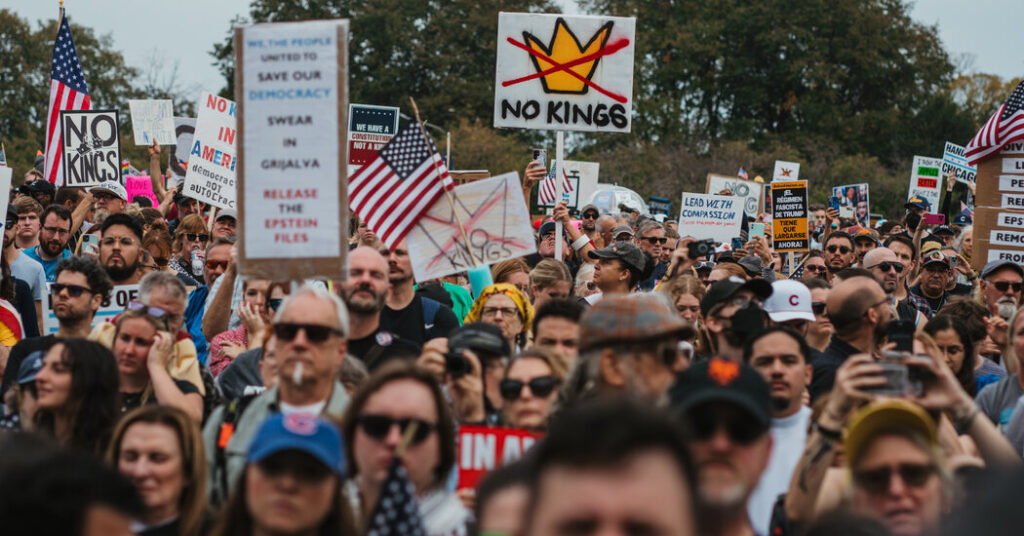
Millions of Americans are expected to turn out on Saturday for mass demonstrations against President Trump, the latest organized display of anger led by the coalition of progressive groups known as No Kings.
Organizers are aiming to make it the largest such protest yet, which would mean exceeding the seven million people they said showed up at the “No Kings” rallies in October and the millions of people they said turned out in June. (The Times has not verified those numbers, which encompass thousands of rallies.)
Those two protests gave the administration’s most ardent opponents an outlet for their discontent at a time when Democrats were deflated from their losses in 2024 and reassessing their missteps.
But as the third “No Kings” demonstration gets started, it’s an open question whether posting another big number will be enough to influence the course of the nation’s politics. Can the protests harness that energy and turn it into victories in the November midterm elections? How can they avoid a primal scream that fades into a whimper?
The phrase “No Kings” is a nod to the anti-authoritarian, democratic principles the country was founded on — which the protesters say Mr. Trump has ignored.
Otherwise, organizers said, “No Kings” protests intentionally lack a single, specific demand, reflecting the diffuse nature of the anti-Trump effort. Promotional fliers and emails highlight a range of issues, including immigration patrols, election interference, the White House ballroom, Ukraine and affordable housing.
Nor has a high-profile leader or public face emerged, in the way that Tom Hayden did during the 1960s antiwar protests or Jerry Falwell in the 1980s for Christian evangelicals. Luminaries of today’s left like Bernie Sanders and Alexandria Ocasio-Cortez act as champions of progressive causes rather than only as foils to Mr. Trump.
Organizers say the idea is to attract as many opponents of the administration as possible — especially the disaffected.
“You might think his consolidation of power is inevitable, but it isn’t,” said Leah Greenberg, co-founder and co-executive director of Indivisible, a progressive group that is organizing “No Kings” events.
Protesters have planned events in more than 3,000 places, from Alaska to Florida, in liberal big cities and Republican strongholds. And beyond urging the faithful to turn out in big numbers and remain nonviolent, organizers have been hands-off about what they expect from attendees.
Bob Norberg, 70, from Gainesville, Fla., has been involved in all three “No Kings” events. On Saturday, he planned to be at a local park, he said, hoping “to invigorate the community to get involved, get motivated and help build momentum.”
Mr. Norberg said he believed the lack of focus in the “No Kings” message might have been less energizing for some. But, he said, he also believes the ambiguity is intentional and effective: The pro-democracy message can appeal to people on many levels.
He said, “It’s become apparent that ‘No Kings’ means ‘all of the above.’”
Videos of the peaceful demonstrations, whether taking up several city blocks or a small-town street corner, are meant to rev up the politically weary, organizers said. So are the whimsical costumes and homemade placards, with cheeky sayings like “Make Orwell Fiction Again.”
But skeptics of such events say that during Mr. Trump’s first term, progressives mistakenly thought that mass protests were a sign of the movement’s widespread popular support, without mastering the harder work of organizing.
“These large-scale protest events make people feel like they’re not alone — it’s like collective therapy,” said Dana R. Fisher, a professor at American University who studies civic engagement.
She has surveyed “No Kings” participants in her research and supports their work. But, she added, collective catharsis and hitting what she called “a magical number” of participants is not enough to sustain an effective political movement. “What we really need to do is the work of defending democracy in our communities,” she said. “It’s not about inflatable costumes. It’s not about clever signs.”
Some anti-Trump organizers have cited the conservative Tea Party movement as inspiration. Its combative, no-compromise spirit became an effective rallying cry for Republicans as they stymied President Barack Obama’s agenda — just as Democrats would like to do to Mr. Trump.
But the Tea Party thwarted Mr. Obama with the help of an expansive political infrastructure and wealthy donors willing to pay for it.
“No Kings” protesters do share one thing with their Republican counterparts: a belief that the country is being led to a precipice by a reckless president. In the Tea Party’s case, that was Mr. Obama.
“What really motivated the Tea Party was a deep, philosophical disagreement with Obama about what government should be — and the sense that his policies represented such an unprecedented overreach,” said Tim Phillips, a conservative activist and former president of the Koch-backed Americans for Prosperity.
“People wanted to stop that,” he said. “The people opposing Trump today see their fight the same way.”
Mr. Trump’s approval rating has fallen to 36 percent as of March 23, from 45 percent around the time he took office last year, according to Reuters/Ipsos.
That kind of drop should help activists, but the “No Kings” rallies have forced progressives to assess whether their messaging is simple and direct enough to reach most voters.
Ms. Fisher of American University and a team of researchers surveyed participants at more than 300 “No Kings” events last summer and found them to be predominantly female, college educated and middle-aged. Close to 90 percent were white, the surveys found.
They were also deeply engaged politically, with more than two-thirds saying they had participated in a political boycott in the last year.
The organized opposition to Mr. Trump has had little difficulty summoning the nation’s outrage at opportune moments. Quantifying the impact of those protests is much harder.
Lara Putnam, a history professor at the University of Pittsburgh who studies political protest movements, said the recent level of activity inside the Trump opposition has been striking. In Pennsylvania, for instance, she said that she had found 80 different “No Kings” events across the state last October. That compared with 27 events on the day of the Women’s March in 2017, a mass demonstration against President Trump during his first term.
Because of social media, “it is much easier to get people in the same place,” Ms. Putnam said. “But it doesn’t necessarily make the other pieces needed for building a political movement.”
Jeremy W. Peters is a Times reporter who covers debates over free expression and how they impact higher education and other vital American institutions.
The post A Challenge for ‘No Kings’ Protests, the Third Time Around appeared first on New York Times.