On Iran’s Rugged Frontier, Kurds Yearn to Join the Fight
March 28, 2026
Hidden among craggy mountaintops, and burrowed in tunnels deep underground, the forces of a would-be Kurdish insurgency lie in wait.
For decades, the rugged frontier dividing the Zagros Mountains between Iran and Iraq has been the refuge of these exiled Iranian militants, who have set up camps in Iraq’s semiautonomous Kurdistan region — on the condition they do not stir too much trouble.
Now, American jets and Iranian drones streak overhead so frequently that the fighters have learned to discern their models just by sound. As they listen to the United States and Israel wage war on Iran, they yearn to join the fight.
“We just have to put our boots on, and we’re ready,” said Rebaz Sharifi, a commander of forces under the Kurdistan Freedom Party. His party is one of several Iranian Kurdish groups driven from their homes throughout four decades of insurgent efforts against Iran.
These groups’ dream has long been to establish federal autonomy, akin to that of their fellow Kurds in Iraq. With Iran’s leaders battered and degraded, they hope their moment has come.
The Kurds argue that with Western military support, they could enter embattled Iran and spark insurgency in their ethnic homeland in its west. That would in turn, they argue, encourage other oppressed Iranian minorities and opposition groups to rise up, and eventually topple the government.
“Iran won’t fall with missiles and drones,” Mr. Sharifi said. “Iran needs a force to enter its territory, give hope to the people, and support them in overthrowing the regime at this time. That force should be the Kurds.”
But the Kurds’ desire to fight has hit a diplomatic roadblock. When the war on Iran began last month, U.S. and Israeli officials briefly considered backing Kurdish forces to enter the country — a move that would have transformed the air war into a riskier campaign. President Trump even called Iraqi Kurdish leaders shortly after the war began, according to four Iraqi officials, to ask them to facilitate the militants’ crossing into Iran.
Then, U.S. officials abruptly paused the idea. Iraqi and regional leaders had pushed back fiercely, arguing that one small Kurdish force could not face down a government showing no signs of crumbling — and that the move would almost certainly drag Iraq into the war.
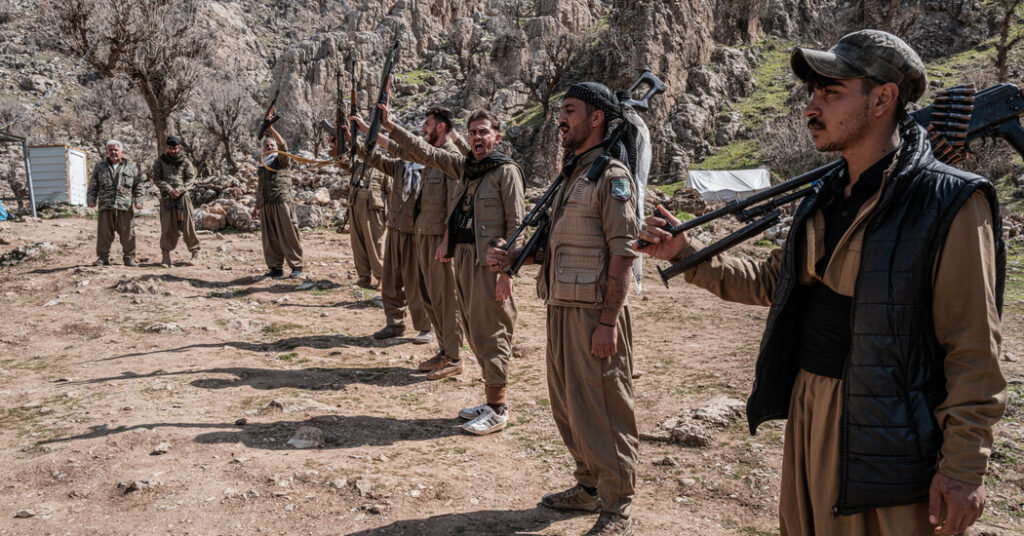
Without American and Iraqi support for their involvement, however, the Kurds are left to wait and train for a fight that may never come. At one mountain camp, as a commander barked orders to hide, the guerrillas melted into the landscape like human chameleons, silently slipping around boulders in traditional baggy Kurdish salwar pants and battered sneakers.
Tehran remains so unnerved by the possibility of a Kurdish attack that it is already battering the region.
The thud of missiles hitting Iraqi Kurdistan’s airports, consulates and military bases, or being intercepted over them, is now the soundtrack of daily life. Mr. Sharifi’s base, hidden among rolling hills, is marred with massive craters from drone strikes.
Hoping to evade nighttime attacks, Mr. Sharifi and his fighters move to the edge of their camp, listening to jackals cackling in the distance as they study the engines they have pulled from mangled drones, eager to learn more about the enemy they hope to soon confront.
Covert Operations
The Kurds are one of the world’s largest ethnic groups without a country. An estimated 40 million live in the border regions of Iran, Iraq, Syria and Turkey. For decades, those governments have frequently discriminated against Kurds, suppressed their culture and banned their language and traditions.
Kurdish groups in all four countries have waged efforts — armed or otherwise — to achieve independence or greater autonomy. Because of that, the Kurds have often made common cause with American forces in the region, most notably in the 2003 U.S. invasion of Iraq that toppled Saddam Hussein and enabled Iraqi Kurds to gain some autonomy.
Now, in the current war, Kurdish leaders say that they are again aligned with the United States, and that their talks with American officials continue — and include discussions over their possible involvement. They are undeterred by current cease-fire efforts, with some viewing the talks as a feint ahead of the next U.S. military escalation.
Iraqi intelligence officials say Iranian Kurds do not have the numbers to seize territory in Iran, estimating their forces at around 6,000. But some of them assess the militants to be capable of stoking regional insurgency. Whether it could succeed, or would simply cause more deadly chaos, was an open question.
Yet the debate over the viability of Kurdish forces, these officials say, misses the far more significant role that Iranian Kurds have played for months in U.S. and Israeli intelligence operations.
After Israel launched attacks on Iran last June, briefly joined by U.S. warplanes, commanders from Iran’s powerful Revolutionary Guards traveled to Baghdad, according to the three senior Iraqi officials. They came with pictures and videos that showed Kurdish militants training with weapons, meeting with suspected American and Israeli operatives, and smuggling people and sophisticated surveillance equipment into Iran.
The Iranians said the evidence backed their monthslong suspicions that the Kurds were preparing to stoke a rebellion, and that those ragtag rebels were facilitating covert U.S. and Israeli operations against Iran.
Some Kurdish leaders in the mountain bases quietly acknowledge ties with foreign agents. Two said their forces had received cash infusions over the past few months from intelligence figures identified as American or from “America’s little brother,” an indirect reference to Israel. That money, according to Iraqi security officials, was used to buy four-by-four vehicles and Kalashnikov rifles in Iraq’s black market.
Karoline Leavitt, the White House press secretary, has said reports that Mr. Trump had supported a plan for the Kurds to launch an insurgency in Iran were “completely false.” But U.S. intelligence officials were involved in earlier efforts to arm Kurdish groups, according to people familiar with the plan.
Israel’s secret service, the Mossad, has fostered longstanding ties with, and supplied arms to, Iran’s Kurdish group. Israeli officials have said part of their secret plans to spur uprisings in Iran included supporting an invasion by Iranian Kurdish militia groups.
Some Kurdish commanders described how they run networks of informants inside the country — including from within Iran’s state security — who track movements of Iranian forces and military equipment. They also ferret out the sites of bridges, or tunnels dug into the mountains, where Iranian rockets and drones are hidden.
Other commanders say they are sneaking in satellite internet devices like Starlink, to circumvent Iran’s communication blackout, or geolocation tools, to pinpoint locations for strikes. They use a secret web of dirt roads that weave through the rocky ravines and foggy peaks along the border.
A more direct military alliance with Washington is not without risks for the Kurds.
It could raise fears of separatism among Iran’s Persian ethnic majority, potentially fracturing opposition to the government instead of emboldening it. And if the state is not toppled, its leaders could take brutal revenge on its Kurdish population.
“This is the most uncertain moment in our history,” said Kako Aliyar, a senior political leader of the Komala party, a social democratic grouping of Iranian Kurds. “We did not start this war, but it must be finished.”
Those fears are not so far-fetched, given the bloody crackdown on antigovernment protests that killed thousands in Iran in the months before the war. And the country’s Kurds feel particularly vulnerable. Iran’s Kurdish minority has long been one the Islamic Republic’s most organized opponents. Kurds have often faced the brunt of state repression. Rights groups say Kurdish detainees face a much higher chance of execution.
“If the regime survives,” Mr. Aliyar added, “they will not forget what happened.”
Disposable Allies?
From their mountain hide-outs, many Kurdish fighters say this is the best chance they will get in their lifetime to gain some autonomy.
“We Kurds have a saying: Where the water runs deepest, that is the best place to swim,” said Ali Bekas, 31, a fighter from the Komala party at a mountain camp. “We don’t care, we’re ready to swim.”
Mr. Bekas is so wedded to the cause, he persuaded his wife to join him right after their marriage. They slip across the borders to fight wherever the battle rages, whether in Turkey, Syria or Iraq.
From a rocky perch nearby, Shaho Beluri, 57, a commander, teaches newer recruits mountain camouflage techniques passed down through more than five decades of Kurdish insurgencies.
“It’s our history,” Mr. Beluri said. “We have all learned from each other.”
They are learning from recent history, too — in particular, the erstwhile alliance Syria’s Kurds had with U.S. forces in the yearslong fight against the Islamic State. Washington abruptly ended the alliance last year in favor of Syria’s new central government.
The decision offered a bitter reminder: As a stateless group, the Kurds are also an ally easily discarded.
Iran’s Kurds are nonetheless benefiting now from the training some fighters received from U.S. forces in Syria.
Dozens of miles from Mr. Beluri’s camp, deep beneath a mountain near the border, battle-hardened fighters are returning from Syria to their commanders with the Kurdistan Free Life Party.
The fighters shelter in a maze of tunnels reinforced with corrugated metal roofs and fitted with bathrooms and kitchens. Surveillance cameras show what is happening above ground.
With no imminent prospects of joining the fight, bored militants have taken to painting tunnel walls with giant red roses.
Fouad Beritan, their commander, said talks with their American counterparts had left Kurdish leaders wary of how little they understand about the U.S. endgame.
The burning desire to fight, he said, should not cloud their calculations around the realpolitik between powerful nations.
“If the U.S. and Iran somehow reach an agreement,” he said, “What happens to us?”
Daniel Berehulak is a staff photographer for The Times based in Mexico City.
The post On Iran’s Rugged Frontier, Kurds Yearn to Join the Fight appeared first on New York Times.