When President Miguel Díaz-Canel of Cuba acknowledged this month that his government was engaged in secret talks with the Trump administration, he revealed that the person guiding the negotiations was the “historical leader of the revolution.”
That honorific is reserved for Raúl Castro, 94, who succeeded his brother Fidel Castro as Cuba’s president from 2008 to 2018, before retreating from the public eye to project an image of a civilian transition under Mr. Díaz-Canel.
But with Cuba on the brink of economic collapse from a U.S. oil blockade and gripped by a worsening humanitarian crisis, other members of the Castro family have emerged from the shadows.
One has spoken directly with Marco Rubio, the U.S. secretary of state. Another is taking part in the negotiations with the Trump administration. Yet another is the public face of Cuba’s groundbreaking (and tantalizing) decision to allow Cuban exiles to invest in the island.
The family’s new profile reflects a dynasty that never really exited the political scene, but instead evolved.
Even as Trump officials increase pressure for sweeping economic changes in Cuba and press for the removal of Mr. Díaz-Canel, Raúl Castro’s handpicked successor as president, a family long vilified by U.S. leaders is positioning new generations of Castros as the nation’s ultimate power brokers.
“This could produce an absurd case of de-Castrofication where the family creates an illusion of change when the real power in Cuba still resides with them and other members of the post-1959 elite,” said Andrés Pertierra, a historian of Cuba at the University of Wisconsin.
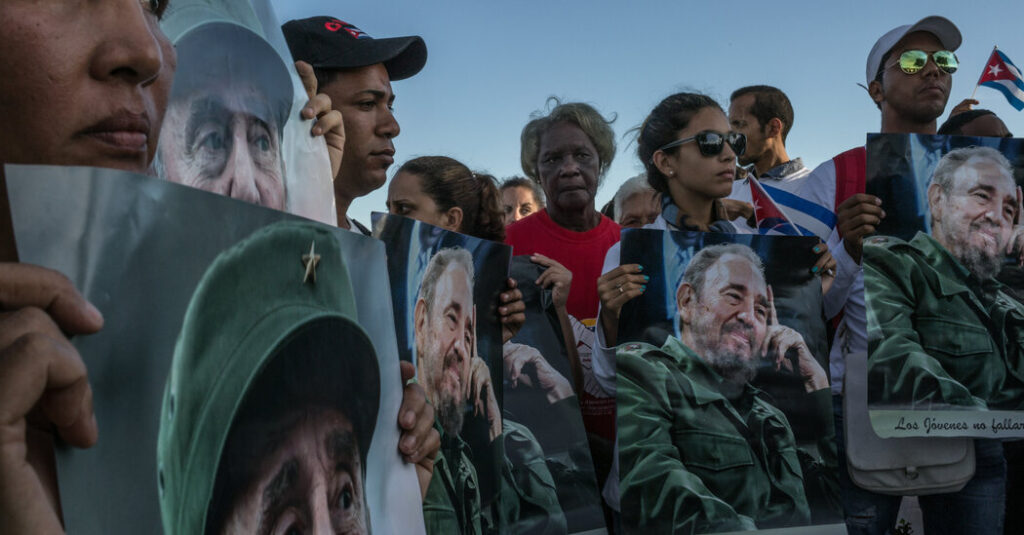
The Castros have shaped Cuba’s fortunes since 1959, when Fidel and Rául Castro, the sons of a wealthy sugar plantation owner, led the revolution that toppled an old order aligned with the United States. They moved Cuba into the Soviet orbit, turning the Caribbean island into a central player in the Cold War.
Fidel Castro, who died in 2016, was the Cuban Revolution’s charismatic “Maximum Leader.” Raúl Castro long maintained a low profile, acting as the main liaison with Moscow and the revolution’s organizational architect, prioritizing bureaucracy, clear hierarchies and administrative efficiency.
The Castro brothers faced many challenges to their rule, including C.I.A. assassination plots, a decades-long U.S. embargo and the collapse of the Soviet Union, once Cuba’s main benefactor. Venezuela had replaced the Soviets, becoming Cuba’s top oil supplier, until U.S. forces captured Nicolás Maduro in January.
Now, with the U.S. ordering Venezuela to halt oil shipments to Cuba, the family faces what may be its greatest challenge: a fuel shortage that has Cuba’s economy teetering, raising questions about the survival of the island’s repressive Communist government.
The U.S. fuel blockade is intended to produce a regime pliant to U.S. demands, similar to the way Venezuela shifted from adversary to client state with the removal of Mr. Maduro.
Mr. Rubio, referring to Cuba, said this month that “the people in charge, they don’t know how to fix it, so they need to get new people in charge.”
Replacing the Castros, if that is what the United States desires, is a tall order.
Raúl Castro, who is said to remain lucid and in relatively good health for a man his age, presides over the family. Since stepping down in 2018, his prestige and power remain rooted in his status as Cuba’s most powerful military figure. As defense minister under Fidel Castro, he oversaw the creation of GAESA, a sprawling military-run business conglomerate that is Cuba’s most important economic force.
Raúl’s children and grandchildren have more prominent official roles in today’s Cuba than Fidel’s descendants, one of whom is an Instagram celebrity known for flaunting a life of luxury in Havana.
One of Raúl Castro’s grandsons, Raúl Guillermo Rodríguez Castro, 41, has emerged as a new player in the crisis. Known as Raúlito, he is also called “El Cangrejo” — the Crab — a reference to being born with six fingers on one of his hands.
Mr. Guillermo Rodríguez has been part of his grandfather’s security detail, but these days mostly serves as his personal aide. He was once a fixture in Cuba’s elite social circles, hanging out with popular musicians such as the Charanga Habanera, who attended his 2008 wedding at an elite military club.
Now Raúlito also has a role as a messenger in the negotiations with the Trump administration, meeting with Mr. Rubio’s team at a recent event in St. Kitts and Nevis where Caribbean nations had convened.
Stunning those who had grown accustomed to his operating behind the scenes, Raúlito appeared this month on state television sitting alongside the regime’s highest-ranking members when Mr. Díaz-Canel disclosed the talks with Washington.
Raúl’s only son, Alejandro Castro Espín, 60, is also resurfacing after largely disappearing from public life when his father stepped down as president. An engineer educated in the Soviet Union and a brigadier general in Cuba’s army, he has held leadership roles in Cuba’s intelligence apparatus and has written books critical of the United States such as “The Empire of Terror.”
Now General Castro Espín is also taking a leading part in the talks with U.S. officials, according to news media reports.Such a role is not new for him; in 2014 he led Cuba’s side in secret talks with the Obama administration that produced a brief thaw in relations with the United States.
Another Castro family member suddenly rising in prominence is Óscar Pérez-Oliva Fraga, 54, a soft-spoken engineer and grandnephew of Raúl and Fidel Castro. He is currently Cuba’s deputy prime minister and minister of foreign trade and foreign investment.
Mr. Pérez-Oliva leaped into the spotlight this month after announcing potentially one of the biggest policy shifts since the Castros seized power in 1959: allowing Cuban exiles to own businesses and invest in Cuba.
That showcased Mr. Pérez-Oliva as a public face of the regime’s survival strategy. It also ignited talk about whether he could be the Cuban version of Venezuela’s new Trump-friendly leader, Delcy Rodríguez, a younger insider more amenable to the United States who can speak the language of international business and yield to Washington’s demands.
Those attributes, along with not having “Castro” in his name, could make him palatable to an administration in Washington that prizes regime compliance over regime collapse, some political analysts say.
At the same time, his family ties could allow him to shore up political support among those within Cuba’s power structures who view the Castros as a source of stability and revolutionary legitimacy.
Mr. Pérez-Oliva Fraga’s recent appointment as a deputy in Cuba’s National Assembly is also viewed as a calculated move, since under Cuban law only deputies can be president, some experts said.
“Maybe he has a future,” said Brian Latell, a former C.I.A. analyst and Cuba expert, said of Mr. Pérez-Oliva. “The Cubans are not without leverage. Trump doesn’t want a societal breakdown on his watch.”
The involvement of so many Castros in the regime’s survival strategy underscores one of the Cuban Revolution’s contradictions: While its Communist leaders sought to create a classless, egalitarian society, many of them become members of an elite class.
Castro offspring were among the most privileged members of this new ruling class, whose members often studied at high schools like the Lenin Vocational Institute, once the crown jewel of Cuba’s revolutionary educational system, or socialized at venues like the Club Habana, originally the pre-revolutionary Havana Biltmore and Country Club.
Still, the possibility of the family at the helm of Cuba’s authoritarian political system retaining its power would disillusion many Cuban exiles in the United States. Some have been pushing for decades for the Castros to be completely sidelined, along with erasing any Communist influence in Cuba.
The Castros are known as shrewd negotiators, extricating themselves from tough spots in the past, said Ricardo Zúniga, a former U.S. official who helped broker former President Barack Obama’s opening with Cuba and also served under President Trump.
The Obama talks took 18 months, partly because the meetings were held in secret, mostly in Canada, and the negotiating teams were tiny.
Those expecting a Venezuela-style outcome in Cuba could also be surprised. Venezuela’s political elite, divided into camps with different economic objectives, was relatively fractious before the capture of Mr. Maduro, making it easier for Trump officials to settle on someone like Ms. Rodríguez, a technocrat who had already introduced market-oriented reforms aimed at improving Venezuela’s economy.
Cuba’s elite, in contrast, is far more cohesive after decades of purges and counterintelligence operations that detected even the smallest signs of dissent. Members of the Castro family have consistently benefited from this system.
“There’s no opposition waiting on the wings and no one like Delcy,” Mr. Zúniga said. Even amid so many challenges, that crucial difference could strengthen the Castros’ hand as they explore ways to hold onto power.
“The elements are in place,” he said, “where you could imagine them trying to transition from a revolutionary oligarchy to a capitalist oligarchy.”
Simon Romero is a Times correspondent covering Mexico, Central America and the Caribbean. He is based in Mexico City.
The post With Cuba Under Pressure, the Castro Dynasty Is Making a Comeback appeared first on New York Times.