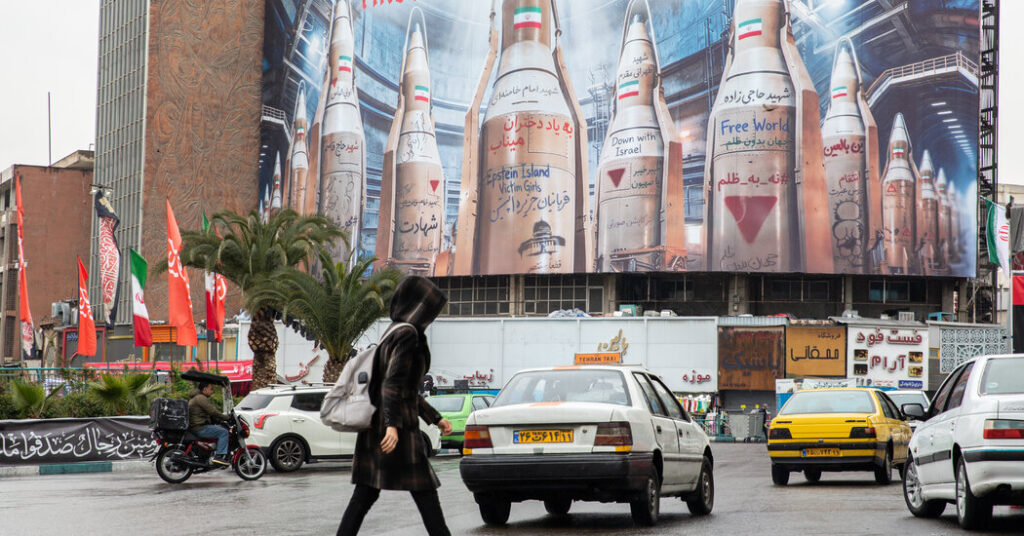
The videos and posts relentlessly mock President Trump or vilify him and as a bloodthirsty leader who strikes civilian targets indiscriminately. They make up content about attacks on American and Israeli targets, including one on Wednesday that featured a fabricated video of a missile striking Liberty Island in New York Harbor. They regularly mention Jeffrey Epstein.
Iran is waging what researchers have described as a sophisticated information war, aided by Russia and China, that is spreading content designed to exploit worldwide opposition to the U.S.-Israeli military campaign and deflect from the country’s considerable losses on the battlefield.
Nearly a month into the war, Iran’s state media outlets and covert operatives are producing a steady torrent of propaganda, overstated narratives and outright disinformation. They are often wielding generative A.I. tools to create increasingly realistic-looking images and videos, according to human rights organizations and research groups studying foreign influence.
Much of the false content has been debunked, but not before reaching millions of people on X, Bluesky, Facebook, Instagram, TikTok and other social media platforms.
The information war, the researchers say, has given Iran’s beleaguered leadership a weapon almost as potent as its ability to disrupt the world’s energy economy by throttling shipments of oil through the Strait of Hormuz. While the impact of the information war can be difficult to measure, experts said it appeared to have stoked popular anger and unease about the conflict in the United States and beyond.
“They’re winning the propaganda war,” Darren L. Linvill, a director of Clemson University’s Media Forensics Hub, said of the Iranians. “They were prepared for it more than the administration, because they’d been preparing for this entire conflict for 50 years.”
With the internet largely shut down inside Iran, the intended audience appears to be people outside the country.
Many of the posts appear to come from accounts controlled by humans, rather than automated bots. Researchers at Clemson identified a furtive network of at least 62 accounts on X, Instagram and Bluesky that spread pro-Iranian content.
The accounts, controlled by the Islamic Revolutionary Guards Corps, set up accounts purporting to be Spanish-speaking users in Texas, California, Venezuela and Chile and English speakers in England, Scotland and Ireland.
In some cases, the content they shared had been lifted verbatim from posts published by real people, including prominent Western influencers like Jackson Hinkle and Mario Nawfal, who each have millions of followers on X and are known for incendiary commentary on foreign affairs and conservative issues.
Another campaign focused on a March 18 interview by Tucker Carlson with Joe Kent, the former director of the National Counterterrorism Center who resigned in protest of the war, according to a report by Honest Reporting, a nonprofit advocacy group that critiques news reports it deems critical of Israel.
First, RT, the Russian television channel, posted a clip of the interview in which Mr. Kent portrayed the attack as unjustified aggression. From there, dozens of accounts spread the same clip almost simultaneously.
“This was not simply organic virality,” the group said. It added, “Actors with varying ideological positions aligned almost immediately around a single, highly specific message: that Israel had manipulated the United States into war.”
Iran has also seized on Mr. Trump’s erratic statements and taken advantage of the weakening of American government and corporate guardrails that once sought to counter false or misleading information.
One video fabricated with A.I. and posted on Instagram by SSN TV, an Iranian state network, ridiculed Mr. Trump’s inability to persuade American allies to provide military help to keep the Strait of Hormuz open to oil tankers. The video includes fakes of President Vladimir V. Putin of Russia and Kim Jong-un of North Korea laughing while listening to a rap song.
“Trump’s inability to do alliance management or coalition building before this war sort of started the fire, and Iran’s disinformation campaigns are just pouring gasoline on that,” said Jonathan Ruhe, an analyst at the Jewish Institute for National Security of America, an advocacy organization based in Washington that supports strong ties between the United States and Israel.
The American military has sought to debunk false claims, including another this week that falsely said Iran had downed an F/A-18 fighter jet. Social media platforms have also moved to take down some obviously fabricated videos.
Even so, more continue to circulate, including content that Mr. Trump and other American government accounts have posted using A.I.-generated content and misleading narratives.
Russia and China, which have close relations with Iran and share a disdain for the unchecked use of American military power, have in turn sharply criticized Mr. Trump’s decision to attack. They amplified Iran’s propaganda and produced their own, according to the researchers.
Although neither country has openly provided direct military support to Iran, influence operations in both countries have worked at times in a seemingly coordinated fashion, according to Graphika, a company that analyzes content online.
Its researchers have documented numerous instances in recent weeks when Russian and Chinese state media or known covert influence operations amplified narratives that Iran has pushed — and vice versa. They have highlighted Iran’s ability to block the Strait of Hormuz and claims that the war was started to distract from the release of files related to Mr. Epstein and his crimes.
Iran’s strategies have been extensively cataloged by social media watchdogs since the war began. Researchers at Graphika described a “travel chain of narratives” that spread from node to node: Iranian state TV airs a misleading broadcast, which is picked up by online influencers who then create A.I.-generated media that Chinese- and Russian-linked bot armies help give wide circulation.
The effort, the company said in a note to clients, “likely aims to normalize support for escalation, shifts blame onto external actors and bolsters the perception of Iran as a victim, justifying defensive or retaliatory stances.”
Cyabra, a social media monitoring company, found that Iran had activated hordes of phony social media accounts to push a message of Iranian dominance on the battlefield, earning 145 million views in the first two weeks of the war.
TikTok accounted for 72 percent of those views. Accounts on TikTok with tens of thousands of followers shared A.I.-generated fakes, including dozens of videos of fake attacks on Israel. The company did not respond to a request for comment.
Cyabra also found evidence that the efforts were the result of “clear coordination” and a “structured campaign” by Iran, citing as evidence the use of recurrent content and hashtags, alongside rapid bursts of posts that appeared online over short periods.
“These tactics allowed the network to rapidly flood the information environment and dominate online discussions during key moments of the conflict,” the company wrote.
Steven Lee Myers covers misinformation and disinformation from San Francisco. Since joining The Times in 1989, he has reported from around the world, including Moscow, Baghdad, Beijing and Seoul.
The post In an Asymmetrical War, Iran Seeks an Edge With Its Information War appeared first on New York Times.