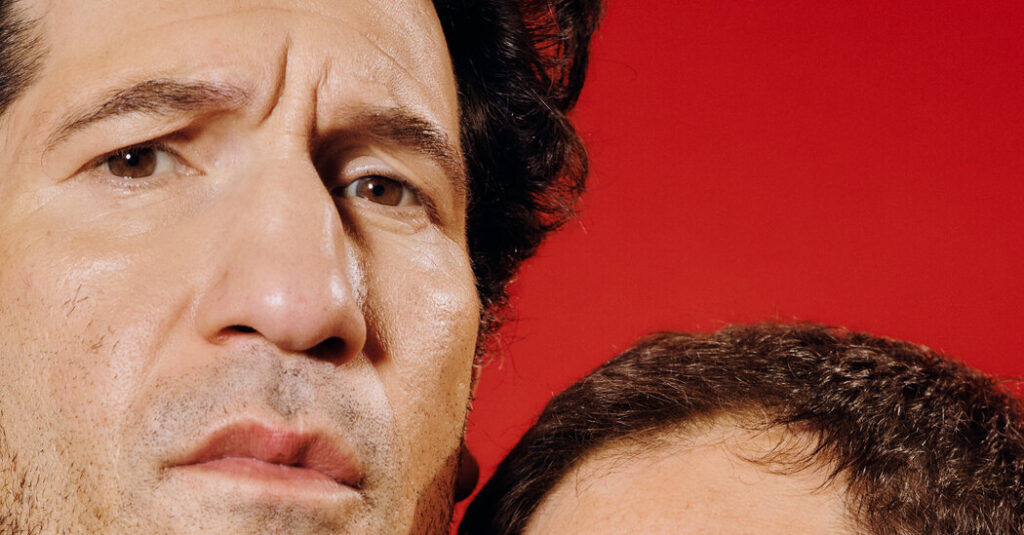
The first thing to know about sharing space with Jon Bernthal and Ebon Moss-Bachrach, two real-life friends who are playing the star-crossed bank robbers Sonny and Sal in the Broadway adaptation of “Dog Day Afternoon,” is that they are not the type to sugarcoat. They are polite and genuine, of course, but no plummy niceties, no slickness.
If things are going to get messy — as they do here and in Sidney Lumet’s 1975 heist classic — they are going to dig into it. Egg each other on, even; pull each other through.
Their faith in each other is “absolute,” the actors agreed during an interview this month at a lounge above the August Wilson Theater, where the show opens on Monday. Good thing, too, because bringing this work to life, reverent yet original, was taking its toll.
Bernthal sat in a tensed fighter crouch, his hoodie pulled up over a watch cap. Moss-Bachrach sunk down in a rumpled henley. Production was testing audio effects as we talked: a chopper, city traffic, a sound bed of frenetic tension beneath our conversation. “There’s nobody I’d rather go to battle with,” Bernthal said fervently of his co-star. And “if we do go down,” Moss-Bachrach said, laughing, “it’ll be spectacular.” (The second thing to know about them is that — their comparable approach to acting aside — they are quite different.)
Bernthal and Moss-Bachrach, both 49, have known each other for more than a decade, and are frequently partnered onscreen, most notably as lifelong compadres in “The Bear,” the FX series which has won them both Emmys. “Dog Day Afternoon,” adapted by the Pulitzer Prize-winning playwright Stephen Adly Guirgis, is their Broadway debut. A few weeks ago, before previews started, they were terrified and enthralled by the gig, in more or less equal measure. Not much changed when they got an audience.
“There’s a huge level of audacity to try to take it on, and that’s not lost on us,” Bernthal said.
Nor is it on Guirgis, who when I talked to him, had just pulled an all-nighter doing rewrites, wrenching monologues “to the bone,” he said, while also suffusing the play with all the ’70s atmospherics that still resonate now — the economic malaise, political and social unrest, and the divisive power of the news media.
“It becomes a crass commercial venture if you’re bringing something back, and it doesn’t have something to say about where we are today,” said Guirgis, a born-and-bred New Yorker and a master of depicting the city’s rickety-yet-enduring ensemble lives, like in his Tony-nominated 2014 drama “Between Riverside and Crazy.”
“Dog Day” is his first adaptation, and undergirding it all is a queer romantic story line that even audiences familiar with the movie may not remember (as evidenced by the gasps from preview crowds when it’s revealed onstage). The British director Rupert Goold, a Tony nominee for “King Charles III” and “Ink,” is treating the material as a propulsive and evolving new play — “we’re constantly setting fire to the edges of it,” he said — but one that its cast and creators contend is about love. Or as John Ortiz, a frequent Guirgis collaborator who plays a police detective, put it: It’s about “how much of a weapon love can be.”
The movie, which won an Oscar for Frank Pierson’s screenplay, dramatizes a real-life bank holdup in Brooklyn that went tragically awry. A Life magazine article from 1972 captured the scene: the pulsing crowd of onlookers that formed as bank tellers became hostages; street-side negotiations and the standoff with the police; the unexpected love triangle of a perpetrator who, the article slyly noted, had “the broken-faced good looks” of Al Pacino. Three years later, Pacino made an indelible impression onscreen as Sonny, fitful yet commanding on that sweaty August day, opposite John Cazale as his loner partner-in-crime, Sal.
What it means to be a man, and how to be a devoted friend, someone who looks out for others before themselves, are central questions of “Dog Day Afternoon,” especially in Guirgis’s version. Is someone who hides his identity — whether it’s a bank robber, or a closeted husband — a coward? Does it matter if he cares for his victims, or plans to use the loot for gender-affirming surgery for a lover? What is the price of loyalty?
The answers are complicated. “Nothing’s wrapped up in a bow in this story,” Bernthal said.
Bernthal was clear on one point, that Sonny belongs in the same league as some of the hypermasculine bruisers (“The Accountant” movies; “The Walking Dead”) and brooding superheroes (“The Punisher”) that have become his signature. The character is a veteran, a defender who’s willing to stand up for himself and his beliefs — personal and political — at a monstrous cost. He is maligned in his time “because of the way that he loves and who he loves,” Bernthal said, with a pleading outrage. “The wound of that!”
Moss-Bachrach’s Sal is even more of an outlier, searching for any recognition of his humanity. Right now, “a lot of us feel powerless, disenfranchised a little bit, scared of what people in positions of power are doing,” Moss-Bachrach said. “This play is about little guys trying to show up and be heard.”
THE DEVELOPMENT PROCESS BEGAN a decade ago, at Warner Bros., which owns the rights. “I loved the fact that it was a gritty New York story that still felt so relevant years later,” said Mark Kaufman, the company executive who oversees its theater ventures. (His other Broadway credits include “Beetlejuice” and “The Lost Boys” musical.) The singular location for “Dog Day,” inside and outside a bank — the revolving set, by David Korins, is rendered in period beige and rust — also made it an easy sell for theater.
Kaufman pitched it to Guirgis, who once described his oeuvre as “stories about people in pain in New York,” but who also has an unparalleled ear for the rhythm and comedy of urban life, and a blunt style himself. As Guirgis recalled it, his initial reaction to putting this cinematic masterwork onstage was: “This sounds stupid.”
Still, Kaufman’s enthusiasm won him over, he said, and he left the meeting thinking, “If somebody is going to screw this up, why shouldn’t I be the one to take a crack at it?”
The relationship between Guirgis and Kaufman took a turn recently, and last week, the playwright was briefly barred from rehearsals at the theater, after the two had a heated argument. “The process of creating and producing a new play is always a passionate one,” the production and Guirgis said on Wednesday in a joint statement, after they had made amends, and Guirgis returned to the fold.
In the years of writing and revising, Guirgis and his collaborators had wrestled with the play’s tone, which swings from rat-a-tat comedy to tense drama.
“It is an act of violent crime,” Goold said in an interview earlier this month. “But it’s also complete bozos who robbed the bank. How funny can this get before we lose sight of its danger? How political can it be before it becomes didactic?”
Guirgis said he thought of it as a genre piece — suspenseful. Onstage, “the clock is ticking,” he said. “That’s something that’s been a good challenge for me.”
Ortiz, a college classmate of Guirgis’s, is a co-founder of the Labyrinth Theater Company, a downtown troupe where he and Guirgis, along with Philip Seymour Hoffman, spent the early 2000s making acclaimed plays like “Our Lady of 121st Street.” Ortiz grew up striving in Brooklyn’s Bedford-Stuyvesant neighborhood. “I was definitely on the have-nots of things in the ’70s,” he said. Putting that onstage, “it’s just really juicy.” (The movie, he said, captured the divide in its opening montage of rooftop pools and trash-strewn streets.)
In the play’s years of development, many actors read for Sonny (including Ortiz). But when Bernthal arrived, at a festival workshop in Ojai, Calif., where he lives, “everybody — women, men, children, even the birds were like, ‘Bernthal! Bernthal!’” Guirgis said. Bernthal, in turn, beckoned Moss-Bachrach. The cast also includes Broadway veterans like Jessica Hecht as the chief bank teller, in an expanded part, as Guirgis aimed for “a real ensemble piece.”
The connection between Sonny and Sal still forms a crux of the story; in this version, they met at a West Village gay hangout in the wee hours. They are each others’ end-of-the-line friends.
Moss-Bachrach and Bernthal could be that for each other, too: They are both fathers, in enduring marriages, who bounced from theater to screen and found success later in their careers. But theirs is not a kinship of shared hobbies or even personalities. “I would never do the things that he does,” Bernthal said.
“Jon’s a pugilist,” Moss-Bachrach noted, with the broken noses to prove it. “And I’m a baker.”
They playfully needle each other, for sure. Bernthal gleefully described how, in what would have been their first encounter, Moss-Bachrach was not aware that Bernthal was his understudy in a play, an Off Broadway revival of Lanford Wilson’s “Fifth of July” in 2003. (“I spent a lot of time just existing invisibly for Ebon,” Bernthal said.) They became friends making “The Punisher,” the 2017-19 Marvel series on Netflix, where Bernthal was the vigilante of the title — “it became so personal to him,” Moss-Bachrach said, praising his “relentlessness” — and Moss-Bachrach was an N.S.A. agent-turned-reluctant partner. “He’s like a jazz musician,” Bernthal marveled. “He always comes from some sort of side angle that’s so truthful, and cuts deeper.”
Goold and Guirgis talked about how Bernthal’s surface toughness is readily punctured with vulnerability. In drama theory, Goold said, his acting is very close-range, and Moss-Bachrach’s performance holds a reserve. “Ebon is sweet and super intelligent, but he has a little edge to him, and he doesn’t necessarily turn it off to make other people feel comfortable,” Guirgis said. “It’s a good dynamic.”
In the movie, Sonny and Sal’s back story was not prominent — “the script was very succinct,” Robert Greenhut, an associate producer, recalled — but Pacino and Cazale, who had worked together on plays and the first two “Godfather” films, were also tight offscreen.
Likewise, Bernthal and Moss-Bachrach are leaning on each other as they wind through the process of creating a living, breathing, sometimes frazzling Broadway production. “Fear is a good inspiration,” Moss-Bachrach said.
There’s terror in the leap the characters make when they risk everything for what they believe is right. And exhilaration in the calculation of what makes something worth trying.
The moment is raw. The approach could be too. “We’re not polished,” Bernthal said. “We have to just be courageous enough to fall flat on our face. That is who we are.”
Melena Ryzik is a roving culture reporter at The Times, covering the personalities, projects and ideas that drive the creative world.
The post How Two Stars of ‘The Bear’ Turned to Robbing a Bank … on Broadway appeared first on New York Times.