Robert Poole is the director of transportation policy at Reason Foundation.
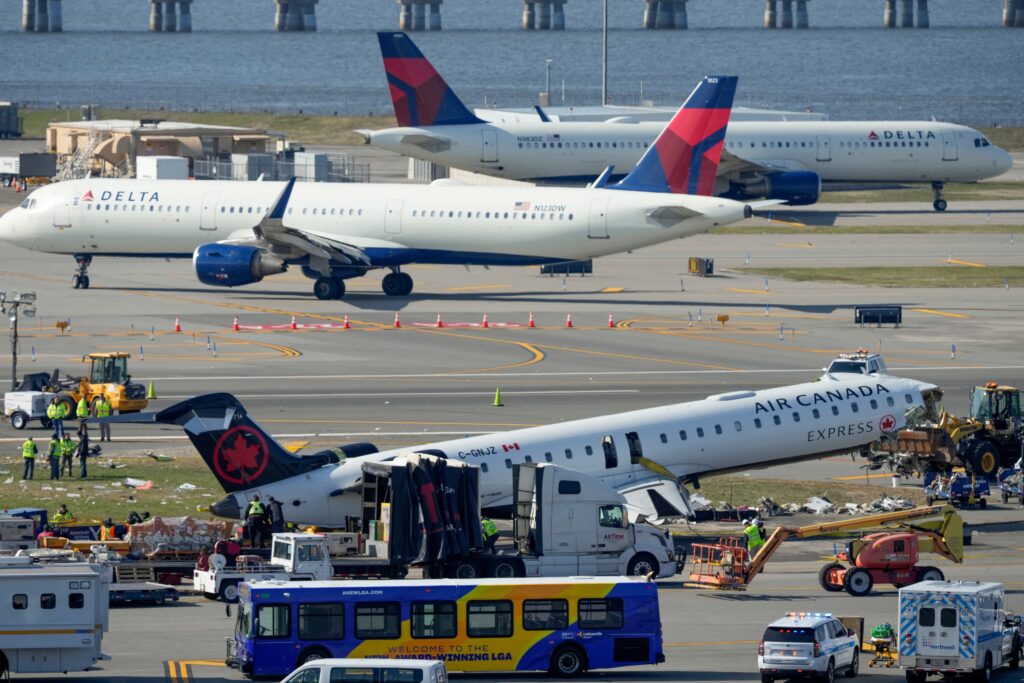
Americans awoke to another air traffic tragedy this week. At around 11:45 p.m. Sunday, an Air Canada Express passenger jet landed at LaGuardia Airport and collided with a rescue truck. Both cockpit crew members died, and dozens of passengers were injured. While it will be some time until the National Transportation Safety Board can analyze the collision and identify its causes, some relevant factors are worth noting.
Runway safety is perhaps the highest priority for the Federal Aviation Administration, the industry’s regulator. In addition to adding various lights and signs, years ago the FAA installed at 35 of the busiest airports a system called the Airport Surface Detection System, Model X, or ASDE-X. LaGuardia was among the recipients.
The ASDE-X is meant to monitor runway activity and provide warnings to air traffic controllers of any potential hazard. It gathers data from multiple sources to track all vehicles on an airport’s surface. It then fuses data from those sources to give controllers a multicolor display of all the runways and taxiways in real time. Based on public recordings, the system was operating on the evening of the collision. What happened?
As a retired FAA systems engineer who helped design the ASDE-X explained to me, the basic collision warnings and alerts are adjustable by technical staff and controllers. In some previous collisions, controllers had apparently turned down the time and distance parameters to prevent false alarms that can be recorded as a controller not taking action. The same engineer noted that this was a factor in previous near misses, such as an Air Canada plane that nearly landed on a taxiway at SFO airport in 2017.
We won’t know for sure what happened in the LGA control tower until the NTSB investigates, but the above is a plausible speculation of how known shortcomings in the ASDE-X could have led to this terrible crash. From voice recordings, it appears that one controller was handling both the landing and ground traffic rescue vehicle. That can happen on night shifts — but regardless, the ASDE-X had the inherent capacity to prevent the collision and didn’t.
Controllers and air traffic researchers are familiar with the system’s limitations. Installing it at the 35 airports began in 2003, but LaGuardia was one of the last to receive it, in 2011. It was designed and tested in the 1990s, meaning it’s already past its realistic service life.
Some questions that need to be asked go beyond this week’s accident. Given the potential for collisions at airports, is older technology like ASDE-X the best we can do? When a new and better system is certified, why can it take more than a decade to be installed?
Part of the answer is that the FAA isn’t a state-of-the-art ATC provider. By my count, about 100 countries have reformed their operations over the past 39 years in ways the FAA hasn’t. Here are some of the most important differences:
- The ATC provider in those nations has been separated from the relevant transport agency and has since been regulated at arm’s length. The FAA, by contrast, is both the ATC operator and aviation safety regulator, a clear conflict of interest. Some years ago an ex-FAA administrator and I co-wrote a journal article comparing the FAA responses to airline safety glitches and ATC safety glitches, illustrating the uneven enforcement.
- These 100 ATC providers receive their revenue not from a legislative body but via user payments from their aviation customers: airliners and business jets. This offers a bondable revenue stream, allowing them to finance long-term large facility and equipment projects. The FAA, meanwhile, operates on whatever Congress chooses to give it each year, which hinders long-term planning.
- The 100 ATC providers can buy new technology in bulk and roll it out over a year or two to all ATC facilities. With the FAA’s annual appropriations from Congress, it takes the agency several years — if not decades — to install a handful of new systems each year. A current example: Adding non-paper flight stripsto airport control towers is proceeding at a snail’s pace.
A superior ATC system would require Congress to take a number of difficult steps that it rejected when the Clinton and Trump administrations proposed them in 1995 and 2017, respectively. The easiest yet most important one: Separate the Air Traffic Organization from the FAA, making the ATC provider a distinct entity within the Transportation Department. Doing so would abolish the FAA’s conflict of interest as the safety regulator and operator. To emphasize the new arm’s length relationship, the new ATC outfit could be housed separately from the FAA — say, adjacent to an ATC facility in Virginia. This change would be consistent with long-standing best practices from the International Civil Aviation Organization.
A useful follow-up would be for Congress to give the separated ATC provider direct user fees as its revenue source as well as the authority to issue revenue bonds. That would begin to fix the ATC system’s grossly inadequate resources for replacing ancient facilities and technologies.
To make these changes, legislators would have to get over two hurdles. First, a point of pride. The revisions would mean Congress losing its ability to micromanage what is in effect a high-tech service business. The upside is too great to pass up. Doing so would bring U.S. air traffic control up to state-of-the art organization and management, which it lags terribly behind.
Second, a rhetorical bogeyman. Congress would have to drop its concern that any reform would amount to “privatization.” Of the world’s 100 or so reformed ATC providers, only four are in some sense privately operated and managed. Nearly all are government utilities that are run as high-tech service providers, regulated at arm’s length by an aviation safety regulator.
We can and should do likewise.
The post What happened at LaGuardia Airport? appeared first on Washington Post.