Financial markets extended a sharp sell-off at the end of the week, hitting a new low for the year, as the Iran war continues to drive anxiety among investors, businesses and consumers about how long the turmoil will last.
The S&P 500, Nasdaq composite index and Dow Jones Industrial Average all finished the week lower, dropping sharply on Friday. The Nasdaq slid into correction territory Thursday, marking a drop of at least 10 percent from a recent peak, and fell more than 400 points Friday. The Dow entered correction territory on Friday, as well, falling more than 800 points. The S&P notched its fifth losing week in a row.
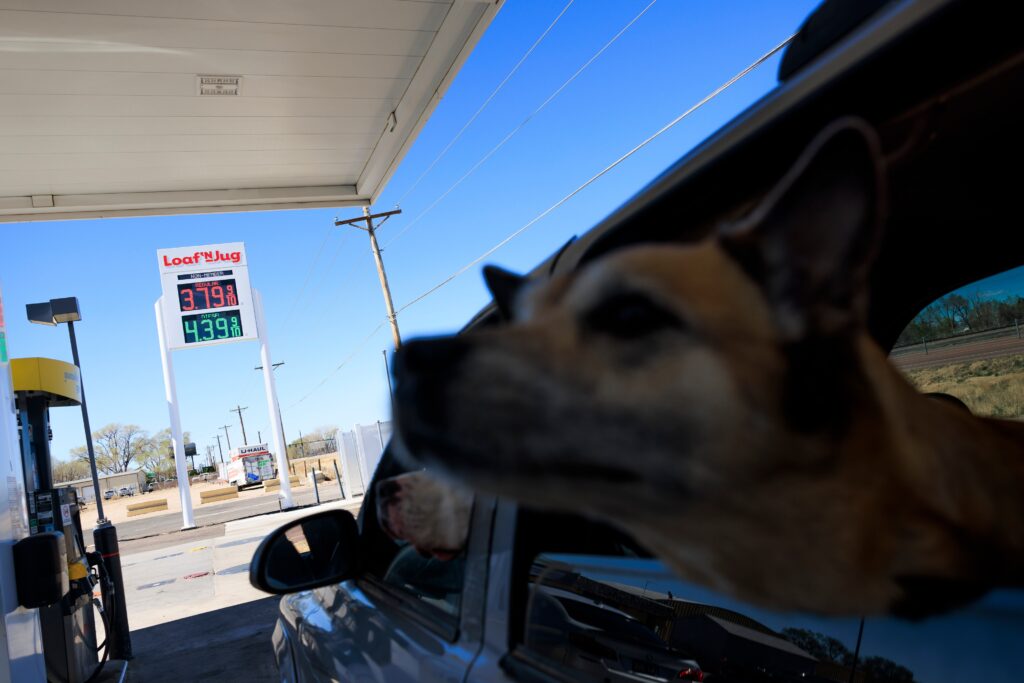
Investor concerns were driven by energy prices, with gas prices at the pump shooting up to a national average of $3.98, a dollar higher than a month ago. And prices are expected to worsen in coming days, with Brent crude oil prices, an international benchmark, above $113 a barrel Friday, up 50 percent from last month.
“The longer oil prices remain elevated, it’s going to be harder to avoid a bad economic outcome,” said Tom Porcelli, chief economist at Wells Fargo. If the increase in oil prices holds for the next several months, that economic headwind could cancel out the tax cuts and other stimulus that the Trump administration was counting on, he added.
Financial leaders around the world have begun to warn that the global economy is increasingly at risk from the ongoing conflict in the Middle East.
“We are facing a real shock that is probably beyond what we can imagine at the moment,” Christine Lagarde, president of the European Central Bank, told the Economist this week.
Americans are also feeling down about the economy. Consumer sentiment, a measurement of Americans’ economic perceptions, fell nearly 6 percent to its lowest level since December, according to a closely watched index from the University of Michigan.
Sentiment about the economy had been trending upward in the initial weeks of research, the survey’s early results found, but dipped significantly after the war in Iran began.
Uncertainty around the conflict also sent 10-year treasury yields — a key benchmark for mortgage rates — to their highest levels this year. Treasury yields tend to increase when investors fear inflation, and rising oil prices have raised fears of price increases across the economy. Mortgage rates, which had been easing, spiked to nearly 6.4 percent for a 30-year loan.
Experts had broadly expected mortgage rates to fall this year, allowing more potential buyers to enter the market. But average rates climbed for the fourth week in a row, according to Freddie Mac, hitting the highest level since early September. High home prices had already made some buyers wary of buying new homes.
The market sell-off came despite President Donald Trump’s extension of a deadline to attack Iranian energy infrastructure; previous signals by Trump he would defuse the conflict have calmed markets. But despite White House claims of diplomatic talks, the critical Strait of Hormuz, which connects the Persian Gulf to the Gulf of Oman, remains effectively closed to commercial marine traffic.
The strait allows shipping of the world’s oil and natural gas industries, serving as a conduit to move the products around the globe. About 20 percent of the world’s oil and natural gas shipments pass through the channel. Trump said Thursday that he has extended his earlier deadline for Iran to reopen the strait by 10 days, saying talks between the two countries are ongoing.
Fuel surcharges, or additional fees to cover the cost of transportation, are also starting to pop up — the U.S. Postal Service said this week it is adding an 8 percent fee on some packages.
The price of diesel has also spiked; the fuel is used to transport goods around the country. That could eventually lead to higher prices on shelves, said Rebecca Babin, a senior equity trader at CIBC Private Wealth.
“If trucking costs more, it eventually gets passed through to consumers,” she said.
It generally takes about six weeks for these spikes to show up in food prices at grocery stores, said Diane Swonk, chief economist at KPMG. She cautioned that what Americans are seeing at the pump is only the beginning of the effects. Shipping costs and import prices are also affected, including prices on goods such as aluminum, which was already suffering from shocks caused by tariffs.
The disturbances are not as significant as those seen in the early years of the pandemic, but they are still difficult, she said.
“History often doesn’t repeat, but it rhymes,” she said. “It’s not just an energy shock, it’s a larger shock that has ripple effects.”
Small businesses are already feeling hits from tariff uncertainty, and adding in the war and energy crisis are making them especially wary. Christy McInnis, president of Construction Sales and Service in the Florida Panhandle, told The Washington Post she wants to believe things will work out.
“But the hit that we’re taking, as an agriculture equipment dealer and outdoor power equipment dealer, is heavy right now,” she said.
All of these creeping price increases have made Americans’ confidence in the economy falter. The University of Michigan’s survey found that middle- and higher-income wealth consumers saw especially large drops in sentiment. Americans felt uneasy about short-term economic prospects and their personal finances for the year, but drops were more measured for long-term expectations.
“These patterns suggest that, at this time, consumers may not expect recent negative developments to persist far into the future,” Surveys of Consumers Director Joanne Hsu wrote in Friday’s report. “These views are subject to change, however, if the Iran conflict becomes protracted or if higher energy prices pass through to overall inflation.”
The Federal Reserve left interest rates unchanged earlier this month despite Trump’s calls for a cut as the Iran war added economic uncertainty.
Andrew Ackerman contributed to this report.
The post Financial markets fall to new 2026 low as oil rises again appeared first on Washington Post.