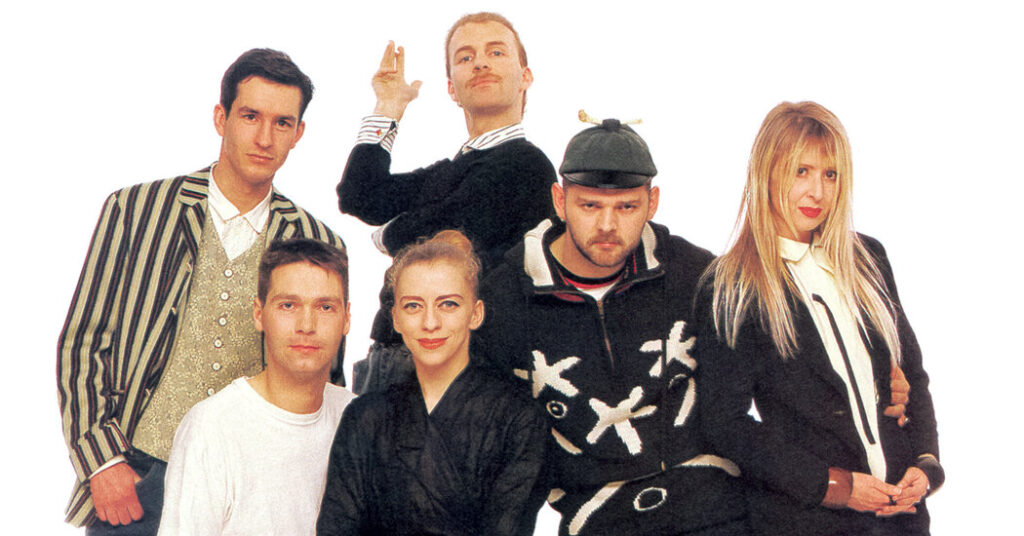
In 1986 six graduates of the Royal Academy of Fine Arts in Antwerp pooled their money, rented a camper van and drove to London to set up some booths at the British Designer Show, a precursor to London Fashion Week.
No one could pronounce their names, which also happened to be the names of their fashion labels — Ann Demeulemeester, Walter Van Beirendonck, Dirk Bikkembergs, Dries Van Noten, Dirk Van Saene, Marina Yee — so reporters there to write about what was new called them the Antwerp Six.
What the Six shared wasn’t a look. The clothes they made ranged from the romantic goth (Demeulemeester) to the pop conceptual (Van Beirendonck), the painterly subversive (Van Noten) and the camp athletic (Dirk Bikkembergs). It was, rather, an age group, an alma mater and an attitude: D.I.Y., anti-glamour, determinedly independent. They were six different designers with six novel propositions about how people might want to dress, which had more to do with upheavals in culture and society than mores and the status quo.
And they changed fashion. Because of the Antwerp Six, Belgium became known as the center of fashion creativity. Because of them, would-be designers from all over the world went to Belgium to be trained. Because of them, chief executives of fashion brands started looking for Belgian schools on the résumés of the creative directors they hired.
In fact, most of the power players of the fashion world have a lineage that can be traced directly back to the Antwerp Six.
Specifically: the current creative directors of Gucci, Chanel, Versace, Tom Ford, Marni, Saint Laurent, Maison Margiela, Prada, Diesel, Balmain and Rabanne all came through the Belgian school system or the Belgian mentorship system, or both.
They are all part of what Kaat Debo, the director of MoMu, the fashion museum in Antwerp, calls “the Belgian diaspora,” whether they were originally Belgian or not.
“It’s what Demna said,” Ms. Debo went on, paraphrasing the creative director of Gucci, who is also a graduate of the Royal Academy of Fine Arts: “I was born in Georgia, but I was born as a fashion designer in Antwerp.”
How that happened and why it still resonates today is made clear by a new exhibition entitled (of course) “The Antwerp Six,” which opened this weekend at MoMu. It is the first show to reunite the Six, who generally resented being lumped together and were initially reluctant to participate when approached two years ago by the exhibition’s curators: Ms. Debo; Romy Cockx, a curator at MoMu; and Geert Bruloot, a founder of the Antwerp boutique Coccodrillo, which stocked designs by the Six.
(To be fair, there was a seventh member of the original Antwerp designer generation, perhaps the most influential of all: Martin Margiela. He attended the Academy of Fine Arts and dated, and was inspired by, Marina Yee, but he went to Paris before any of the others and resisted being categorized with them — or anyone else, for that matter. When asked to be interviewed for the MoMu exhibition catalog, he declined because he felt the story was not his to tell.)
Thus the show functions as both celebration and interrogation. As Raf Simons, a member of the second Belgian generation, a former intern for Walter Van Beirendonck and now the co-creative director of Prada, said, the original lesson of the Antwerp Six was that the goal should be to “make our own system.” Instead, the existing fashion system took note and then swallowed its progeny whole.
That is why, even though the Six exhibited as a group for only three years before they went their separate ways, that time has become more than a moment in history. It has become myth. Myth that represents the promise, and potential, of a once — and possibly future — fashion world.
What’s in the Water?
“People always ask, ‘Is there something in the water in Antwerp?’” Ms. Debo said. “Why was this possible?”
In some ways, the exhibition is an attempt to find an answer. It begins by setting the scene of the late 1970s and ’80s in Antwerp and beyond — in London, where Vivienne Westwood and Malcolm McLaren were shaking things up, merging the music scene with fashion; in Paris, where Rei Kawakubo and Yohji Yamamoto had upset the very polished couture apple cart.
Some of the conditions were specific: the influence of a professor who was a stickler for the most traditional fashion skills, creating conditions ripe for rebellion; the luck of having a government determined to boost local manufacturing by putting money into fashion education; the unexpected benefit of coming from a country where there was no tradition to overcome because there was no pre-existing style identity.
And some of it was environmental: a sense of alienation from the big shoulders, poof skirts and unabashed ostentation that had become the look of the 1980s. Instead, the Six dreamed of clothes that could be an antidote to all that; that weren’t retro and weren’t garishly go-go; that had a certain gritty or even cartoonish truth.
“You could start from zero,” Ms. Demeulemeester said. “You just had to make sure your work had meaning. You had to add something.”
What exactly the Six were adding is clear in the show, which features six separate galleries, each curated by the individual designers in collaboration with MoMu (including Ms. Yee, who had pivoted to art but died in December just before the show was finalized). Thus, Mr. Van Beirendonck’s room features his face projected onto a mannequin standing amid a sea of other mannequins wearing his Pop Art creations and facing an alien robot character known as Puk Puk that often played a role in his collections.
Mr. Bikkembergs’ room is papered with images of his first store, which was entered through the imaginary apartment of a soccer player decades before fashion and football became a thing. And Ms. Demeulemeester’s room is black with 20 mannequins wearing all black clothing from two decades of her career.
“It was a different view on fashion and how to make fashion and how to sell fashion,” Mr. Van Noten said of the group’s way of thinking.
And it worked in part because of the proliferation of multibrand boutiques that were discovering and supporting new talent, chief among them Barneys New York, which bought the collections of the Six when they first exhibited in London.
“That meant that they had a selling point in New York,” Mr. Bruloot said, “so they had press coverage in the United States.” So they could start building their businesses, which they did slowly, over time.
Ms. Demeulemeester didn’t have her first show until she had been in business for 10 years. They all shunned celebrities, precollections and any advertising at all. They used their shows as advertisements. Mr. Van Noten’s gallery is covered in video screens displaying the finales of collections over the years because, he said, that was how he told his stories through clothing.
Yet as disparate as the Six were, Mr. Simons said, they left one shared legacy for those who came after: a new “model for being an independent designer.”
When Mr. Simons, who had studied industrial design, finally decided to start his own label after working for Mr. Van Beirendonck, he was not scared. “I saw how they did it,” he said. “You make some stuff, you show some people. If it’s interesting, you can go to Paris and set up somewhere independently. There wasn’t a system or a structure. It was: Try to make great pants that aren’t around yet.”
And if you can’t afford to do it alone, you get together with some friends, pool your resources and see what happens.
A Different Way to Do It
“We had the luxury of inventing something,” Ms. Demeulemeester said.
Whether that is possible in the current fashion world is debatable. “The problem is, it’s very dominated by business and rules,” Mr. Simons said. “The audience has to be this, dress this one, shoot that one.” Many outlets, like Barneys, that once supported new designers are no more.
The next generation of Belgian designers generally followed the Antwerp Six in starting their own labels. Demna created Vetements, Mr. Simons his namesake line; ditto Haider Ackermann, now creative director of Tom Ford and a former student at the Royal Academy. But as the designers were increasingly tapped to run megabrands, those small, independent lines became less and less tenable, and many are now closed.
It is thus possible to see the MoMu show as a relic of a bygone era, if you are taking it literally, or as inspiration if you see it conceptually.
“We don’t have the answers,” Ms. Debo said. What the museum wanted to do, she said, was to “create a platform for dialogue.”
The idea, she said, was to ask, “What’s the future of independent fashion design? What’s the future of this industry? What do we actually show the consumer? What is fashion week? The Antwerp designers operated from the periphery. We all know that we need innovation in our industry. But who will bring the innovation?”
What is clear is that there is an appetite for the conversation. “We are a bit overwhelmed by all the attention we are getting from all over the world,” Ms. Debo said. “There are students from Mexico City messaging me, ‘I saved for my tickets to come to Antwerp.’ I got a note from a teacher in Brazil.”
Mr. Van Noten said he had always been a little confused by why “all those young people were so interested, or sometimes obsessed, about the Antwerp Six.”
“But now I understand it more,” he said, “because for them, it’s not really nostalgia.” It is rather, he said, the possibility he and his former compatriots represent of doing things a different way.
“The core of the Belgian fashion movement was all individuals with their own collection under their own name,” he said.
After all, even as the Six became more established, most of them rejected the opportunity to join other houses, despite the support and resources (and money) involved. “At one point one of those big houses” — she would not say which one — “asked me if I would like to make haute couture,” said Ms. Demeulemeester, who sold her brand in 2013 and segued into ceramics and home furnishings. “I said yes, but then I realized I would have to make haute couture in the name of a designer who was a long time gone. I said I wanted to make Ann Demeulemeester haute couture, and I never heard from them again.”
The point is, she said, “If you design for an existing label, you have to adapt to the style of the house. But if you start a new one, you are free.”
Mr. Van Noten, who sold his brand in 2018 and retired in 2024 to start a foundation to work with craftspeople and students, was also approached to take the helm of various brands, but he always said no.
“I enjoyed selecting every color of every yarn and looking at every bead,” he said. “That, for me, was the fun of creation. It was not enough to just give instructions and big ideas.”
Mr. Bruloot said he wanted to help put the MoMu show together in part to encourage young designers to believe that they can do more than just “hook up with one of the big houses.”
“Open your mind and try to find new ways, because customers are hungry for that,” he said.
Mr. Simons, for one, hopes it works. “My motto has always been, new generations need to come in and they need to smash us in the face,” he said. “That’s the only way to sustain fashion in the long run.”
Photo Illustrations by Gluekit. Photographs by James Byard/Alamy; Belga News Agency/Alamy; Julien Mignot for The New York Times; Ans Brys for The New York Times; Mohammed Badra/EPA, via Shutterstock; Lyvans Boolaky/Getty Images; Nicolas Maeterlinck/Penske Media, via Getty Images; Federico Barbieri for The New York Times; Pascal Le Segretain/Getty Images; Miguel Medina/Agence France-Presse — Getty Images; Amy Sussman/Getty Images; Alamy; Getty Images; Carmine Romano for The New York Times; Francois Durand/Getty Images; Clement Pascal for The New York Times; Dimitrios Kambouris/Getty Images.
Vanessa Friedman has been the fashion director and chief fashion critic for The Times since 2014.
The post Everyone Thinks Parisians Rule Fashion. Everyone is Wrong. appeared first on New York Times.