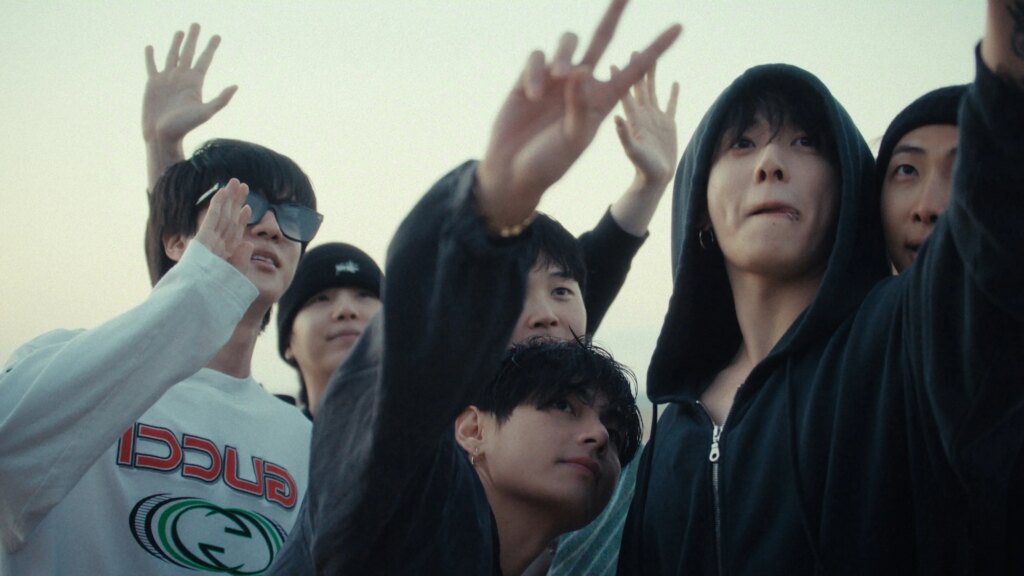
On March 21st, BTS: The Comeback Live, the group’s long-awaited return from group hiatus due to military enlistment, was streamed live on Netflix to millions of viewers around the world. On Friday, Netflix released BTS: The Return, a feature documentary that takes viewers into the making of BTS’ latest album, Arirang.
HYBE, the entertainment conglomerate that grew from BTS’ success, has previously released similar behind-the-scenes production diaries through the platform Weverse and quieter collaborations with YouTube or Disney. If BTS were looking to solely reach their fans, HYBE has the technology, reach, and resources to make it happen. BTS: The Comeback Live and BTS: The Return represent something different: a desire to reach a global audience, perhaps one that does not know much about BTS past their identity as a K-pop group.
To that end, The Comeback Live and The Return act as kind of a one-two punch for Netflix subscribers looking to understand both the scale of BTS’ pop culture power and the complex artists beneath it all. For those who want to understand more about what went into the making of both projects, here’s a breakdown.
BTS’ first performance in years is rooted in history
After a nearly four-year hiatus due to mandatory military service, any space would have become meaningful with BTS’ performance. However, HYBE chose one of the most symbolically important spaces in all of Korea for the group’s comeback setting: Gwanghwamun Square.
In 1394, when King Tae-jo relocated the capital for the new Joseon empire to Hanyang (known today as Seoul), he built Gyeongbokgung Palace at the foot of Mt. Bugaksan. The road that ran from Gyeongbokgung’s Gwanghwamun gate and past the nearby government ministries was called Yukjogeori, or Six Ministries Street. During the Joseon dynasty, which spanned 600 years until 1897, Gwanghwamun Square was a symbol of the capital and the empire, and Yukjogeori (called Sejongno today) was a place where the king met his people. Today, it is the place where Koreans gather to protest, celebrate, and be together. This is the venue where BTS staged their first performance in nearly four years.
If the symbolism of that setting sounds like a lot of pressure for one squad of seven men, well, yes. The soft power spectacle was made even more high-stakes with the addition of Netflix as a partner. The U.S.-based streamer, which has invested billions of dollars into Korean production over the last decade, recently got into the live entertainment business. While Netflix had previously done live sporting events, including WWE events and an NFL Christmas game, BTS’s comeback event was its first live music performance and first live event from Korea. The streamer brought on Hamish Hamilton, the British director behind every Super Bowl halftime show since 2010, and his company Done+Dusted, for the event.
“Every decision we have made in terms of camera approach, stage design and production has been built around one question: how do we make the person watching at home feel like they are standing in that square?” Hamilton said in Netflix press notes for the event, highlighting the “picture frame concept” of the LED-powered, cube-shaped stage that made Gwanghwamun gate a more integral part of the show. “We put a lot of effort into how to highlight this precious location, Gyeongbokgung and Gwanghwamun, while infusing modern elements,” Garrett English, the executive producer of the event, told press the day before the performance. “The most important point was to harmonize sufficiently with this historic space.”
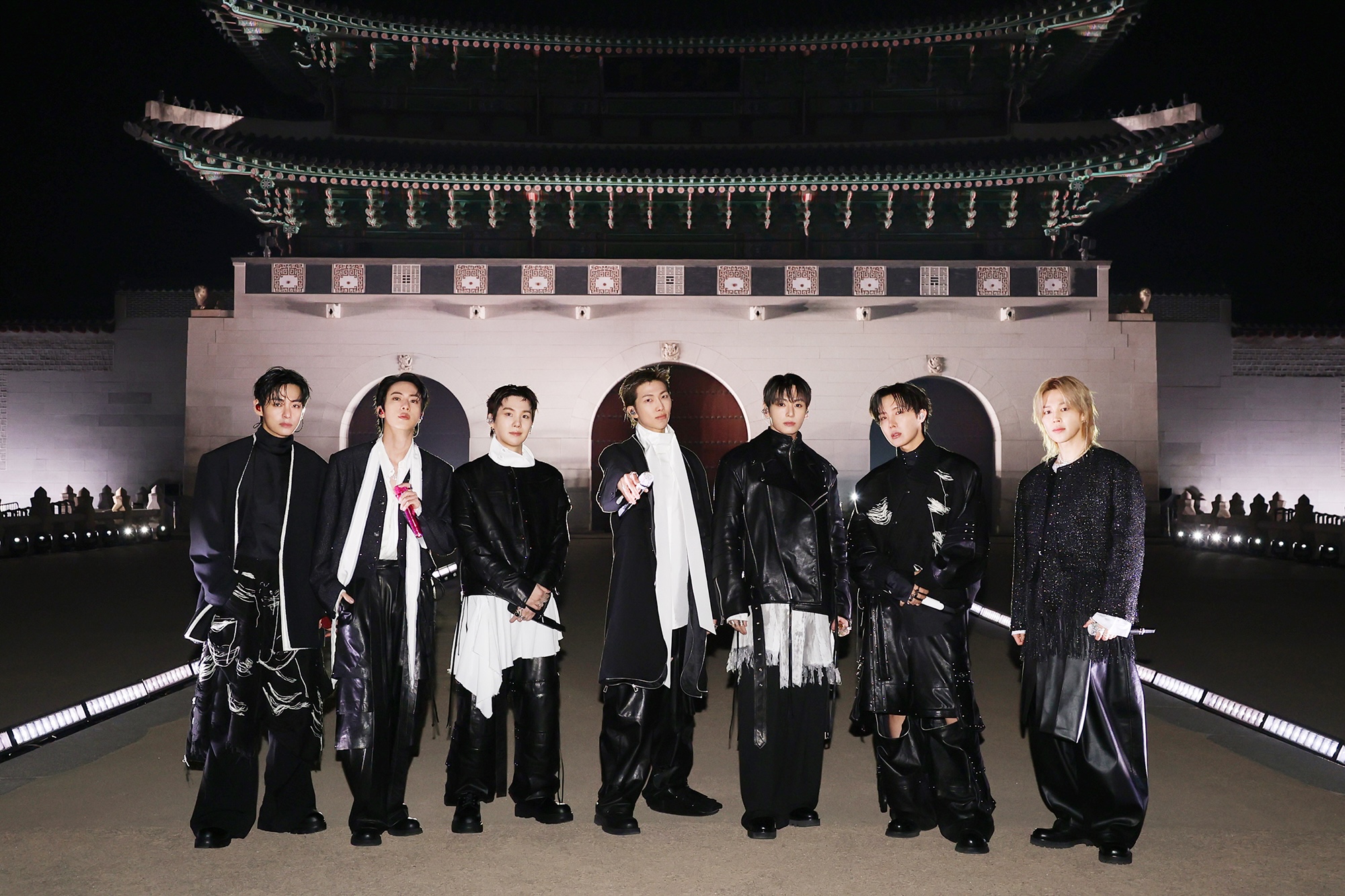
This included BTS’ entrance, which began on the wol-dae, a ceremonial stage in front of Gwanghwamun gate. Fifty dancers lined the area before parting to reveal RM, Jin, Suga, J-Hope, Jimin, V, and Jung Kook, dressed in outfits inspired by early Joseon-era generals. “We aimed to embody Korea’s indomitable spirit, which has overcome hardships throughout history, Song Jae-woo, Creative Director of Korean brand Songzio, told The Chosun Daily. “We connected the images of Admiral Yi Sun-sin and King Sejong standing majestically in Gwanghwamun with BTS members, incorporating themes like ‘heroes’ and ‘warriors’ into the clothing.”
BTS pulled off the performance was pulled off without any practice on the Gwanghwamun stage, a feat that Done+Dusted’s Guy Carrington told Variety was not usual: “Without the traditional three or four days of rehearsal time on the stage to run this through from start to finish, we needed their buy in, and we needed access to them. Hamish and I sat down with them in Seoul a few weeks ago to take them through the show and talk them through the process. And they totally got it. This was right after [Bad Bunny’s performance at the] Super Bowl and they’d all watched it, so they understood how these things get put together.”
With Bugaksan rising behind them, BTS put on a one-hour show that melded tracks from new album Arirang, including “Body to Body,” “Hooligan,” “2.0,” “Aliens,” “FYA,” “Swim,” “Like Animals,” and “Normal,” with some of their older hits, including “Butter,” “Mic Drop,” “Dynamite,” and “Mikrokosmos.” The performance was watched in-person by roughly 22,000 ticketed fans and thousands more without tickets gathering around screens placed from Gwanghwamun to City Hall Plaza. Popular Science found that the sound from the free, open-air performance could be heard from more than a mile away in Myeongdong and more than two miles away at Cheonggyecheon stream.
“I’m incredibly thankful that we’re able to perform at Gwanghwamun Square, one of the most historic places,” BTS rapper Suga said during the performance. “We titled our new album Arirang because we wanted to show our identity, and standing here at Gwanghwamun carries that same meaning.”
How BTS: The Return gets personal
While BTS: The Comeback Live went huge in its attempt to bring in eyeballs, BTS: The Return goes satisfyingly small, stripping away the pomp and the circumstance of the group’s fame to show the humans underneath, only asking the members to be themselves. In it, Vietnamese American director Bao Ngyugen, whose previous work includes The Stringer and The Greatest Night in Pop, takes us behind the scenes of BTS’ songwriting camp in L.A. as they prepare Arirang, their fifth studio album. The film’s back half follows RM, Jin, Suga, J-Hope, Jimin, V, and Jung Kook back to Korea where they complete post-production on the album and prepare to step back into the spotlight.
The seven members of BTS spent two months in L.A. in the summer of 2025, immediately following the final members’ military discharge. Living together for the first time in years—albeit, this time, in a massive residence complete with a pool—the group went to the recording studio everyday to write and record. Nguyen used the drives between the two spaces to get the members’ thoughts and feelings about this very particular moment in their careers and lives.
“These car rides became a confessional to them in many ways, and so I began just asking them questions while they’re in the car,” Nguyen tells Time. “And what’s beautiful about a car ride too is there’s a beginning, middle, end that everyone understands. They know they’re getting in the car. They knew the time that it would take to get to the studio, because they’ve done it so many times, so they almost knew how to compress their answers, but still be reflective. We do so many interviews with them in the car over time, and it became this beautiful interiority of their lives and what they were thinking.”
For Nguyen, who first pitched the idea of a documentary about BTS after seeing them perform at L.A.’s SoFi Stadium in 2021, the connection between the group and their fandom, known as ARMY, is the stuff of Greek mythology. “When they had their moments talking to the crowd, I just saw the energy between ARMY and the band,” he says. “And for me, because I’m always thinking of story and myth, it’s like, ‘Oh, my God, this is like the Odyssey. It’s like the group is Odysseus and ARMY is like Penelope, longing for their heroes to return, in many ways.”
Nguyen floated the pitch to BTS’ label, but the doc was not possible due to military enlistment. “Years later, I get a call back, and they’re like, ‘You remember when you had this idea of doing a documentary? … Well, they’re coming back to LA to record this album. Would you be interested in doing it?’” It might have felt like fate when, during one of Nguyen’s first interviews with RM, the rapper and group leader used the ancient Greek concept of time, as understood as Kaoros and Chronos, to explain how he felt about his time in L.A. with his “second family.” “The impermanence of time,” RM calls it, mixing English and Korean in his expression of the concept that gets to a theme of the film.
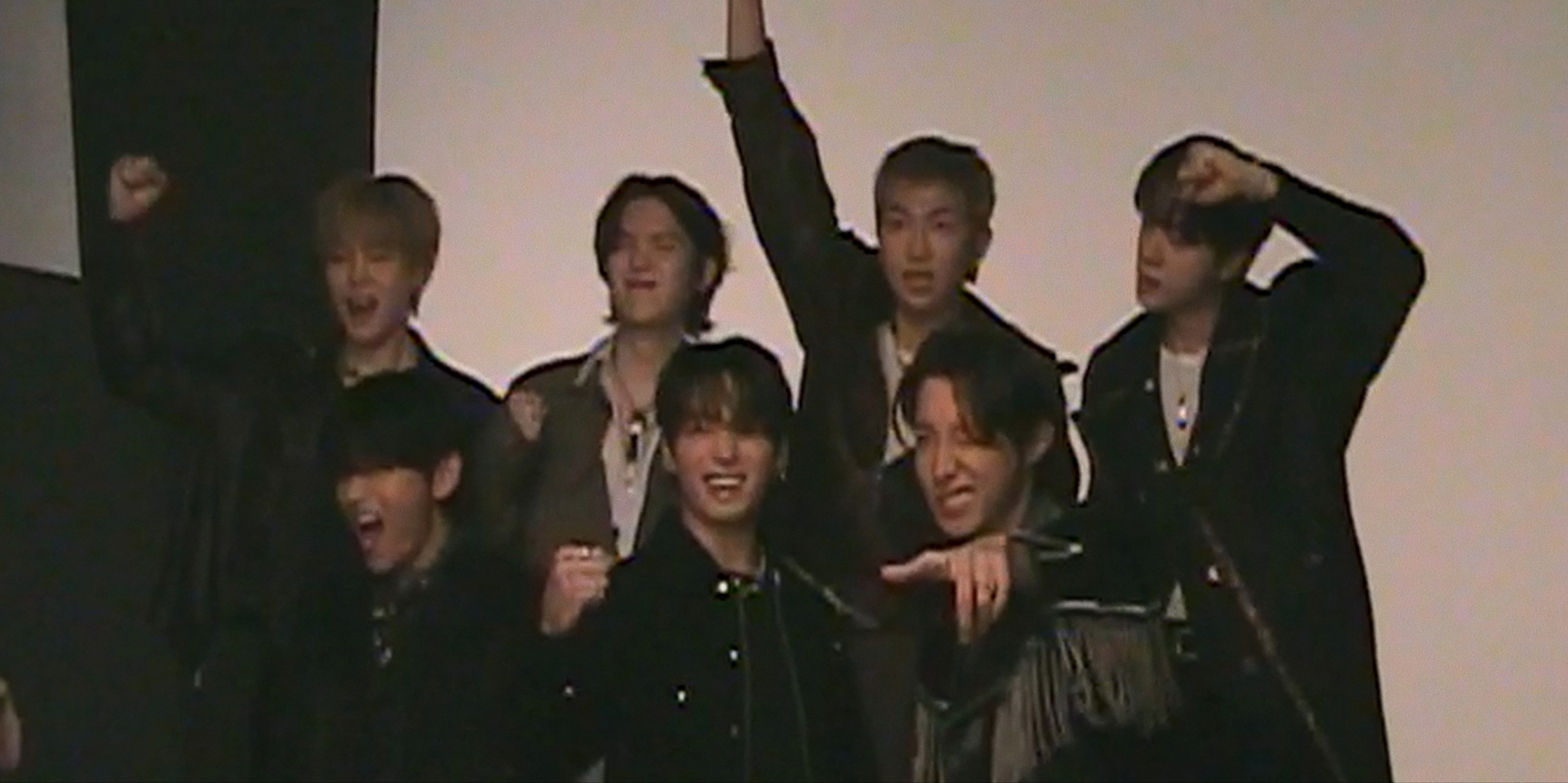
In addition to the footage Nguyen captures and the car confessionals, he gave the members old-school mini DV camcorders to record their lives from their own perspectives. “For me, there’s such a textual quality to mini DV or VHS footage that feels like your father or your mom, shooting home videos. I was like, ‘I want these to be like their home video footage of their time in LA.’” In an age of hyper photo-realism and AI images, the hazy quality of the camcorder footage adds a warm, intimate film to BTS’ time in L.A. The result is reminiscent of BTS’ early “Bangtan Bombs” on YouTube, and is in stark contrast to most of the shiny, precise images we see of BTS today.
“Certain members are not camera shy, and they want to document everything, and then there are others who want to sit in their privacy a bit more,” says Nguyen. “And so that’s why I thought giving them these cameras was a way for them to have agency of how much that they wanted to give into the personal perspective. I wanted to have them have some ownership over when our film crew was there versus when they can just pick up the camera and show their perspective.”
This kind of thoughtfulness in the filmmaking process comes through in the final form, especially in the contrast to the scenes in which BTS are asked to consider which parts of their music they should shift to make it more “accessible” to global audiences. In one memorable moment, Suga tells their Big Hit management team: “We’d like to write more lyrics in Korean. There’s too much English right now, especially for rap verses.” RM follows up with: “Because for this album authenticity matters.” Nicole Kim, vice president at Big Hit, tells the members: “Of course authenticity is important. But if we want this album to go global, we need to go ahead and try.”
Again and again, BTS is asked to consider their legacy as a once-in-a-generation icon, a sentiment that RM says gives him a visceral reaction. This tension between superstar and musician is at the heart of The Return, and one Nguyen was perhaps especially qualified to take on as a theme. “I’ve done a lot of films about icons, like Bruce Lee and ‘We Are the World’ and what I find interesting about making films about pop culture is: these are the figures and subjects that we choose to celebrate as a society, right? And what does that say about the society as a whole, that we’re choosing to uplift these people and culture?”
At the same time, Nguyen is interested in peeling back those mythic layers to the humanity beneath. “For me, it’s like, what are the things that make us human within that bigger iconography? And the idea of them coming back to themselves and not knowing whether or not they have to be who they were before they left or be something entirely different, I think it’s very relatable to everyone, and not just people who know BTS.”
Over the course of making the film, Nguyen says his understanding of the K-pop group changed. “Coming into it, the sense of them as just icons and being famous was what I had imagined, but the weight of being famous and also representing a country to the world was something that I didn’t expect initially,” he says. “Witnessing all the conversations and debates that they had internally in the film… I just have so much more respect and admiration for what they’ve done before and what they’re doing now, and what they have to do in the future.”
As RM expresses in the film, and as is evident in the moments of love and affection between the members, BTS is only able to carry that weight because they do it together. “I think individually, it’d be too heavy for them,” says Nguyen, “but through them as seven, that’s how they are able to do what they do.”
On March 21st, BTS: The Comeback Live, the group’s long-awaited return from group hiatus due to military enlistment, was streamed live on Netflix to millions of viewers around the world. On Friday, Netflix released BTS: The Return, a feature documentary that takes viewers into the making of BTS’ latest album, Arirang.
HYBE, the entertainment conglomerate that grew from BTS’ success, has previously released similar behind-the-scenes production diaries through the platform Weverse and quieter collaborations with YouTube or Disney. If BTS were looking to solely reach their fans, HYBE has the technology, reach, and resources to make it happen. BTS: The Comeback Live and BTS: The Return represent something different: a desire to reach a global audience, perhaps one that does not know much about BTS past their identity as a K-pop group.
To that end, The Comeback Live and The Return act as kind of a one-two punch for Netflix subscribers looking to understand both the scale of BTS’ pop culture power and the complex artists beneath it all. For those who want to understand more about what went into the making of both projects, here’s a breakdown.
BTS’ first performance in years is rooted in history
After a nearly four-year hiatus due to mandatory military service, any space would have become meaningful with BTS’ performance. However, HYBE chose one of the most symbolically important spaces in all of Korea for the group’s comeback setting: Gwanghwamun Square.
In 1394, when King Tae-jo relocated the capital for the new Joseon empire to Hanyang (known today as Seoul), he built Gyeongbokgung Palace at the foot of Mt. Bugaksan. The road that ran from Gyeongbokgung’s Gwanghwamun gate and past the nearby government ministries was called Yukjogeori, or Six Ministries Street. During the Joseon dynasty, which spanned 600 years until 1897, Gwanghwamun Square was a symbol of the capital and the empire, and Yukjogeori (called Sejongno today) was a place where the king met his people. Today, it is the place where Koreans gather to protest, celebrate, and be together. This is the venue where BTS staged their first performance in nearly four years.
If the symbolism of that setting sounds like a lot of pressure for one squad of seven men, well, yes. The soft power spectacle was made even more high-stakes with the addition of Netflix as a partner. The U.S.-based streamer, which has invested billions of dollars into Korean production over the last decade, recently got into the live entertainment business. While Netflix had previously done live sporting events, including WWE events and an NFL Christmas game, BTS’s comeback event was its first live music performance and first live event from Korea. The streamer brought on Hamish Hamilton, the British director behind every Super Bowl halftime show since 2010, and his company Done+Dusted, for the event.
“Every decision we have made in terms of camera approach, stage design and production has been built around one question: how do we make the person watching at home feel like they are standing in that square?” Hamilton said in Netflix press notes for the event, highlighting the “picture frame concept” of the LED-powered, cube-shaped stage that made Gwanghwamun gate a more integral part of the show. “We put a lot of effort into how to highlight this precious location, Gyeongbokgung and Gwanghwamun, while infusing modern elements,” Garrett English, the executive producer of the event, told press the day before the performance. “The most important point was to harmonize sufficiently with this historic space.”
This included BTS’ entrance, which began on the wol-dae, a ceremonial stage in front of Gwanghwamun gate. Fifty dancers lined the area before parting to reveal RM, Jin, Suga, J-Hope, Jimin, V, and Jung Kook, dressed in outfits inspired by early Joseon-era generals. “We aimed to embody Korea’s indomitable spirit, which has overcome hardships throughout history, Song Jae-woo, Creative Director of Korean brand Songzio, told The Chosun Daily. “We connected the images of Admiral Yi Sun-sin and King Sejong standing majestically in Gwanghwamun with BTS members, incorporating themes like ‘heroes’ and ‘warriors’ into the clothing.”
BTS pulled off the performance was pulled off without any practice on the Gwanghwamun stage, a feat that Done+Dusted’s Guy Carrington told Variety was not usual: “Without the traditional three or four days of rehearsal time on the stage to run this through from start to finish, we needed their buy in, and we needed access to them. Hamish and I sat down with them in Seoul a few weeks ago to take them through the show and talk them through the process. And they totally got it. This was right after [Bad Bunny’s performance at the] Super Bowl and they’d all watched it, so they understood how these things get put together.”
With Bugaksan rising behind them, BTS put on a one-hour show that melded tracks from new album Arirang, including “Body to Body,” “Hooligan,” “2.0,” “Aliens,” “FYA,” “Swim,” “Like Animals,” and “Normal,” with some of their older hits, including “Butter,” “Mic Drop,” “Dynamite,” and “Mikrokosmos.” The performance was watched in-person by roughly 22,000 ticketed fans and thousands more without tickets gathering around screens placed from Gwanghwamun to City Hall Plaza. Popular Science found that the sound from the free, open-air performance could be heard from more than a mile away in Myeongdong and more than two miles away at Cheonggyecheon stream.
“I’m incredibly thankful that we’re able to perform at Gwanghwamun Square, one of the most historic places,” BTS rapper Suga said during the performance. “We titled our new album Arirang because we wanted to show our identity, and standing here at Gwanghwamun carries that same meaning.”
How BTS: The Return gets personal
While BTS: The Comeback Live went huge in its attempt to bring in eyeballs, BTS: The Return goes satisfyingly small, stripping away the pomp and the circumstance of the group’s fame to show the humans underneath, only asking the members to be themselves. In it, Vietnamese American director Bao Ngyugen, whose previous work includes The Stringer and The Greatest Night in Pop, takes us behind the scenes of BTS’ songwriting camp in L.A. as they prepare Arirang, their fifth studio album. The film’s back half follows RM, Jin, Suga, J-Hope, Jimin, V, and Jung Kook back to Korea where they complete post-production on the album and prepare to step back into the spotlight.
The seven members of BTS spent two months in L.A. in the summer of 2025, immediately following the final members’ military discharge. Living together for the first time in years—albeit, this time, in a massive residence complete with a pool—the group went to the recording studio everyday to write and record. Nguyen used the drives between the two spaces to get the members’ thoughts and feelings about this very particular moment in their careers and lives.
“These car rides became a confessional to them in many ways, and so I began just asking them questions while they’re in the car,” Nguyen tells Time. “And what’s beautiful about a car ride too is there’s a beginning, middle, end that everyone understands. They know they’re getting in the car. They knew the time that it would take to get to the studio, because they’ve done it so many times, so they almost knew how to compress their answers, but still be reflective. We do so many interviews with them in the car over time, and it became this beautiful interiority of their lives and what they were thinking.”
For Nguyen, who first pitched the idea of a documentary about BTS after seeing them perform at L.A.’s SoFi Stadium in 2021, the connection between the group and their fandom, known as ARMY, is the stuff of Greek mythology. “When they had their moments talking to the crowd, I just saw the energy between ARMY and the band,” he says. “And for me, because I’m always thinking of story and myth, it’s like, ‘Oh, my God, this is like the Odyssey. It’s like the group is Odysseus and ARMY is like Penelope, longing for their heroes to return, in many ways.”
Nguyen floated the pitch to BTS’ label, but the doc was not possible due to military enlistment. “Years later, I get a call back, and they’re like, ‘You remember when you had this idea of doing a documentary? … Well, they’re coming back to LA to record this album. Would you be interested in doing it?’” It might have felt like fate when, during one of Nguyen’s first interviews with RM, the rapper and group leader used the ancient Greek concept of time, as understood as Kaoros and Chronos, to explain how he felt about his time in L.A. with his “second family.” “The impermanence of time,” RM calls it, mixing English and Korean in his expression of the concept that gets to a theme of the film.
In addition to the footage Nguyen captures and the car confessionals, he gave the members old-school mini DV camcorders to record their lives from their own perspectives. “For me, there’s such a textual quality to mini DV or VHS footage that feels like your father or your mom, shooting home videos. I was like, ‘I want these to be like their home video footage of their time in LA.’” In an age of hyper photo-realism and AI images, the hazy quality of the camcorder footage adds a warm, intimate film to BTS’ time in L.A. The result is reminiscent of BTS’ early “Bangtan Bombs” on YouTube, and is in stark contrast to most of the shiny, precise images we see of BTS today.
“Certain members are not camera shy, and they want to document everything, and then there are others who want to sit in their privacy a bit more,” says Nguyen. “And so that’s why I thought giving them these cameras was a way for them to have agency of how much that they wanted to give into the personal perspective. I wanted to have them have some ownership over when our film crew was there versus when they can just pick up the camera and show their perspective.”
This kind of thoughtfulness in the filmmaking process comes through in the final form, especially in the contrast to the scenes in which BTS are asked to consider which parts of their music they should shift to make it more “accessible” to global audiences. In one memorable moment, Suga tells their Big Hit management team: “We’d like to write more lyrics in Korean. There’s too much English right now, especially for rap verses.” RM follows up with: “Because for this album authenticity matters.” Nicole Kim, vice president at Big Hit, tells the members: “Of course authenticity is important. But if we want this album to go global, we need to go ahead and try.”
Again and again, BTS is asked to consider their legacy as a once-in-a-generation icon, a sentiment that RM says gives him a visceral reaction. This tension between superstar and musician is at the heart of The Return, and one Nguyen was perhaps especially qualified to take on as a theme. “I’ve done a lot of films about icons, like Bruce Lee and ‘We Are the World’ and what I find interesting about making films about pop culture is: these are the figures and subjects that we choose to celebrate as a society, right? And what does that say about the society as a whole, that we’re choosing to uplift these people and culture?”
At the same time, Nguyen is interested in peeling back those mythic layers to the humanity beneath. “For me, it’s like, what are the things that make us human within that bigger iconography? And the idea of them coming back to themselves and not knowing whether or not they have to be who they were before they left or be something entirely different, I think it’s very relatable to everyone, and not just people who know BTS.”
Over the course of making the film, Nguyen says his understanding of the K-pop group changed. “Coming into it, the sense of them as just icons and being famous was what I had imagined, but the weight of being famous and also representing a country to the world was something that I didn’t expect initially,” he says. “Witnessing all the conversations and debates that they had internally in the film… I just have so much more respect and admiration for what they’ve done before and what they’re doing now, and what they have to do in the future.”
As RM expresses in the film, and as is evident in the moments of love and affection between the members, BTS is only able to carry that weight because they do it together. “I think individually, it’d be too heavy for them,” says Nguyen, “but through them as seven, that’s how they are able to do what they do.”
On March 21st, BTS: The Comeback Live, the group’s long-awaited return from group hiatus due to military enlistment, was streamed live on Netflix to millions of viewers around the world. On Friday, Netflix released BTS: The Return, a feature documentary that takes viewers into the making of BTS’ latest album, Arirang.
HYBE, the entertainment conglomerate that grew from BTS’ success, has previously released similar behind-the-scenes production diaries through the platform Weverse and quieter collaborations with YouTube or Disney. If BTS were looking to solely reach their fans, HYBE has the technology, reach, and resources to make it happen. BTS: The Comeback Live and BTS: The Return represent something different: a desire to reach a global audience, perhaps one that does not know much about BTS past their identity as a K-pop group.
To that end, The Comeback Live and The Return act as kind of a one-two punch for Netflix subscribers looking to understand both the scale of BTS’ pop culture power and the complex artists beneath it all. For those who want to understand more about what went into the making of both projects, here’s a breakdown.
BTS’ first performance in years is rooted in history
After a nearly four-year hiatus due to mandatory military service, any space would have become meaningful with BTS’ performance. However, HYBE chose one of the most symbolically important spaces in all of Korea for the group’s comeback setting: Gwanghwamun Square.
In 1394, when King Tae-jo relocated the capital for the new Joseon empire to Hanyang (known today as Seoul), he built Gyeongbokgung Palace at the foot of Mt. Bugaksan. The road that ran from Gyeongbokgung’s Gwanghwamun gate and past the nearby government ministries was called Yukjogeori, or Six Ministries Street. During the Joseon dynasty, which spanned 600 years until 1897, Gwanghwamun Square was a symbol of the capital and the empire, and Yukjogeori (called Sejongno today) was a place where the king met his people. Today, it is the place where Koreans gather to protest, celebrate, and be together. This is the venue where BTS staged their first performance in nearly four years.
If the symbolism of that setting sounds like a lot of pressure for one squad of seven men, well, yes. The soft power spectacle was made even more high-stakes with the addition of Netflix as a partner. The U.S.-based streamer, which has invested billions of dollars into Korean production over the last decade, recently got into the live entertainment business. While Netflix had previously done live sporting events, including WWE events and an NFL Christmas game, BTS’s comeback event was its first live music performance and first live event from Korea. The streamer brought on Hamish Hamilton, the British director behind every Super Bowl halftime show since 2010, and his company Done+Dusted, for the event.
“Every decision we have made in terms of camera approach, stage design and production has been built around one question: how do we make the person watching at home feel like they are standing in that square?” Hamilton said in Netflix press notes for the event, highlighting the “picture frame concept” of the LED-powered, cube-shaped stage that made Gwanghwamun gate a more integral part of the show. “We put a lot of effort into how to highlight this precious location, Gyeongbokgung and Gwanghwamun, while infusing modern elements,” Garrett English, the executive producer of the event, told press the day before the performance. “The most important point was to harmonize sufficiently with this historic space.”
This included BTS’ entrance, which began on the wol-dae, a ceremonial stage in front of Gwanghwamun gate. Fifty dancers lined the area before parting to reveal RM, Jin, Suga, J-Hope, Jimin, V, and Jung Kook, dressed in outfits inspired by early Joseon-era generals. “We aimed to embody Korea’s indomitable spirit, which has overcome hardships throughout history, Song Jae-woo, Creative Director of Korean brand Songzio, told The Chosun Daily. “We connected the images of Admiral Yi Sun-sin and King Sejong standing majestically in Gwanghwamun with BTS members, incorporating themes like ‘heroes’ and ‘warriors’ into the clothing.”
BTS pulled off the performance was pulled off without any practice on the Gwanghwamun stage, a feat that Done+Dusted’s Guy Carrington told Variety was not usual: “Without the traditional three or four days of rehearsal time on the stage to run this through from start to finish, we needed their buy in, and we needed access to them. Hamish and I sat down with them in Seoul a few weeks ago to take them through the show and talk them through the process. And they totally got it. This was right after [Bad Bunny’s performance at the] Super Bowl and they’d all watched it, so they understood how these things get put together.”
With Bugaksan rising behind them, BTS put on a one-hour show that melded tracks from new album Arirang, including “Body to Body,” “Hooligan,” “2.0,” “Aliens,” “FYA,” “Swim,” “Like Animals,” and “Normal,” with some of their older hits, including “Butter,” “Mic Drop,” “Dynamite,” and “Mikrokosmos.” The performance was watched in-person by roughly 22,000 ticketed fans and thousands more without tickets gathering around screens placed from Gwanghwamun to City Hall Plaza. Popular Science found that the sound from the free, open-air performance could be heard from more than a mile away in Myeongdong and more than two miles away at Cheonggyecheon stream.
“I’m incredibly thankful that we’re able to perform at Gwanghwamun Square, one of the most historic places,” BTS rapper Suga said during the performance. “We titled our new album Arirang because we wanted to show our identity, and standing here at Gwanghwamun carries that same meaning.”
How BTS: The Return gets personal
While BTS: The Comeback Live went huge in its attempt to bring in eyeballs, BTS: The Return goes satisfyingly small, stripping away the pomp and the circumstance of the group’s fame to show the humans underneath, only asking the members to be themselves. In it, Vietnamese American director Bao Ngyugen, whose previous work includes The Stringer and The Greatest Night in Pop, takes us behind the scenes of BTS’ songwriting camp in L.A. as they prepare Arirang, their fifth studio album. The film’s back half follows RM, Jin, Suga, J-Hope, Jimin, V, and Jung Kook back to Korea where they complete post-production on the album and prepare to step back into the spotlight.
The seven members of BTS spent two months in L.A. in the summer of 2025, immediately following the final members’ military discharge. Living together for the first time in years—albeit, this time, in a massive residence complete with a pool—the group went to the recording studio everyday to write and record. Nguyen used the drives between the two spaces to get the members’ thoughts and feelings about this very particular moment in their careers and lives.
“These car rides became a confessional to them in many ways, and so I began just asking them questions while they’re in the car,” Nguyen tells Time. “And what’s beautiful about a car ride too is there’s a beginning, middle, end that everyone understands. They know they’re getting in the car. They knew the time that it would take to get to the studio, because they’ve done it so many times, so they almost knew how to compress their answers, but still be reflective. We do so many interviews with them in the car over time, and it became this beautiful interiority of their lives and what they were thinking.”
For Nguyen, who first pitched the idea of a documentary about BTS after seeing them perform at L.A.’s SoFi Stadium in 2021, the connection between the group and their fandom, known as ARMY, is the stuff of Greek mythology. “When they had their moments talking to the crowd, I just saw the energy between ARMY and the band,” he says. “And for me, because I’m always thinking of story and myth, it’s like, ‘Oh, my God, this is like the Odyssey. It’s like the group is Odysseus and ARMY is like Penelope, longing for their heroes to return, in many ways.”
Nguyen floated the pitch to BTS’ label, but the doc was not possible due to military enlistment. “Years later, I get a call back, and they’re like, ‘You remember when you had this idea of doing a documentary? … Well, they’re coming back to LA to record this album. Would you be interested in doing it?’” It might have felt like fate when, during one of Nguyen’s first interviews with RM, the rapper and group leader used the ancient Greek concept of time, as understood as Kaoros and Chronos, to explain how he felt about his time in L.A. with his “second family.” “The impermanence of time,” RM calls it, mixing English and Korean in his expression of the concept that gets to a theme of the film.
In addition to the footage Nguyen captures and the car confessionals, he gave the members old-school mini DV camcorders to record their lives from their own perspectives. “For me, there’s such a textual quality to mini DV or VHS footage that feels like your father or your mom, shooting home videos. I was like, ‘I want these to be like their home video footage of their time in LA.’” In an age of hyper photo-realism and AI images, the hazy quality of the camcorder footage adds a warm, intimate film to BTS’ time in L.A. The result is reminiscent of BTS’ early “Bangtan Bombs” on YouTube, and is in stark contrast to most of the shiny, precise images we see of BTS today.
“Certain members are not camera shy, and they want to document everything, and then there are others who want to sit in their privacy a bit more,” says Nguyen. “And so that’s why I thought giving them these cameras was a way for them to have agency of how much that they wanted to give into the personal perspective. I wanted to have them have some ownership over when our film crew was there versus when they can just pick up the camera and show their perspective.”
This kind of thoughtfulness in the filmmaking process comes through in the final form, especially in the contrast to the scenes in which BTS are asked to consider which parts of their music they should shift to make it more “accessible” to global audiences. In one memorable moment, Suga tells their Big Hit management team: “We’d like to write more lyrics in Korean. There’s too much English right now, especially for rap verses.” RM follows up with: “Because for this album authenticity matters.” Nicole Kim, vice president at Big Hit, tells the members: “Of course authenticity is important. But if we want this album to go global, we need to go ahead and try.”
Again and again, BTS is asked to consider their legacy as a once-in-a-generation icon, a sentiment that RM says gives him a visceral reaction. This tension between superstar and musician is at the heart of The Return, and one Nguyen was perhaps especially qualified to take on as a theme. “I’ve done a lot of films about icons, like Bruce Lee and ‘We Are the World’ and what I find interesting about making films about pop culture is: these are the figures and subjects that we choose to celebrate as a society, right? And what does that say about the society as a whole, that we’re choosing to uplift these people and culture?”
At the same time, Nguyen is interested in peeling back those mythic layers to the humanity beneath. “For me, it’s like, what are the things that make us human within that bigger iconography? And the idea of them coming back to themselves and not knowing whether or not they have to be who they were before they left or be something entirely different, I think it’s very relatable to everyone, and not just people who know BTS.”
Over the course of making the film, Nguyen says his understanding of the K-pop group changed. “Coming into it, the sense of them as just icons and being famous was what I had imagined, but the weight of being famous and also representing a country to the world was something that I didn’t expect initially,” he says. “Witnessing all the conversations and debates that they had internally in the film… I just have so much more respect and admiration for what they’ve done before and what they’re doing now, and what they have to do in the future.”
As RM expresses in the film, and as is evident in the moments of love and affection between the members, BTS is only able to carry that weight because they do it together. “I think individually, it’d be too heavy for them,” says Nguyen, “but through them as seven, that’s how they are able to do what they do.”
The post What BTS: The Return Reveals About the Biggest Boy Band’s New Era appeared first on TIME.