New York Harbor is dry no longer.
On Friday, just after 1 p.m., the Staten Island Ferry sold its first beers in seven years.
“This is just as big as the Super Bowl,” Jonathan Guash, who works for the beer distributor that arranged the shipment to the ferry service and was one of the lucky recipients, said after taking a swig of Michelob Ultra.
Mr. Guash, 26, a Staten Island native who was too young to drink the last time alcohol was served on the ferry, said he had waited all morning for a chance to be the first patron.
“It was like a legend,” he said about his fizzy first sip of what locals simply call ferry beer.
After a long drought — first because of a lapsed vendor contract in 2019, then a global pandemic that threatened to kill the tradition for good — passengers can finally cruise the five-mile trip between Lower Manhattan and Staten Island with a frosty brew in hand.
The New York City Department of Transportation, which owns the orange ferries that carry passengers for free across the Upper New York Bay, announced earlier this week that alcoholic beverages would once again be sold onboard.
The drinks, which include a range of larger-volume beers, or tall boys, hard seltzers and canned cocktails, are available on the SSG Michael H. Ollis as of Friday, and will soon be sold on two more of the fleet’s ferries, the Sandy Ground and the Dorothy Day.
To the uninitiated, the ability to buy and down a 25-ounce beer during a choppy 25-minute boat ride may seem trivial, or perhaps ill advised. Passengers could already buy drinks at the Whitehall Terminal in Manhattan, or on the other side of the bay, in St. George in Staten Island.
But to hear some longtime riders tell it, there’s nothing like a ferry beer.
“I can’t wait to board the ferry and get myself a beer and a hot dog,” said Marguerite Maria Rivas, 69, an English professor at Borough of Manhattan Community College and Staten Island’s first poet laureate.
Ms. Rivas, a resident of Staten Island’s Silver Lake neighborhood who has taken the ferry for decades, missed the ritual of cracking open a tall boy at the end of a long day, sliding into her usual seat on the ferry’s lower deck and watching Manhattan recede in the ship’s wake.
There was a cadence to the routine. She would buy a can of Foster’s in the afternoon at the same onboard stand where she got her coffee in the morning.
In March 2020, she became seriously ill with Covid-19. Months later, with the pandemic in full swing, she returned to a commute that had changed for the worse: fewer familiar faces, less camaraderie and no bar.
She doesn’t drink much, she said, but having the option feels like a reclamation.
“This is a benchmark for normality, for me and other Staten Islanders,” she said.
The Staten Island Ferry, which carries more than 16 million riders per year and about 45,000 each weekday, is the biggest municipal ferry service in the United States.
Every day, at all hours, tourists and locals alike ride for free, as the boats glide past the Statue of Liberty and Ellis Island, offering a postcard view of the Lower Manhattan skyline.
Other boat services, including NYC Ferry, which mainly traverses the East River, already serve alcohol on board.
The modern version of the Staten Island Ferry began in the 1810s, and drinking on board has been common for much of its history, said Gabriella Leone, the curator of Historic Richmond Town, the borough’s historical society.
It is unclear when, exactly, the first ferry beer was sold, but in 1935, two years after the end of Prohibition, an irate passenger complained in The New York Times that the lack of water fountains at the ferry terminals might be a ploy to jack up beverage prices.
“Is this in deference to the concessionaires who will naturally sell more pop and minute bottles of beer at the same price charged for regular-size bottles,” Lane Aspinwall, of Staten Island, asked in a letter to the editor.
The city’s agreement with the new vendor, a Dunkin’ franchisee with a 10-year lease, isn’t expected to be a windfall. A spokesman for the Transportation Department said the vendor would pay the city $27,000 per month in order to sell the concessions.
But the ferry service, which is heavily subsidized by the city, is not designed to generate revenue.
It’s part of a shrinking list of public spaces left in New York without an admission fee. And after the city eliminated the 50-cent fare in 1997, the ferry — and the ferry beer — became synonymous with something else: cheap dates.
In 2012, Mayor Michael R. Bloomberg, a billionaire, said a ride on the ferry, plus a six-pack of beer, was the perfect first-date plan.
For Brenda McPhail, 37, a pilot from Vancouver, British Columbia, who decided to take in the sights of the harbor before leaving town, the drinks were a bonus.
Ferry beers are rare back home, she said. She had read that a select few rides today might feature their long-awaited return, and she happened to board the right boat.
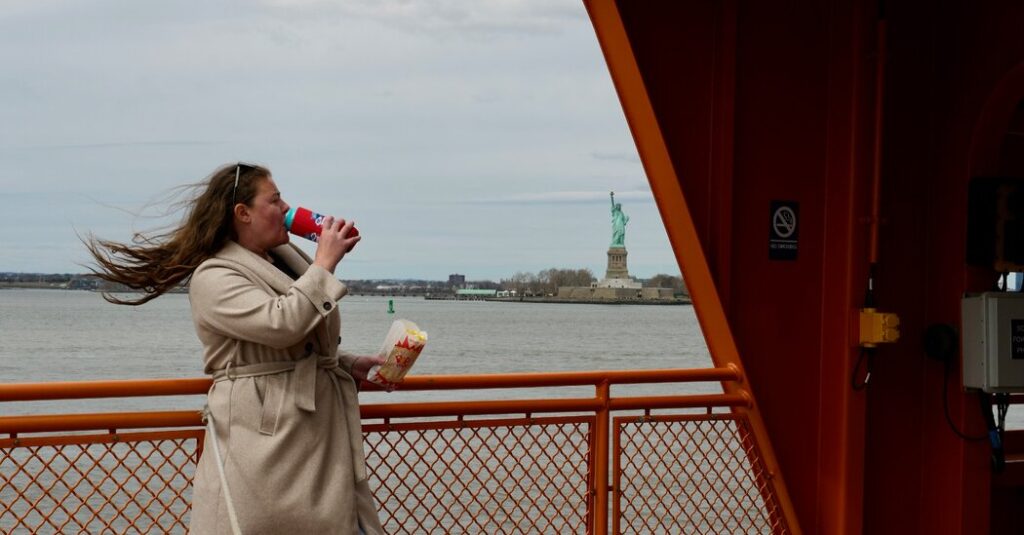
“I feel so good,” she said on the deck, a tall boy in one hand, popcorn in the other.
“I didn’t know how I was going to make history, but this is a pretty good way to do it.”
Stefanos Chen is a Times reporter covering New York City’s transit system.
The post The Bar Is Open Again on the Staten Island Ferry appeared first on New York Times.