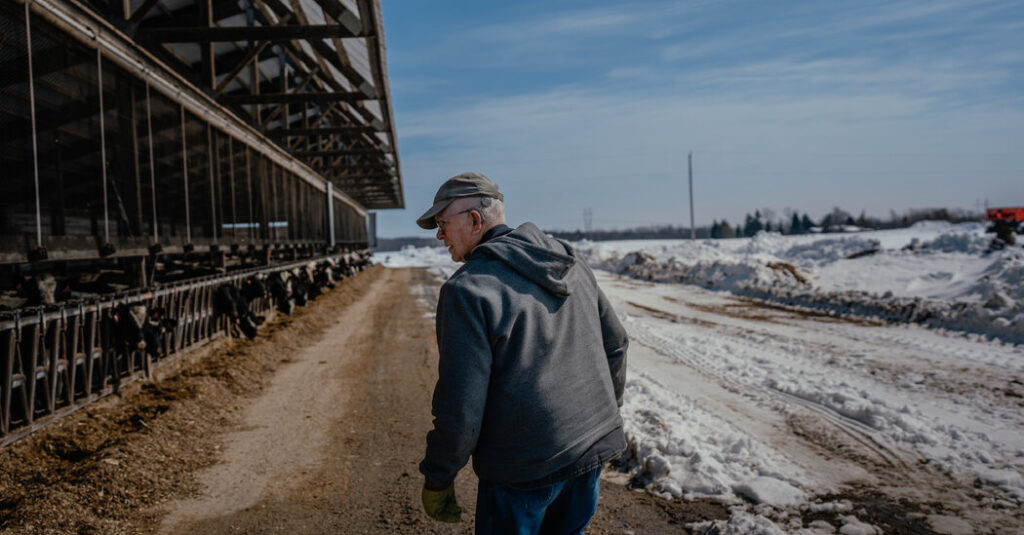
It was 5 a.m. and five degrees above zero on the O’Harrow dairy farm, and two workers, men from Honduras, moved down rows of outdoor hutches pouring steaming milk into buckets for mooing calves. A third followed in the darkness with a flashlight, looking for babies that did not drink, a sign of illness.
That worker, who came from Mexico as a teenager, knew that a calf that was sick in the morning could be dead by evening. He knew this because he has worked in the dairy industry in Wisconsin for his entire adult life, and on this family farm for about 20 years. Now in his 40s, he has mastered the intricacies of milking, birthing and inseminating, and logging it all onto a computer. This February morning, he was passing down his knowledge to the 19-year-old grandson of the family who employs him.
“We’re a little bit behind today, so you can hear everybody’s kind of angry at us,” said Sullivan O’Harrow, the grandson, who motioned toward the bellowing calves as he walked beside the worker training him.
Immigrant workers are the lifeblood of the O’Harrow farm, a four-generation family enterprise with 1,600 cows in northeastern Wisconsin. But many of them will not travel to Mexico to see dying parents, or drive to nearby towns to visit siblings, or let journalists use their names in newspapers, because they are afraid of being swept up in the Trump administration’s immigration crackdown.
That they need to hide strikes the O’Harrow family as morally wrong, but also as potentially bad for the country: These workers oversee America’s milk. By one estimate, dairies that employ immigrant workers produce 79 percent of the nation’s milk supply and the price of milk would double without them.
For two decades, Tim O’Harrow, 79, the family patriarch, has tried to persuade politicians he has voted for and donated to — most of them Republican — that they need to fix the nation’s broken immigration system.
But Washington has failed to make any meaningful changes, and Republican voters continue to be anti-immigration, particularly those in Wisconsin, a swing state where 95 percent of Republicans support mass deportation, according to a recent poll by Marquette University Law School.
That has left the O’Harrows in an uncomfortable place — stuck between what they see as an obvious truth, that immigrants are essential to America’s food supply, and a national political mood hurtling in the other direction.
And now, after generations of feeling at home in the Republican Party, the O’Harrows feel politically homeless.
“I don’t know that I’m a Republican anymore,” Tim said. “I don’t know what we are anymore.”
‘Well, Who’s Going to Milk the Cows?’
Tim O’Harrow is first and foremost a dairyman, but for years, he was also a Republican, and for years those identities coexisted peacefully.
He was born in 1946, the year before his parents bought the farm, which is about a 45-minute drive north of Green Bay.
At that time, few, if any, Wisconsin dairy farms employed immigrant workers. Farms were small and families were big. Tim’s parents employed one local man, but he and his eight siblings were mostly the ones who woke up before dawn to clean manure and help feed and milk about 50 cows, before heading off to school.
Tim’s father, Russell, also grew up on a farm, which helped establish the family’s Republican politics. As a young man in the 1930s, Russell watched as farmers, trying to raise the price of milk by withholding supply, dumped one of his family’s milk shipments into a river. Tim said that the experience had stuck with his father, and after Russell graduated from college and bought his own farm, he gravitated to the more institutionalist and conservative American Farm Bureau Federation and the Republican Party.
Tim continued that tradition. He was president of his county Farm Bureau branch in the late 1970s and was appointed to President Ronald Reagan’s National Dairy Board in the 1980s. In those years, the Republican Party was open to immigration. Reagan, during the 1980 presidential campaign, dismissed the idea of “putting up a fence” on the border. Later, he extended amnesty to millions of undocumented immigrants from South and Central America.
Meanwhile, family farms in Wisconsin were struggling.
Families had gotten smaller — Tim, one of nine children, had only two of his own — just as farms were under pressure to get bigger. Large-scale farming was underway in California, helped by Mexican labor, and sweeping changes in the industry were resulting in ever thinner margins.
Tim added cows, but soon had difficulty finding enough workers to care for them. It was hard and repetitive work, with long shifts that started before dawn, including on weekends. No one wanted to do it for what he could afford to pay, which at the time was several dollars above minimum wage. He hired students, single men, working mothers, people from a prison probation program.
“They would call five minutes before milking time, and say, ‘I’m not going to make it,’” Tim said. “Well, who’s going to milk the cows? We’re trying to run a business. It just wasn’t working.”
In 1999, the farm’s head herdsman went to a meeting about the labor problem. One dairyman recommended Mexican workers.
“He said, ‘Don’t talk about it, just do it,’” Tim recalled.
Eight days later, two workers signed on. The O’Harrows never looked back.
Immigrant Workers Arrive
The O’Harrow farmworker who has been training Sullivan starts at 4 a.m., six days a week. He oversees the daily operation and the 39 workers as they tend the calves, keep the cows moving through the milking parlors, and feed them in the long barn, where, on this morning, two women were administering vaccines, even as the shots kept freezing in the cold.
Joel O’Harrow, Tim’s son, runs the farm. By 6 a.m., he is at the office — a repurposed building with an empty swimming pool in the middle — and starts handling problems. On this morning, he needed to make a decision about an older farmhand who had stopped working, because of trouble with his eyesight, but was still being paid.
The dairy industry is one of the most dependent on undocumented workers, according to David Bier, an immigration expert at the Cato Institute. Visas are available for farm work, but only if it is seasonal. Rank-and-file dairy workers do not qualify because of the year-round demands, despite the industry’s efforts to get them included.
A 2023 study by the School for Workers at the University of Wisconsin-Madison found that more than 10,000 undocumented immigrants perform roughly 70 percent of the labor on the state’s dairy farms.
On the farms themselves, the question of status is complicated. The O’Harrows have an I-9 federal work form filled out for every person on their staff, as called for by federal law. The form requires work authorization and identity documents, which can include a Social Security card and a driver’s license.
But workers can buy such documents on the black market. And while some states, like Wisconsin, do not issue driver’s licenses to undocumented immigrants, others, like neighboring Minnesota and Illinois, do, and employers can legally accept them.
Federal rules do not require farmers to be immigration sleuths. If an applicant’s documents “reasonably appear to be genuine,” the rules say, then they should be accepted. And penalties can be imposed if employers reject an applicant or their documents on the basis of a foreign-sounding name or accent.
The O’Harrows, then, do not know the precise immigration status of many of their workers. They know only that they have fulfilled the government’s requirements.
Legal status is not a topic of daily conversation. But children and families are. Deb O’Harrow, Tim’s wife, who worked on the farm for nearly 30 years and is now retired, said that to pass the time during long days, she liked to ask workers about their children. Some went to school with the O’Harrow grandchildren. One worker’s son even wrestled on the same team with an O’Harrow grandson.
“We’d share family stories which would lighten up the day,” Deb said.
She learned about their lives in their home countries, almost always Mexico in the early years. One had been a cheese maker. Another a musician. They played a game: Deb had to learn one Spanish word a week, and then use it in a sentence.
“Sometimes I’d say, ‘That’s too hard, give me another one,’” she said.
When she wanted to train one worker to feed the calves, she said that others warned that he was too shy, “‘You can’t do that, he doesn’t speak.’”
But “he learned just by listening,” she said, “and then we couldn’t shut him up.”
Workers can make in an hour what they made in an day in Mexico. The O’Harrows pay between $14 and $20 an hour. The minimum wage in Mexico is about $17 a day.
Many eventually returned to their countries, Deb said, including two brothers who were saving money to start a junkyard. The musician moved back too, and kept in touch. On a video call, he introduced Deb to his new wife. Once, when she referred to a worker as Hispanic, he corrected her, saying she should call him Mexican.
But the uncertainty around their immigration status followed the workers, and, at times, confronted them with impossible choices.
One agonized over whether to go to Mexico to comfort her dying mother, knowing that she might not be able to return to her husband and children in Wisconsin. Another weighed how to help his son in Mexico, who had developed a drug addiction.
To Joel, these sacrifices are profound, and make the public debate about immigration sound shallow and cruel.
“These are problems that are real,” he said. “Nobody talks about them. And then a friend of mine, a good friend says, ‘Well, they’re just illegals, right? That’s what you’re hiring?’”
The G.O.P. Changes, and So Does Tim
For Tim, the family patriarch, his politics first came into conflict with his profession in the fall of 2006.
An ICE agent and officers from the sheriff’s department arrested one of the farm’s most stalwart workers, a Mexican man in his 30s, handcuffing him as he was going about his morning duties.
The O’Harrows were shocked: The man had a family and a bank loan and donated to the local Catholic church. Tim said they later learned that he had made a mistake on his paperwork at a previous job, an infraction that hardly seemed to warrant deportation.
The man’s wife also worked on the farm. When Joel told her what happened and tried to console her, he said that she stiffened and pushed him away.
She and her son followed her husband back to Mexico.
Tim said the raid left him deeply angry and filled with resolve to push for change.
He began joining his friend John Rosenow, a Wisconsin dairy farmer who is a Democrat, on trips to Washington to argue for immigration reform. Tim said they were not asking for citizenship for farm workers, but for a way for them to emerge from the shadows. They visited the offices of both Democrats and Republicans — because, as Tim saw it, all parts of the political class had a hand in making the problem.
But the tide was turning against reform.
A major bipartisan effort died in Congress in 2007. And in Wisconsin that year, undocumented immigrants were barred from having driver’s licenses. Tim and John had lobbied against that ban at the State Capitol.
“That was a stupid, stupid political stunt that they did,” Tim said, referring to the Republican lawmakers who introduced it.
In Wisconsin, dairy farming is not only a cultural identity but also an economic engine, and Tim believed elected officials had a special responsibility to acknowledge the importance of immigrant labor, and to make things easier, not harder.
He began to get into arguments, first with the head of the Farm Bureau in Wisconsin, who refused to publicly oppose the driver’s license ban, and then with one of the state’s U.S. senators, Ron Johnson.
Mr. Johnson had started out relatively open on immigration, and Tim had donated to his campaign. But over time, Tim said, the senator’s views had hardened, boiling down to, “We have laws, you should follow them.”
Tim said he found the position cartoonishly simple and morally cowardly, and told Mr. Johnson as much in an angry phone call.
(A spokeswoman for Mr. Johnson said he did not recall the phone conversation. In an emailed statement, Mr. Johnson defended his record, saying he had tried to “improve legal pathways,” and was still committed to reform.)
“What has Ron Johnson done on this issue in the 15 years he’s been in Congress?” Tim asked. “He’s playing to where the votes are. But what have you done morally and for the good of humankind?”
‘I Don’t Know Where We’re Going’
The cold February morning had turned to afternoon. The calves had been fed, the farm had warmed with the sun and Joel was sitting with Tim and Deb around their dining room table, talking. Their dog, Inka, lolled on a carpet, chewing a toy.
Tim said he felt extreme frustration that in all these years, Congress has failed to act, and now seems farther from a solution than ever before in his lifetime.
“I don’t know where we’re going,” he said. “I don’t know how to help. My time is running out.”
Joel said he still had hope that showing people the farm, and its problems, and the plight of the workers, could help.
“I’ve been afraid, and I’ve wanted to hide,” he said. “But now I’m to the point where I don’t know what else to do. We need to speak up.”
Politically, he feels different too. In past elections, he voted party line for Republicans. He voted for Donald J. Trump in 2024, as did his father, a choice that, for both men, was part muscle memory, part dislike of the Democratic candidate.
But the past year has been a series of disappointments. There were the immigration raids. The killings of two U.S. citizens in Minneapolis. (Tim: “You can’t have masked thugs go out and kill citizens. Not in our country.”) And then, the war in Iran. (Joel: “He said he wouldn’t do war. And he did it.”)
Both men said they would be open to voting for a Democrat for Congress this November. And for the first time in 20 years, a Democratic primary will be held in their district, a sign that the party believes it has a chance to flip what has been a solidly Republican seat.
The raids, for the most part, have not descended on Wisconsin dairy farms. But both men say they worry about the possibility.
They said one thing seems obvious: Deporting 14 million people is both wildly impractical and would mean the rapid collapse of American agriculture.
But that is not where most Republicans in Wisconsin are right now. The Marquette University Law School poll found that 87 percent of state Republicans said they approved of ICE tactics.
Even some U.S. citizens working on the O’Harrow farm support the deportations, a position Joel finds confusing and thinks comes from too much talk radio on the tractor.
“They love those guys,” he said, and wondered at the contradiction.
“You work with a guy every day, and you still say it? Really? That’s the answer?”
Sabrina Tavernise is a writer-at-large for The Times, focused on political life in America and how Americans see the changes in Washington.
The post A Republican Farmer Relies on Immigrant Work. He Sees His Party Erasing It. appeared first on New York Times.