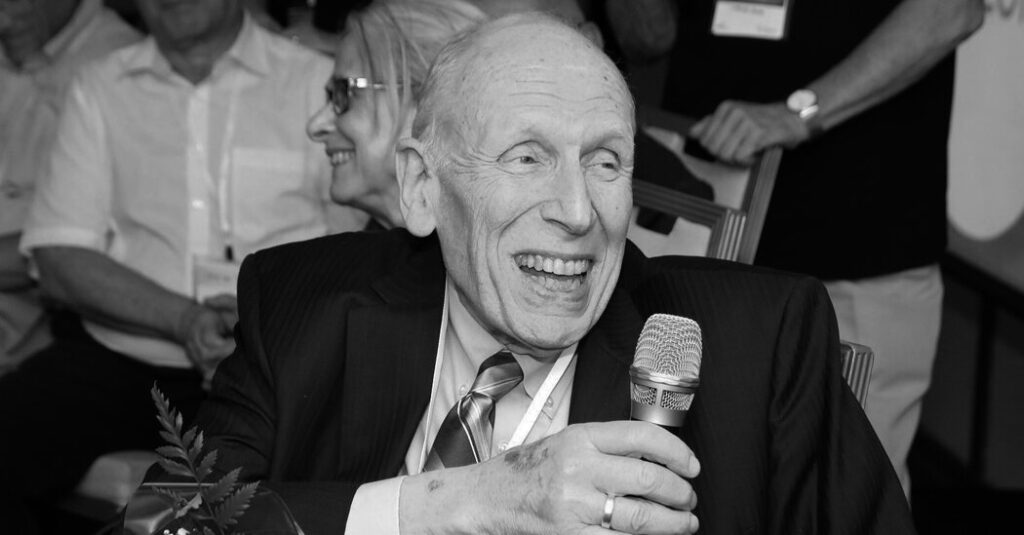
Dr. Jesse Roth, an endocrinologist who helped revolutionize the understanding of diabetes by demonstrating that it occurs because of faulty or paltry insulin receptors — proteins on the surface of cells — died on March 11 at his home in Hurley, N.Y., in the Hudson Valley. He was 91.
His death was confirmed by his daughter Alisa Roth.
In a career of more than 50 years, Dr. Roth spent nearly three decades as a leading theoretician and scientist at the National Institutes of Health in Bethesda, Md., where he advanced the understanding of how cells respond to hormones and also mentored generations of young scientists.
Dr. Roth left in 1991 to take a position at Johns Hopkins University. And in 2000, he joined the Feinstein Institutes for Medical Research in Manhasset, N.Y., on Long Island, where he continued studying hormones and their receptors across multiple conditions, including obesity, well into his 80s.
“He was energized by science, and his enthusiasm was infectious,” Dr. Betty Diamond, the director of the Institute of Molecular Medicine at the Feinstein Institutes, said in an interview. “He changed our whole concept about how cells respond to hormones.”
Dr. Roth arrived at the N.I.H. in July 1963 and began his research in a division that was then known as the National Institute of Arthritis and Metabolic Diseases (and later renamed the National Institute of Diabetes and Digestive and Kidney Diseases).
In time, he would become the scientific director of that institute and assistant surgeon general of the U.S. Public Health Service, but in the 1960s and early ’70s, he was working in the lab with a small cadre of colleagues, trying to answer one of that era’s biggest scientific questions: whether cells had protein receptors that responded only to insulin.
“Jesse was a larger-than-life personality, always exuberant, spewing ideas a mile a minute,” Dr. Robert Lefkowitz, a professor of medicine at Duke University and a postdoctoral fellow in Dr. Roth’s lab in the late 1960s, said in an interview.
“The idea that there would be receptors for hormones — and drugs — probably goes back more than 100 years, but there was no physical evidence for the receptors,” said Dr. Lefkowitz, who was awarded the 2012 Nobel Prize in Chemistry with Dr. Brian Kobilka for research that revealed the inner workings of G protein-coupled receptors, the largest known class of cell surface receptors.
In 1971, Dr. Roth and his colleagues provided the first direct evidence that cells carry a specific receptor for insulin. That finding helped transform the understanding of Type 2 diabetes from a disease believed to be caused by too little insulin to one of insulin resistance at the cellular level.
Dr. Roth’s evidence suggested that when a cell fails to respond to insulin, glucose cannot enter it, and that that leads to high blood sugar. The reason: insulin receptors that are faulty or too few in number.
“This was paradigm-shifting and very controversial at first,” Dr. C. Ronald Kahn, a professor of medicine at Harvard Medical School and the chief academic officer at the Joslin Diabetes Center in Boston, said in an interview.
Dr. Kahn, who was a postdoctoral fellow in Dr. Roth’s laboratory in 1970, said critics argued that the insulin resistance that Dr. Roth had documented was merely an experimental artifact rather than a true cause of the disease. But as evidence mounted, his findings prevailed.
Dr. Roth recalled giving talks back then and being met with blank stares.
“I remember presenting some of the receptor work at several excellent academic centers and the audience just looking at me, wondering why I would be doing this,” he said in an interview published in The Journal of Clinical Investigation in 2020.
In an elegant experiment, the Roth team proved the existence of cell receptors by tagging insulin with radioactive iodine and then exposing rat liver cells to it. The scientists could see the hormone bind at specific sites.
The technique built on work that Dr. Roth had done at the Veterans Administration hospital in the Bronx, where he pursued postdoctoral research after his medical residency.
There, he studied under Dr. Solomon Berson, a physician, and the medical physicist Rosalyn Yalow, whose lab was deeply involved in the study of insulin. In 1977, she became the first U.S.-born woman to win the Nobel Prize in Physiology or Medicine, for developing the radioimmunoassay, a technique that uses radioactive isotopes to analyze biological samples.
Many in the fields of endocrinology and molecular biology consider Dr. Roth’s work seminal, but the world’s highest award in science eluded him.
“Of the biomedical scientists in the second half of the 20th century, Jesse contributed the most important conceptual insights without receiving a Nobel Prize,” Dr. Kahn said.
Jesse Roth was born on Aug. 5, 1934, in Brooklyn, the second of three children of Paul Roth, who co-owned a clothing company in Manhattan’s garment district, and Rebecca (Milberg) Roth, who managed the home.
Attending public schools, Jesse was drawn to science at an early age, he told The Journal of Clinical Investigation. Yet as an undergraduate at Columbia University in the early 1950s, he majored in art history.
He went on to attend medical school, enrolling at Albert Einstein College of Medicine in the Bronx to avoid the antisemitism that shaped admissions at other institutions in the 1950s. “If you were Jewish and you were from New York, you had a tough time getting into medical school,” Dr. Roth said in the journal interview.
He was a member of the inaugural class there, graduating in 1959, and completed his medical residency at Barnes Hospital (now Barnes-Jewish Hospital) in St. Louis.
Dr. Roth was active in the civil rights movement in the 1960s, providing medical care to injured demonstrators. The N.I.H. Catalyst, a journal published by the National Institutes of Health, reported that he was one of five N.I.H. volunteers to answer President Lyndon B. Johnson’s call for help in assessing whether Southern hospitals were in compliance with federal desegregation mandates or flouting them.
Dr. Roth met his future wife, Susan Laufer, a children’s book author, in 1968, when she was a teacher for Head Start, the federally funded preschool program. At the time, he was providing pro bono medical services for the program.
In addition to their daughter Alisa, his wife survives him, along with another daughter, Alana Roth; a son, Alex; five grandchildren; and a brother, Joshua.
To colleagues, Dr. Roth was a towering figure in more ways than one.
“He was physically large — 6-3, 6-4,” Dr. Lefkowitz said, recalling that Dr. Roth offered to answer his questions one day if they “walked and talked” together as he was heading out of the lab.
“That was next to impossible,” Dr. Lefkowitz said. “Jesse had a huge stride, and it was really hard to keep up.”
The post Jesse Roth, Who Advanced the Understanding of Diabetes, Dies at 91 appeared first on New York Times.