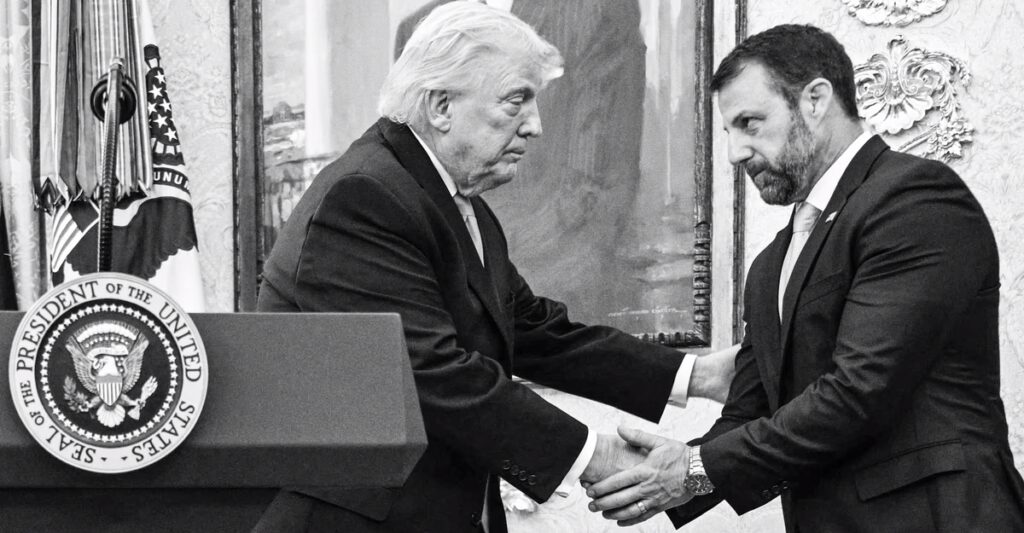
Markwayne Mullin cultivated a reputation in Congress as a brawler, but he sounded more like a peacemaker as he was sworn in this week as secretary of the Department of Homeland Security. “I don’t care what color your state is. I don’t care if you’re red or you’re blue,” Mullin, a former mixed-martial-arts fighter, said during the brief Oval Office ceremony, with President Trump looking over his shoulder. “My job is to be secretary of Homeland and to protect everybody the same.”
Mullin’s conciliatory tone has concerned some of the most ardent supporters of Trump’s immigration crackdown. They worry that the president has lost his nerve after the killings of Renee Good and Alex Pretti in January, and that firing Kristi Noem signaled a retreat from his promise to conduct the largest mass-deportation campaign in U.S. history. Some Trump opponents have a similar view; they are hopeful that the civic resistance displayed in Minneapolis stopped the administration’s authoritarian march in its tracks.
Although Mullin gives Trump a different face at DHS, his arrival doesn’t change the administration’s overarching goal—enshrined into law last July by the One Big Beautiful Bill Act—to remove 1 million people a year from the United States. Noem fell short of that during her tenure at DHS (U.S. Immigration and Customs Enforcement completed about 400,000 deportations last year), but she didn’t have the full kit of mass-deportation tools at her disposal, and her team was internally divided and often dysfunctional. Mullin inherits a rapidly expanding immigration-enforcement apparatus at DHS, amped up by $170 billion in additional funding.
Since Valentine’s Day, the Transportation Security Administration and several other DHS agencies have been shut down amid a bitter fight over ICE’s tactics. Early this morning, after Trump said he’d order Mullin to pay TSA staff, senators reached a deal that would fund everything in the department with the exception of ICE and Border Patrol. The deal, which now goes to the House, does not include the changes Democrats have demanded to ICE tactics. The lack of an annual budget will hardly be a roadblock to mass deportations. ICE’s Enforcement and Removal Operations, the branch of the agency focused on arrests and deportations, has an annual budget of $5.3 billion, but the OBBBA provided nearly six times that much—$30 billion—in operating funds. The shutdown, in other words, hasn’t been a fight about money or about stopping Trump’s mass-deportation plan. It’s been about whether ICE officers can continue to wear masks while they’re carrying out the mass-deportation plan that Congress has already paid for.
The spending spree is now Mullin’s to manage. He’s getting a new fleet of deportation aircraft and nearly a dozen warehouses that ICE plans to convert into megajails, some with capacity for 10,000 detainees. ICE is hiring and training 12,000 officers and agents, more than doubling the size of its workforce. It has signed roughly 800 new agreements with county sheriffs and local police departments willing to assist with immigration enforcement. And the Trump administration has won fresh legal victories from two appellate courts that have backed new measures to keep immigrants in ICE detention while their cases are pending. The potential pool of immigrants ICE can hold in custody—making them easier to deport—is now much larger.
Mullin said during his confirmation hearing that he doesn’t want DHS to be in the headlines every day—the same stance embraced by Tom Homan, the White House border czar. Homan has said that he’s been talking with Mullin several times a day, and DHS officials I’ve spoken with expect the mentorship to continue as the new secretary—who has never worked in federal law enforcement or led a federal agency—transitions into the role. The Homan approach to mass deportation is not as loud and flashy as the one employed by Noem; her chief adviser, Corey Lewandowski; and their roving field marshal, the Border Patrol commander Greg Bovino. But it may prove to be more effective at delivering what Trump wants.
When Trump sent Homan to take over in Minneapolis and remediate the political damage left by Noem’s team, Homan steered ICE back to “targeted enforcement,” developing lists of people to find and arrest rather than using the more indiscriminate tactics promoted by Bovino, who retired this week. Homan, who ran ICE during Trump’s first term and promoted the family-separation policy at the border, once received a service medal from President Obama, and has learned to tailor his message to whatever audience he’s addressing. Last year, he aggressively attacked Democrats for having so-called sanctuary-city policies, but since taking over in Minneapolis, he’s been calm and measured in his public statements, emphasizing a focus on immigrants with criminal records while assuring conservatives that “no one is off the table.”
[Read: Kristi Noem bought 11 warehouses to use as ICE jails. Now what?]
Homan’s tactical shift would give ICE a lower profile while aiming to make it easier for local jurisdictions and their police departments to cooperate on immigration enforcement. That’s what Mullin seemed to be referring to when he told senators at his confirmation hearing that he wanted ICE to operate more like a “transport” agency that could go around collecting deportees from the jails of local jurisdictions partnering with ICE.
Chad Wolf, who served as acting Homeland Security secretary at the end of Trump’s first term, told me that the president clearly signaled that he wants a “new approach” when he sent Homan to Minneapolis and replaced Noem with Mullin. “The overall policy goals, resources, and the law are likely to stay largely the same,” Wolf said, “but the way they carry out immigration enforcement may look different.”
Noem and her staff were belligerent toward Democrats and also toward reporters, many of whom were skeptical of their methods and claims. The department blocked the release of immigration data, weakened internal oversight, and drew complaints from lawmakers of both parties who said that Noem’s team ignored them. Mullin, who comes from the dealmaking world of Congress, has started off differently. When it came time for Senator Ruben Gallego of Arizona, a Democrat, to question Mullin during the confirmation hearing, Gallego greeted him with “Hello, neighbor”—their Senate offices are nearly adjacent—and Mullin replied, “Hey, brother.”
Two Democrats, Senator John Fetterman of Pennsylvania and Senator Martin Heinrich of New Mexico, voted to confirm Mullin, but Gallego did not. I asked him on Wednesday how he thought Mullin would do in the job. “I know he’s a good guy, but at the end of the day, what he does with DHS, or doesn’t do with DHS, is what worries me,” Gallego told me. “I don’t know who is actually going to be in charge of DHS.”
Gallego was referring to Stephen Miller, the White House homeland-security adviser. Gallego said that Miller continues pushing the administration in an extreme direction, citing Miller’s trip to Texas this week to urge Republicans to challenge a 44-year-old Supreme Court decision that upheld education rights for all children, regardless of immigration status. I asked Gallego whether he thought Mullin would take orders from Miller. “I think he’s going to take orders from the president,” Gallego said.
[Read: The wrath of Stephen Miller]
Noem’s rocky 14-month tenure at DHS was marked by two phases. During the first phase, last spring, before DHS got the infusion of new money, Noem led a shock-and-awe campaign aimed mostly at scaring people into leaving. Working off plans formulated by Miller, she spent heavily on ads urging “self-deportation,” while the White House deployed the FBI, the Marshals Service, and other federal law-enforcement agencies to help ICE.
By last May, when it was clear that this approach wouldn’t come close to meeting the White House’s goal of 1 million deportations, Noem and Miller were turning up pressure on the ICE workforce. They set a quota of 3,000 arrests a day and threatened to fire ICE officials who fell short, telling them to sweep up laborers in parking lots. This fueled resentment among overtaxed rank-and-file ICE officers—and still didn’t deliver the deportation numbers Miller wanted. Noem sent Bovino and his Border Patrol agents into Los Angeles last June, and viral social-media clips of agents raiding Home Depot parking lots soon followed.
[Read: Trump loves ICE. Its workforce has never been so miserable.]
Noem’s second phase started after Trump signed the spending bill on July 4, 2025, as Lewandowski implemented a policy requiring the secretary’s approval on every DHS contract worth more than $100,000. The enormous amount of money flowing across Noem’s desk led to complaints of bottlenecks and worsening bureaucracy, and raised suspicions that Lewandowski was grifting off the contracts. He has denied any wrongdoing.
Mullin said that he will rescind the contract-review policy and told senators, “I’m not a micromanager.” But the divided leadership structure that devolved into rivalries during Noem’s tenure remains in place, with Homan as border czar and Miller viewed as the shadow secretary who operates more like an actual czar. Miller continues to hold daily 10 a.m. conference calls with DHS leaders and the heads of other federal agencies to demand updates on the machinery of mass deportation: the pace of ICE hiring, the number of daily arrests, the status of key contracts. Noem reportedly told a colleague, “Everything I’ve done, I’ve done at the direction of the president and Stephen,” according to an Axios report in late January.
Andrea Flores, a former immigration adviser to Joe Biden, told me that the White House has remained steadfast in its mass-deportation goals and has been “putting the infrastructure in place to signal that arrests will continue to grow.”
Homan is a key messenger, Flores said, and Miller is the one setting the agenda.
“The DHS-secretary role appears to be the least influential member of the president’s immigration-policy team,” she said.
Trump officials continue to push an extreme agenda at DHS and across the federal government, Flores said, noting that the administration will present oral arguments next week to the Supreme Court in its effort to limit birthright citizenship.
The post Kristi Noem is Gone. Now Mass Deportations Can Really Begin. appeared first on The Atlantic.