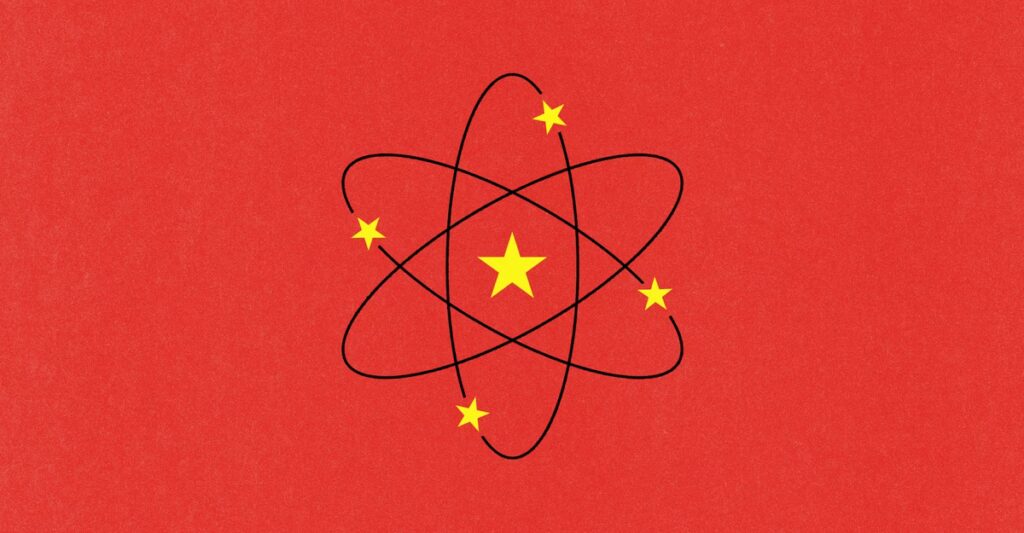
If China finally eclipses the United States as the world’s preeminent scientific superpower, there won’t be an official announcement. Neither will there necessarily be a dramatic Promethean demonstration, a bomb flash in the desert, a satellite beeping overhead, a moon landing. It will be a quiet moment, observed by a small, specialized subset of scientists who have forsaken the study of the stars, animals, and plants in favor of a more navel-gazing subject: the practice of science itself.
This moment may now be at hand. American science has been the envy of the planet since the Second World War at least, but it has recently gone into decline. After President Trump took office last year, his administration started vandalizing the country’s scientific institutions, suspending research grants in bulk and putting entire lines of cutting-edge research on ice. In August, Trump’s Department of Health and Human Services canceled $500 million in mRNA-vaccine research, less than two years after Americans won a Nobel Prize for pioneering that technology. More than 10,000 science Ph.D.s have left the federal workforce, according to one group’s estimate, and the White House has been withholding money from frontline researchers in computer science, biomedicine, and hundreds of other fields that will define the human future. As one historian of science put it to me in July, “This is an unparalleled destruction from within.”
[Read: Every scientific empire comes to an end]
While all of this has been unfolding, metascientists have been following a very different story overseas. They’ve watched in wonder as China has built out a gigantic research apparatus at world-record speed, stocking institutions, universities, and laboratories with talent and some of the best equipment and facilities money can buy. In 1991, China spent $13 billion on research and development. Today, its annual spending is more than $800 billion, second only to the U.S. The Chinese government just unveiled a plan to grow the country’s science budget by 7 percent each year for the next five years. According to a new forecast from Nature, China’s public spending on research is likely to overtake the United States’ by 2029.
Just because a research ecosystem is sprawling and expensive doesn’t mean that it reliably creates and diffuses new knowledge. (At its peak, the Soviet Union had the world’s largest scientific workforce, yet it couldn’t keep pace with America’s more open system.) But we haven’t seen the scale at which Chinese science will operate once the country fully taps its talent pool. China’s population is four times the size of America’s, and its culture is unabashedly pro-science, even relative to other developed countries. Its universities are already handing out twice as many STEM degrees as their U.S. counterparts do, and nearly double the number of Ph.D.s.
For almost a decade now, Chinese scientists have been publishing more papers too. Again, the sheer volume of this effort gives us only a coarse sense of what’s happening there. When China began to dominate that metric, some of its universities were paying cash rewards to scholars for each publication, and a lot of Chinese research papers were shoddy make-work. The government has since ordered universities to stop encouraging academic mass production. The factors that drive salaries and promotions for professors are now more fine-grained, and it shows: China’s share of the world’s most widely cited scientific papers has grown, Caroline Wagner, a professor at Ohio State University who studies scientific policy, told me. In 2023, Chinese scientists produced 58,000 of the world’s roughly 190,000 most influential publications, according to Wagner. Their contribution was second only to the United States’. Wagner likes this metric because it’s relatively hard to game (though some Chinese scientists do seem to be trying).
If you were building a bespoke dashboard to monitor the state of science in China, you’d have many such data streams to choose from. The problem is, they’d all be lagging indicators. We can’t easily assess the quality of research that China’s scientists are doing today, because that work won’t be published for another year or two at least, and then its scientific influence—measured by the resulting papers’ citation rates—won’t peak until a few years after that, on average. (Some papers experience a citation boom even later; metascientists call them “sleeping beauties.”) Nobel Prizes have an even more dramatic lag: So far, only one Chinese scientist has earned a Nobel for scientific work done in China, but Nobel laureates are often summoned to Stockholm decades after they’ve completed their revolutionary research.
In the meantime, we do have some more immediate signs that Chinese scientists are ascendant. Last year, a team of American and Chinese researchers published an analysis of international research collaborations. Their machine-learning model identified the lead authors of nearly 6 million scientific teams to see who was actually in charge. The team found that among U.S.-China collaborations, the share of leaders who were affiliated with Chinese institutions had grown from 30 percent in 2010 to 45 percent in 2023. The researchers projected that China will pull even with the U.S. next year or in 2028 at the latest.
In the end, China’s scientific-superpower status will likely depend on the world-changing force of its discoveries. “We don’t just want papers,” Yian Yin, a professor of information science at Cornell, told me. “We want papers that turn into real theoretical insights or technologies.” Some of these can be tracked by looking at how research is cited in patent applications, but this additional diffusion can introduce its own lag of 10 years or more. Even so, China’s fast rise in the applied sciences is already obvious, Yin said. The country is in the midst of a solarpunk revolution. Thanks to its advances in chemistry and materials science, China has caught up with or surpassed the U.S. in the design and manufacture of advanced batteries, electric vehicles, and solar cells—key technologies for the 21st century.
Future historians of science will have a better perspective on precisely when the torch-passing occurs, if it does. The significance of a scientific achievement is not always easy to recognize in real time. When Chinese alchemists invented gunpowder in the ninth century, no one grasped the full range of its potential uses. It was initially thought to be a curiosity, a firework or a special effect, until Song-dynasty arms dealers started using it to make fire arrows and other military explosives. European scientists heard about it only centuries later.
A thousand years before that, when the Chinese invented paper, they initially used it for padding and packing. No one thought to use it for disseminating knowledge. About that same time, Chinese scholars were compiling the Jiuzhang Suanshu, a mathematical treatise focused on solving practical problems with computation. There are 246 of them, drawn from the everyday realms of agriculture, land surveying, and taxation. One chapter includes a matrix technique. It is now regarded as an early intellectual ancestor of matrix-based linear algebra, which powers neural networks, up to and including large language models.
History is a story that we tell ourselves about how we got to the present, and if China soon sits atop the sciences, history will be reinterpreted. China’s past glories may be recast as part of an extended narrative of dominance, and America’s eight-decade reign may come to be regarded as a mere blip.
The post The Next Scientific Superpower appeared first on The Atlantic.