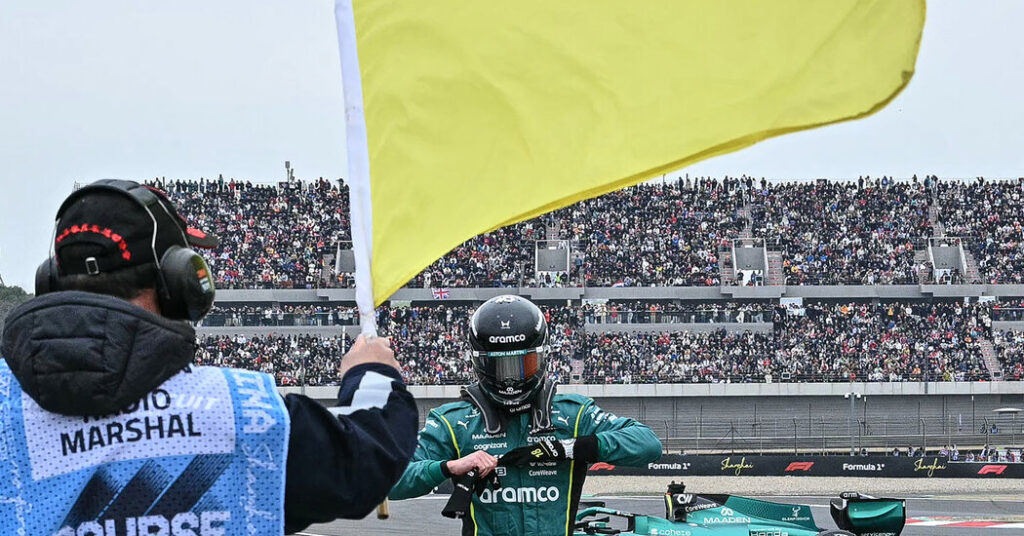
It has been the worst start to a season since Aston Martin returned to Formula 1 in 2021.
Fernando Alonso and Lance Stroll, the team’s drivers, retired in the first two Grands Prix in Australia and China because of technical issues related to the power unit from its supplier, Honda. The automaker’s home race in Japan is this weekend.
“It’s not a great time for the team,” Stroll said after the race in China in March. “Everyone’s frustrated with where we are. It’s not the way we want to go racing.
“But there’s a lot of potential, of that I have no doubt. We have great facilities, very talented people inside the team, and Honda has won four of the last five world championships. I have a lot of belief in the whole team.”
Honda announced in 2020 that it would leave Formula 1 at the end of 2021. It continued a partnership with Red Bull, helping the team win the constructors’ championship in 2022 and 2023, and Max Verstappen win four drivers’ titles from 2021 to 2024. He missed out on a fifth last year by 2 points.
Following a change to the power unit regulations this season, with a 50-50 split between internal combustion and electrical energy, Honda and Aston Martin formed a partnership.
Since preseason testing at the Circuit de Barcelona-Catalunya in Spain in January Honda’s power unit has had issues. In testing in Bahrain in February, the extent of those problems became apparent.
“During the Bahrain preseason test, we experienced unexpected vibration which caused damage to battery-related components of the power unit,” Koji Watanabe, Honda Racing Corporation president, said.
A few days before the first race in Australia, Adrian Newey, Aston Martin team principal, said the vibrations were affecting the car.
“That vibration into the chassis is causing a few reliability problems,” he said. “Mirrors falling off, taillights falling off, all that sort of thing, which we are having to address.”
Worse was the impact on his drivers. “Fernando is of the feeling that he can’t do more than 25 laps consecutively before he will risk permanent nerve damage in his hands,” Newey said this month. “Lance is of the opinion that he can’t do more than 15 before that threshold.”
Honda introduced “countermeasures,” Watanabe said without being specific.
In Australia, Stroll did not take part in qualifying because the team did not have time to rebuild his car after issues with the power unit forced him to miss the last of the three practice sessions.
The F.I.A., the sport’s governing body, cleared Stroll to compete in the race. He completed 43 laps before retiring, Alonso 21. Both cars experienced problems on track that forced them to return to the garage for checks. They were sent back out before being told by the team to stop to preserve components.
In China, Alonso and Stroll finished the sprint race on Saturday, which is one-third the distance of a Grand Prix.
In the Grand Prix, Stroll retired after nine laps with a battery-related problem. Alonso managed 32 laps before the vibrations in his car became too severe.
In-car footage showed him taking his hands off the steering wheel when driving on a straight to reduce the pain.
“The vibration level was very high,” Alonso said. “At one point, from lap 20 to 35, I was struggling a little to feel my hands and my feet, and we were one lap behind, we were last, so there was no point to keep going.”
Alonso said repairs were introduced over the weekend to counter the vibrations, which were worse during the race than in any other session.
“We lowered the r.p.m. of the engine and things like that, so everything vibrated less,” he said.
“But in the race, obviously, you needed to go high in some of the r.p.m.s to make an overtake, or to recharge the battery or something like that. Over time, it became more difficult, more demanding.”
Alonso said Honda needed more time on the dyno, a specialized testing rig to evaluate the performance of an engine without a car running on track, to address the problems.
Shintaro Orihara, Honda track-side general manager and chief engineer, said the failures of the cars in China were unsatisfactory.
On the positive side, he said, “We ran more miles than in Melbourne, which is encouraging. We also increased our reliability throughout the sprint weekend, but this isn’t yet enough to complete the full race distance.
“We have improved the vibrations on the systems side, but it’s still an issue for driver comfort. This is a key area to address as we look ahead to the next race in Japan.”
Mike Krack, Aston Martin’s chief track-side officer, said it was difficult to say how long it would take Honda to resolve the vibration issue.
“We had some additional countermeasures in China compared to Melbourne,” he said. “The work is continuing, and it’s in all areas basically, and I have to say we have not had any other related issues, other than the driver stopping in the race.
“But we have not had bits falling off or anything like that, which can happen as well. So we need to keep working, to increase the reliability of the whole package, and then we need to work on the performance as well.”
Alonso completed 33 consecutive laps in China, the most the car has managed in one stint since it first hit the track in Barcelona, providing Aston Martin and Honda with valuable information.
Newey said the difficulties were not Honda’s alone to address, but also those of his team.
“It’s using a lot of energy, in the human sense as opposed to the kilowatt sense, on our part to try to work with Honda and to produce the best overall solution,” he said.
It is a difficult situation for the drivers, in particular, Alonso, who turns 45 in July. Newey said that Alonso, a two-time champion who won the second of his titles 20 years ago, is “still super quick, super talented, super sharp.”
“Talking to him, he doesn’t feel as if he’s suffering in any way,” Newey said. “His eyesight’s still very good, his reactions.”
“He’s very proud of the fact that he was the fastest starter last year on reaction time. He’s an amazing person, but for Fernando, it’s a hard mental place to be in at the moment.”
Alonso said his situation was “less tough than you think” because it did not matter whether he finished third, fifth or 17th in a Grand Prix.
“To finish in any other position that is not first, for me, it’s the same pain and the same struggle,” he said.
“Obviously, we are now on this journey with the team, which is not ideal, but it’s the first year of this collaboration between Aston Martin and Honda. We have to go through this moment in time, and I’m ready to help as much as I can.”
The post For Aston Martin, It’s a Whole Lot of Shaking appeared first on New York Times.