Humans have long dreamed of a cure-all.
In Greek mythology, the goddess Panacea carried a potion that could heal any disease. Chinese alchemists during the Tang Dynasty sought an “elixir of life” to grant immortality. In the late 19th century, radium, newly discovered by Marie Curie, was hailed as a miracle ingredient — mixed into lotions, candies, even toothpaste — before researchers realized it could also kill.
The modern contender is a class of weight-loss and diabetes drugs known as GLP-1s, sold under the brand names Ozempic, Wegovy, Mounjaro and Zepbound.
As prescriptions have soared, clinicians have reported unexpected benefits in addition to controlling blood sugar and body weight. “I have patients who email me and they say, ‘I’ve had rheumatoid arthritis, and my hands are a mess,’ and then take these drugs and now, a week later, they feel brand new. There’s no weight loss — but they are getting these dramatic anti-inflammatory effects,” said Daniel Drucker, an endocrinologist at the University of Toronto who has studied GLP-1s for decades. Similar improvements have been noted by Harlan Krumholz, professor of medicine at Yale University, in blood pressure, and by other clinicians in sleep apnea, joint pain, liver disease, and possibly heart disease, asthma and addiction.
The medications differ by brand. Ozempic and Wegovy are semaglutides, synthetic versions of GLP-1 that regulate blood sugar and signal fullness, while Mounjaro and Zepbound are tirzepatides, which mimic GLP-1 and also act on a second hormonal pathway, GIP, or glucose-dependent insulinotropic polypeptide, potentially enhancing their effects.
These mechanisms help explain the remarkable benefits clinicians are now observing — but they do not come without risks. Rare but serious complications have been reported, including stomach paralysis, a condition in which the stomach stops moving food normally, and an unusual eye disorder that can threaten vision. In March, researchers at the annual meeting of the American Academy of Orthopaedic Surgeons reported a link between GLP-1 use and osteoporosis and tendon tears.
For all the drugs’ promise, their benefits come with another important caveat: They don’t necessarily stick around. Early evidence suggests many of these effects fade once the medication is stopped. Weight regain can start within weeks of stopping the drug — and studies suggest many patients regain much of the weight within a year. This month, a new study in BMJ Medicine showed that even a short break from the drugs significantly increases the risk of heart attack, stroke and death compared with being on the medicines — and the effects may not be fully reversible.
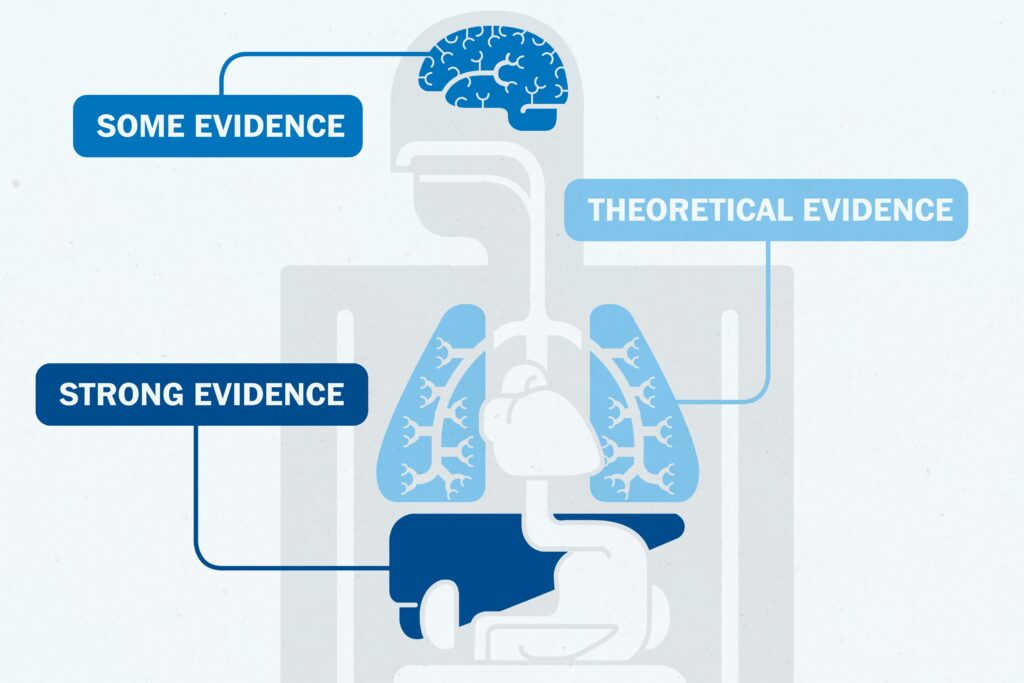
Even so, GLP-1s are forcing scientists to rethink what a single drug can do. Beyond metabolism, the medications appear to influence inflammation, the immune system and brain function, revealing how interconnected these systems may be. What began as a treatment for high blood sugar and body weight now offers a window into the broader architecture of human health — and hints at ways medicine might address diseases once considered entirely separate.
The proven, promising and theoretical
Kidney disease
In a clinical trial with more than 3,500 patients, semaglutides dramatically reduced the risk of kidney complications in people with Type 2 diabetes and chronic kidney disease. The study, presented at the European Renal Association meeting in Stockholm in 2024 and simultaneously published in the New England Journal of Medicine, was stopped early due to the strong findings. The study also showed improvements in the severity of disease were unrelated to changes in body weight and that the “mechanisms of kidney protection with semaglutide are likely to be multifactorial.” The Food and Drug Administration in January 2025 approved Ozempic to treat chronic kidney disease among people who also have Type 2 diabetes.
Heart disease
The FDA in March 2024 approved semaglutide for cardiovascular disease in those who are overweight or obese — a group that is estimated to include millions of Americans.
A November 2023 study in the New England Journal of Medicine found that semaglutide reduced the risk of major cardiovascular events — including heart attack, stroke and cardiovascular death — by about 20 percent in overweight or obese adults who already have established cardiovascular disease but not diabetes.
The following year, another trial showed that tirzepatide lowered the risk of serious heart‑related problems and improved overall health in patients with obesity and a type of heart failure known as heart failure with preserved ejection fraction.
Liver disease
A study published in 2024 in the New England Journal of Medicine and funded by Novo Nordisk, the maker of Ozempic and Wegovy, found that semaglutide significantly improved outcomes for people with metabolic dysfunction-associated steatohepatitis (MASH) and liver fibrosis. MASH is a severe form of metabolic liver disease — the progressive stage of what was once commonly called fatty liver disease — and is closely linked to obesity and cardiometabolic dysfunction, conditions that affect a large share of U.S. adults.
A number of smaller studies with limited time frames showed promising results in several indicators of this type of liver disease, but more comprehensive research is needed. One of the most recent studies focused on HIV patients, who can be vulnerable to the condition as a side effect of some treatments, and found that liver fat fell by 31 percent in patients taking semaglutide for six months.
In August 2025, the FDA granted accelerated approval to semaglutide for the treatment of MASH in adults with moderate to advanced liver scarring.
Sleep apnea
Two major clinical trials have shown that tirzepatide improved symptoms of obstructive sleep apnea in people with obesity. Being overweight or obese is the top risk factor in the condition that affects millions of U.S. adults. The results of the studies, funded by Eli Lilly, were presented at the American Diabetes Association conference in Orlando and published in the New England Journal of Medicine.
In December 2024, the FDA made Zepbound the first approved treatment for moderate to severe obstructive sleep apnea in adults.
Alzheimer’s and dementia
A paper published in January 2025 using Department of Veterans Affairs data of nearly 2.5 million patients found that people prescribed GLP-1 drugs had a lower relative risk of developing dementia compared with those who took other drugs for diabetes. In August 2024, an analysis of the medical records of more than 100 million U.S. patients showed that taking Ozempic was linked to a lower risk of cognitive problems, according to a paper in the Lancet’s eClinicalMedicinejournal. And another study out that summer, presented at the Alzheimer’s Association International Conference, found that taking liraglutide, an older GLP-1 drug, was tied to much slower cognitive decline compared with not taking the drug and that it appeared to reduce shrinkage in key parts of the brain.
But in November, Novo Nordisk announced that its two largest gold-standard randomized trials involving people with mild cognitive impairment or dementia showed that semaglutide conferred no cognitive benefits.
The results were a major disappointment, but researchers have not abandoned the idea of using GLP-1 drugs to treat neurodegenerative disease. Some scientists have suggested the Novo Nordisk trials may have come too late in the course of illness — enrolling patients who were already experiencing cognitive decline — and that the drugs might prove more effective if taken before symptoms develop. New studies aimed at testing that possibility are now being designed.
Addiction
Some doctors are prescribing weight-loss drugs like Ozempic and Zepbound off-label to help reduce cravings for alcohol and illicit drugs.
Ozempic and other drugs work by prodding GLP-1 receptors in the abdominal area, but there are similar receptors in the brain, including some involved in our reward pathways. Scientists have wondered whether the medications might help dampen that system by interacting with dopamine activity in the brain.
A large study in the BMJ published in March of more than 600,000 U.S. veterans with Type 2 diabetes found that starting a GLP-1 was associated with a 14 percent lower overall risk of developing alcohol, cannabis, cocaine, nicotine, and opioid use disorders. Among veterans with preexisting substance-use disorders, GLP-1 use was also linked to fewer drug-related emergency visits, hospitalizations, overdoses, deaths, and instances of suicidal behavior over three years.
Likewise, a study published in February 2025 in JAMA Psychiatry found that patients with alcohol-use disorder drank less and had fewer cravings for alcohol and cigarettes over a nine-week treatment period when given a weekly injection of semaglutide.
A large placebo-controlled trial is in the works.
Arthritis and inflammation
A new frontier for GLP-1 drugs is inflammation, a normal defensive response from the body that involves releasing chemicals to fight off invaders or damage. But if the response goes on too long or in the absence of any harm it can hurt healthy tissue and lead to a range of chronic diseases. Eli Lilly is zeroing in on what one executive called a “big bucket” of inflammatory diseases — including Crohn’s disease and severe skin and lung disorders.
A study published in October 2024 in the New England Journal of Medicine found that patients in a randomized clinical trial who were treated with semaglutides had a decrease in pain from knee osteoarthritis and degenerative joint disorder versus those treated with a placebo.
The authors explained that knees suffer from excess weight but that it’s unclear whether the impact was due to the weight loss or whether there’s a specific action of the GLP-1 drugs on the joints. As for the latter possibility, other arthritis experts have theorized that a decrease in inflammation due to the medications may also play a role in reducing pain.
In May 2024, an analysis in Obesity Science and Practice using medical claims data found that taking semaglutides may reduce the risk of developing knee osteoarthritis.
Then, in the June 2024 issue of the Journal of Clinical & Translational Endocrinology, researchers wrote that small studies show patient improvement in renal function, psoriasis and fat around the heart, along with a reduction in risk of blood clots and enhancement in the ability to form new blood vessels. There is evidence this may be related to semaglutide’s potential ability to modulate or reduce inflammation, but the exact mechanisms of how this might occur are not fully understood.
Asthma
A large study by researchers in the United Kingdom published in April 2025 examined the effects of GLP-1 drugs in people with obesity and asthma. The analysis involved about 60,000 patients, including roughly 10,000 GLP-1 users who had both obesity and asthma.
Patients on the drugs had better control of their asthma symptoms, but they did not see measurable improvements in lung function, researchers found. They theorized that the medications’ anti-inflammatory effects — rather than any direct impact on the airways themselves — may help reduce symptom flare-ups and improve overall disease control.
Cancers
Studies point to potential benefits and risks. Although animal research prompted a thyroid cancer warning on Ozempic’s label, this effect has not been demonstrated in humans. At the same time, some evidence suggests that GLP-1 drugs may reduce the risk of certain obesity-related cancers.
Excess weight itself is often associated with a worse response to cancer treatment, but there is evidence from multiple studies in animal and laboratory experiments that GLP-1 medications may reduce cancer cell migration and proliferation — as well as tumor growth — through reducing inflammation or other means.
A large retrospective study that looked at the electronic medical records of 101.2 million patients with Type 2 diabetes found that those who were taking GLP-1 drugs had a markedly reduced risk of colon cancer. The analysis, conducted by scientists at Case Western Reserve University School of Medicine and published as a research letter in JAMA Oncology in December 2024, does not prove that the medication caused the reduction in risk. The scientists, however, noted that the link is strong enough to warrant further study.
Separately, a very small study published in the journal Obesity in May 2023 suggested that semaglutides may aid in the activity of natural killer cells, a type of white blood cell, which can hinder cancer cells from multiplying and turning into tumors.
A review published in Nature Cancer in January noted dozens of GLP-1 clinical trials related to cancer and highlighted work in endometrial cancer, breast cancer and prostate cancer.
Covid-19
Some evidence suggests GLP‑1 drugs could blunt the worst outcomes of viral infections.
While semaglutide does not appear to prevent covid‑19 infection, a study of 17,604 adults with obesity found that those taking the drug had a 19 percent lower risk of death and fewer serious complications if they became infected. In a commentary on the findings, Jeremy Samuel Faust, an emergency physician at Brigham and Women’s Hospital and an assistant professor at Harvard Medical School, marveled that “semaglutide (and others like it) could have dramatically improved outcomes of a pandemic caused by a respiratory virus, of all things.”
Fertility
Social media has been filled with anecdotal reports of “Ozempic babies,” but there is limited data about the medications and fertility.
For now, many doctors theorize that the surprise pregnancies are mostly due to the indirect benefits of treating diabetes and weight loss. Past studies show obesity itself can make getting pregnant more difficult and is linked to pregnancy complications and miscarriage. But some scientists have wondered whether GLP-1 medications could improve the quality of eggs and sperm independently.
Women with Type 2 diabetes can have an imbalance in the hormones estrogen and progesterone that can interfere with ovulation and lead to irregular periods. In men, there’s some evidence that weight loss associated with treating obesity with semaglutide may help increase sperm count, concentration and motility, but more studies are needed on the role of the drugs on male fertility.
‘Food noise’
“Food noise” may not be a formal medical term, but clinical and behavioral studies suggest these drugs reduce both physiological hunger and the brain’s response to food rewards.
Clinical trials of GLP-1 drugs have consistently shown reductions in appetite, cravings and intrusive food thoughts. In large randomized trials, participants taking semaglutide and tirzepatide not only lost significant weight compared with those taking placebos but, on validated questionnaires, also reported less hunger and reward-driven eating, suggesting the drugs blunt appetite. In an 18-week randomized clinical trial reported in Diabetes in June 2023, for example, adults with obesity taking tirzepatide showed significantly greater reductions in hunger and cravings.
Smaller brain-imaging studies show reduced activation in reward-related brain regions in response to high-calorie food cues among people taking GLP-1s.
Polycystic ovary syndrome (PCOS)
Some doctors have been prescribing Ozempic off-label for polycystic ovary syndrome (PCOS), an often-misdiagnosed condition in which a woman’s body produces excess testosterone resulting in painful and heavy periods, infertility and other complications including metabolic ones.
Scientists say there are at least a dozen studies involving GLP-1 use underway for women with PCOS and obesity. In a study published in the Journal of Clinical Medicine in September 2023, researchers reported that low doses of semaglutide significantly reduced body weight in almost 80 percent of obese PCOS patients who did not respond to previous treatment and that their menstrual cycles normalized.
“Of course, other studies are needed, but these initial results look very promising,” the authors wrote.
About this story
Reporting by Ariana Eunjung Cha. Graphics and animations by Aaron Steckelberg and Kati Perry. Story editing by Lynh Bui. Graphics editing by Emily M. Eng and Manuel Canales. Design editing by Betty Chavarria. Video editing by Drea Cornejo. Copy editing by Christopher Rickett.
The post 13 surprising ways GLP-1s may benefit the body, according to science appeared first on Washington Post.