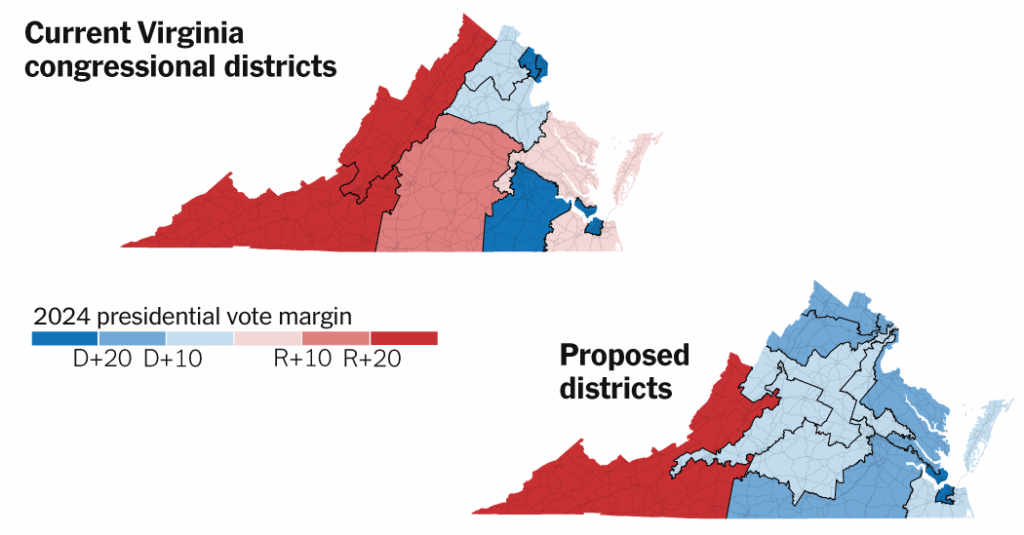
Virginians are voting on a proposed congressional map that could eliminate all but one Republican-leaning district, the latest checkpoint in the national race by both parties to redraw districts ahead of the midterms.
Early voting on the April 21 referendum has been underway since March 6 and will continue through April 18.
The number of early in-person and mail-in ballots cast is slightly higher than at this point in the 2025 governor’s race, which saw to the highest nonpresidential voter turnout in state history.
Overanalyzing the early vote can be perilous because of how much remains unknown. In Virginia, it is even harder to analyze than in some other states, because voters do not declare a political party when they register to vote, and geographic analysis of where ballots have been cast does not offer information about who actually voted in those districts.
Voter data does, however, indicate whether voters have participated in party primaries. And that information can give us a rough sense of the partisan breakdown of those who have cast ballots so far.
The partisan breakdown is similar to the one seen during the early vote in the 2025 governor’s race, which Abigail Spanberger, the Democratic candidate, won by more than 15 percentage points. Such a disparity is normal given Democrats’ proclivity for early voting and offers no direct indication of how people, particularly those who have no previous history of voting in primaries, are voting. And early and absentee voters only make up a portion of the overall vote in any election, with voters who cast ballots on Election Day tending to be significantly more conservative.
This data, compiled by L2, a nonpartisan data firm, includes voters who have cast early or mail ballots ahead of the April 21 election, and it indicates whether they have participated in Democratic primaries or Republican primaries in the past. (It does not show for whom they voted.) The New York Times classified voters as Democratic or Republican based on which party’s primaries they had participated in most frequently.
Voters who have not participated in a Democratic or Republican primary in recent years have made up a smaller share of the early electorate in this election than they did in 2025. But participation from those unaffiliated voters increased as Election Day approached in 2025. The split between voters with previous Democratic and Republican participation stayed relatively stable.
Jonah Smith is a data journalist at The Times, specializing in computational reporting and analyzing large data sets.
The post Tracking the Early Vote in Virginia’s Redistricting Referendum appeared first on New York Times.