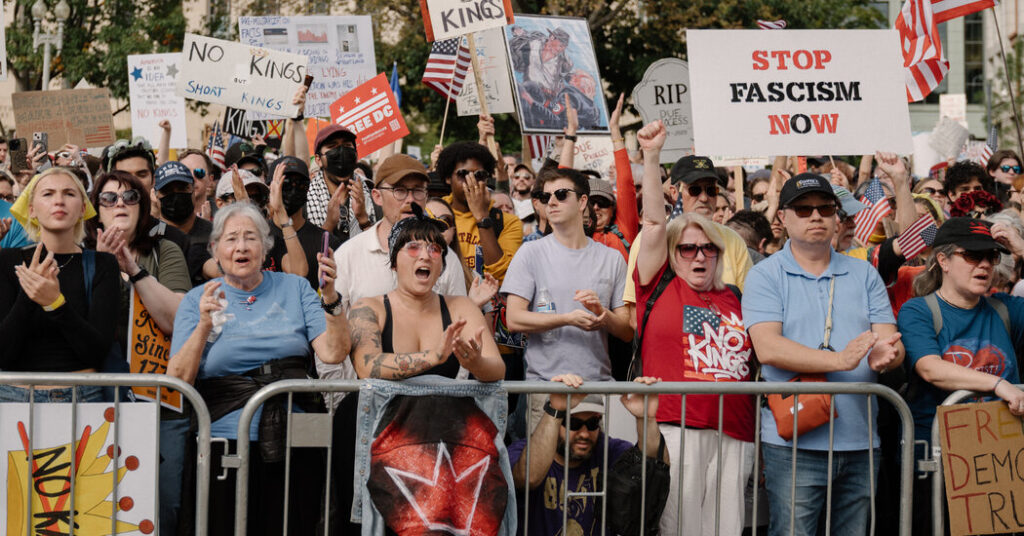
More than 3,000 “No Kings” demonstrations are scheduled across the country on Saturday to condemn an array of President Trump’s policies and to express general discontent toward the president, whom the protesters view as acting like a monarch.
“Trump wants to rule over us as a tyrant,” the No Kings website says. “But this is America, and power belongs to the people — not to wannabe kings or their billionaire cronies.”
A spokeswoman for the White House, Abigail Jackson, said in a statement that “the only people who care about these Trump derangement therapy sessions are the reporters who are paid to cover them.”
The events come as Mr. Trump’s approval ratings hover around 40 percent, and Democrats are hopeful to make inroads in the midterm elections.
It’s the third such protest organized nationwide over the past year. Here’s what to know.
Who organizes the No Kings Protests?
The events on Saturday have been organized by national and local groups, including well-known progressive coalitions such as Indivisible, 50501 and MoveOn.
Following a similar playbook as the two protests last year, the events are supposed to be peaceful gatherings open to people of all ages and backgrounds. Anyone can sign up to host an event, and the organizers have offered online trainings on safety, security and de-escalation.
What is the goal of No Kings?
Like the earlier ones, the protests are not focused on any particular issue. Instead, they are meant to unite people who have various grievances about the federal government. In the past, that has included aggressive immigration enforcement voting rights and the costs of health care. On Saturday, the actions are likely to feature people speaking out about the war in Iran.
When was the first No Kings protest?
In June 2025, on the same day that Mr. Trump scheduled a military parade in Washington for the Army’s 250th anniversary — which also coincided with his 79th birthday — planned protests took place in cities across the country, and internationally in countries including Britain, Mexico and Germany. The event was branded as a “day of defiance” against a perceived overreach by Mr. Trump and his allies.
Four months later, more than seven million people attended No Kings Day demonstrations on Oct. 18 in cities in all 50 states, according to organizers. Although The New York Times could not confirm that count, large crowds were evident in cities across the country, with people waving American flags and chanting “No more Trump” as they gathered to demonstrate outrage over immigration raids, the deployment of federal troops in cities, government layoffs and the rollback of vaccine requirements, among other measures.
In New York City, officials said that more than 100,000 people had attended, ranging from children to older adults.
Where are No Kings protests taking place?
The upcoming protests are collectively expected to see larger turnout than the previous two events. Organizers have asked participants to avoid confrontations and to not bring any weapons.
Organizers have created an online map of local events, with new events being continuously added.
Most of the protests are scheduled to run for about two hours in the late morning or early afternoon. They will be held in public parks, downtown streets and other public spaces.
Pooja Salhotra covers breaking news across the United States.
The post What We Know About Saturday’s ‘No Kings’ Protests appeared first on New York Times.