Early last year, New York flipped a switch on an audacious system to charge drivers entering Midtown or Lower Manhattan, the first of its kind in the United States. Passenger cars with an E-ZPass had to pay $9 to enter Manhattan below 61st Street from morning until 9 p.m., with lower prices overnight and higher prices for larger vehicles.
To hear the furious objections and lawsuits at the time, it was as if the city and state wanted to return the island’s streets to horses and buggies. “It’s nothing more than a scam — a cash grab,” said Representative Mike Lawler, a Republican congressman from New York City’s northern suburbs. “A disaster,” said New Jersey’s governor at the time, Philip Murphy, a Democrat. “Businesses will flee,” warned Donald Trump, who was then president-elect and vowed to kill the plan when he took office. He predicted that it would be “virtually impossible for New York City to come back as long as the congestion tax is in effect.”
The scaremongers were wrong. Over its first 14 months, the congestion pricing system has exceeded even the high hopes of many supporters. It has reduced traffic, improved the quality of life and even provided a boost for businesses. Talk of killing it has faded. This month, a federal judge ruled that the Trump administration’s attempt to end the program was illegal.
While the program could still use some tweaks, its success should encourage some other large cities to consider their own congestion pricing plans as part of broader efforts to improve public transit. Cities are safer, healthier and more pleasant when residents spend less time stuck in traffic or surrounded by it.
The triumph of congestion pricing also offers a larger reminder: Government, done right, has immense power to improve people’s lives. Many Americans have grown cynical of government, and they are right to be disappointed about its frequent failure to deliver results in the 21st century. But the answer cannot be allowing the private market and pursuit of profits to dominate American life. Leaders should instead take political risks, as officials in New York did, to create programs that can deliver tangible results.
Here’s how effective the system has been:
-
Less traffic. Each day, about 73,000 fewer cars enter Manhattan below 61st Street than before the system was in place. That is an 11 percent drop. “I never drive into the city anymore,” one Brooklyn resident told The Times. “I only take the subway. It’s a relief.” Overall, vehicles travel 4.5 percent faster within the zone — and much faster at key crossings. Car speeds are up 51 percent at the Holland Tunnel and 25 percent at the Lincoln Tunnel. Traffic has also eased in parts of Brooklyn, Queens, the Bronx and the suburbs, because fewer cars are moving through those neighborhoods to get to Manhattan.
-
More mass transit riders. About 300,000 more people rode the city subways each day last year than in 2024, an 8.9 percent increase. Ridership is also up on New York City’s buses — which are moving more quickly now — and on suburban railroads. The new system can also help the transit system in the future, because increased ridership and the new congestion fee bring in money that can be used for mass transit improvements and expansions. (The base congestion fee will rise from $9 to $12 in 2028 and $15 in 2031.)
-
A safer, quieter city. The number of people seriously injured in a car crash declined by 9 percent in the zone in 2025. Vehicle noise complaints are down 17 percent. “Fewer cars honking, fewer cars running red lights, fewer cars blocking crosswalks,” another Brooklyn resident told The Times. Air quality appears to be improving, too, although it is not clear how much of that is because of congestion pricing.
-
A better business environment. Defying Mr. Trump’s prediction that Manhattan would become a commercial “ghost town,” business revenue in the city rose more quickly last year than in the surrounding suburban counties. Congestion pricing is obviously not the only reason, but it has helped. The city is a more pleasant place to walk, and pedestrian traffic below 61st Street has risen.
If the success of congestion pricing were limited to a single city, skeptics might still have reason to doubt the policy. But success is now the norm. Congestion pricing has reduced traffic and pollution in London, Milan, Singapore and Stockholm during the 21st century. In London, vehicle traffic in the central city, measured by total distance driven, has declined about 30 percent since the program began in 2003, even as the city’s population has grown more than 20 percent. This track record demonstrates that congestion pricing can work in a variety of urban areas.
The biggest challenge for the policy has been the surge in ride-sharing cars and home delivery vehicles in recent years. They have caused traffic to remain a problem even in cities with congestion pricing, including New York and London. One reason is that these vehicles often do not pay their fair share. A typical passenger car in New York does not spend hours circulating city streets. An Uber does, yet it pays the same fee as the passenger car. Delivery trucks are even more problematic because of their size and frequent stops. Charles Komanoff, a transportation planner who helped design New York’s system, has smartly suggested that taxis and ride-sharing cars and delivery trucks pay per minute, rather than per ride.
Even with its limitations, congestion pricing has made traffic less severe than it would otherwise be. And more cities would benefit from considering their own versions. The average American commuter wastes more than 60 hours a year in traffic, compared with 38 hours in 2000, according to the Texas A&M Urban Mobility Report. Cities with crowded downtowns and robust public transit networks, such as Chicago, Philadelphia, San Francisco and Washington, are the best candidates for congestion pricing. Already, Boston is studying the idea. In Washington, officials released a study favorable to congestion pricing this month, although the city’s mayor, Muriel E. Bowser, unwisely rejected the idea.
It is never politically easy to enact a policy that increases costs in a salient way. Citizens are understandably wary, and scaremongering is inevitable. But the success of New York’s congestion pricing plan demonstrates that the list price of an activity — driving downtown, in this case — is not the same as its actual cost. In truth, vehicle traffic imposes greater burdens on people than a toll does. It forces them to waste time in their cars, often feeling frustrated. It pollutes the air and contributes to lung disease. It leads to more deaths from vehicle accidents.
Cities are better places to live when they acknowledge these costs and take steps to reduce them. New Yorkers should feel proud that their city has succeeded in doing so.
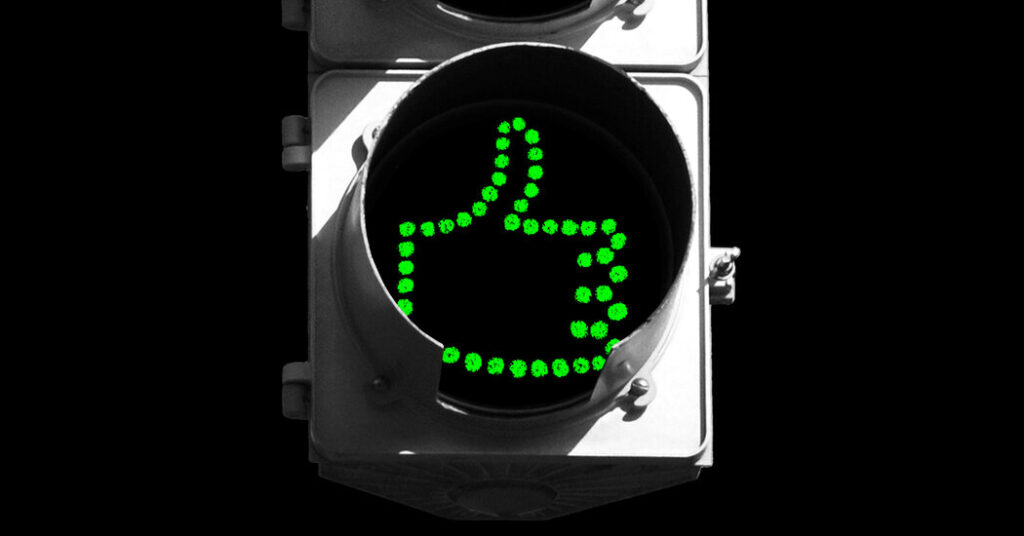
Source photograph by Joelle Icard, via Getty Images.
The Times is committed to publishing a diversity of letters to the editor. We’d like to hear what you think about this or any of our articles. Here are some tips. And here’s our email: [email protected].
Follow the New York Times Opinion section on Facebook, Instagram, TikTok, Bluesky, WhatsApp and Threads.
The post Americans Spend Too Much Time Stuck in Traffic. There’s a Way to Get It Back. appeared first on New York Times.