It is not just Democrats in Congress who fear that Donald Trump’s war in Iran is going sideways. After a classified Pentagon briefing on Wednesday, Republican lawmakers on the House Armed Services Committee appeared shaken.
“We will not sacrifice American lives for the same failed foreign policies,” said Nancy Mace, warning about the possibility of American troops in Iran. The committee chair, Mike Rogers, complained that members aren’t getting nearly enough information about war plans. Troop movements, he said, should be “thoughtful and deliberate.” The implication was that they might not be.
“This is the first week where I have felt that there’s been really any resistance to this war from Republicans,” Jason Crow, a combat veteran and Democratic member of the committee, told me. His colleagues’ public comments, he suggested, only hint at the depth of their anxiety. In closed meetings, he said, they express many concerns “that they’re unwilling to show publicly.”
Some conservatives are still arguing that pessimism about the war stems from a blinkered and biased elite. While those in “sophisticated circles” might think the war is going poorly, National Review’s Noah Rothman wrote on Wednesday, their “dour outlook seems wholly divorced from an objective appraisal.” But at least some of the Republicans hearing directly from the Pentagon aren’t so sanguine. “On a bipartisan basis, it was pretty clear to us that there was no plan, no strategy,” said Sara Jacobs, another Democratic member of the committee. The briefers, she said, “could not articulate an end game, and we are three weeks into this war.”
The big question now is if an American ground invasion is imminent. I suspect people are underestimating the possibility because it’s such a manifestly terrible idea. Americans certainly don’t want to see troops on the ground: In a Reuters/Ipsos poll last week, only 34 percent of respondents said they would back the deployment of Special Forces soldiers into Iran, and a mere 7 percent support a larger-scale attack. The markets — one of the few forces that can constrain Trump — seem to assume a relatively quick resolution to the war, which is likely why oil prices haven’t risen as much as some anticipated.
Trump himself appears to be wary of letting his Iran misadventure drag on. The Wall Street Journal reports that he wants a speedy end to the war, and at times he seems to be begging Iran’s leaders to make a deal. “They better get serious soon, before it is too late, because once that happens, there is NO TURNING BACK,” he posted on Thursday morning. You could almost see the flop sweat wafting off him.
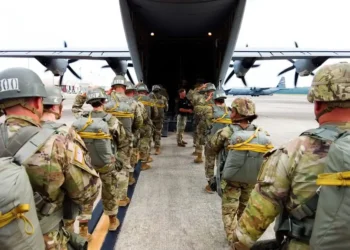
Yet despite all the reasons America shouldn’t escalate its war with Iran, there’s a good chance it will. Trump is sending thousands more troops to the Middle East, and in the past, when he’s massed military forces outside a hostile country, he’s used them. “Some U.S. officials think a crushing show of force to conclude the fighting would create more leverage in peace talks or simply give Trump something to point to and declare victory,” Axios reported on Thursday.
Jacobs, the Democratic congresswoman, told me that the Pentagon’s request for $200 billion to fund a war that’s burning through hundreds of millions of dollars a day is a tell. “That’s not a one-time cost to wrap things up,” she said. “That’s a down payment on a long war.”
This would not, obviously, be the first time the United States ramped up a war of choice just to avoid a humiliating defeat. In his memoir, former Defense Secretary Robert McNamara wrote about how, during the Vietnam War, the C.I.A. warned that failure “would be damaging to U.S. prestige,” leading the United States to prolong a pointless conflict in the hope of saving face. During years of fighting in Iraq and Afghanistan, Crow recalled, military leaders would repeatedly claim “that one more big troop surge, one more big offensive, would get it done and put us in a better position and win the war.”
Never before, however, has America arrived at the threshold of a quagmire so quickly, with so much advance warning about the precise errors it was making. We have spent much of the past decade — in no small part due to Trump’s election — reckoning with the cost of the Iraq war to global stability and American cohesion. For the first time I can remember, both major parties have significant, influential antiwar contingents. Trump ran for president, however mendaciously, as the peace candidate, claiming that Kamala Harris would lead America into World War III.
And yet here we are, lurching toward a new version of a familiar catastrophe, suffering from some national form of neurotic repetition compulsion. “This is like the horrible, lame-dad cover band version of the worst of American foreign policy,” said Matt Duss, executive vice president of the Center for International Policy.
Someday, perhaps, when we’re picking up the pieces from yet another ill-conceived war, Republicans will explain that behind the scenes, they opposed it. One of the biggest problems in Congress, said Crow, is the gap between what people say privately and their willingness to demonstrate “the strength of their convictions” in public. “I’m always trying to close that gap with folks, and I always remind people that it’s never too late to do the right thing,” he said. He may be right, but the sooner the better.
The Times is committed to publishing a diversity of letters to the editor. We’d like to hear what you think about this or any of our articles. Here are some tips. And here’s our email: [email protected].
Follow the New York Times Opinion section on Facebook, Instagram, TikTok, Bluesky, WhatsApp and Threads.
The post Republicans Know This War Is Going Badly appeared first on New York Times.