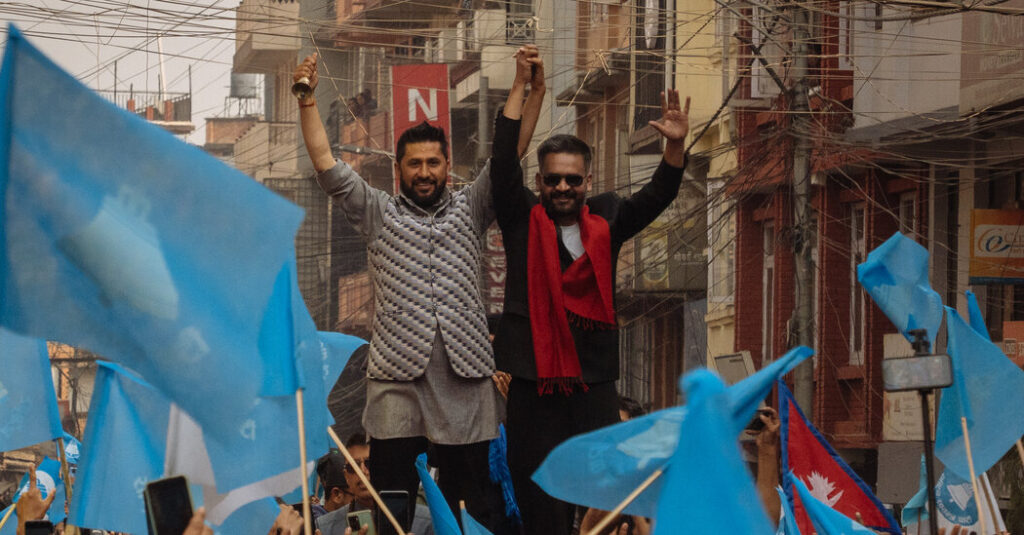
Balendra Shah, a 35-year-old rapper turned wunderkind politician, was sworn in as prime minister of Nepal at 12:34 p.m. on Friday, a time deemed auspicious by astrologers. The ceremony, attended by Hindu priests and Buddhist monks, was a stunning capstone to a youth-led revolution that unseated an unpopular government last year and made this mountainous nation the vanguard of a global uprising by Gen Z.
Elections on March 5 gave a resounding mandate to the Rastriya Swatantra Party, or R.S.P., a young political force that vowed to sweep away Nepal’s scandal-blemished gerontocracy. Many Nepalis, though, were voting not for a party but for a man: Mr. Shah, whose lyrics captured the frustrations of a youthful population all too often forced by endemic graft and political impunity to seek work abroad. On Thursday night, Mr. Shah released a music video replete with patriotic imagery that racked up more than 2 million views in 11 hours.
In 2022, Mr. Shah, known in Nepal simply as Balen, shocked the ruling class by successfully running as an independent candidate for mayor of Kathmandu, the country’s capital. His decision earlier this year to join the R.S.P., which he had excoriated earlier as no different from older political parties, did little to dull his popularity.
Mr. Shah faces an early test of his credentials as a champion of Gen Z and an instrument of change. A long-delayed investigative report on the deadly violence and mass arson that accompanied Nepal’s revolution last September has raised questions about who should be held accountable. That puts pressure on Mr. Shah to decide how to proceed, even as members of the party he joined may be implicated in some of the chaos last year.
On Sept. 8, security forces shot into crowds of anti-government protesters, killing 19. The next day, a coordinated campaign of arson burned thousands of buildings across Nepal within the span of a few hours, including the prime minister’s office, most government ministries, top courts and hundreds of police stations. Dozens more people died on Sept. 9. The wife of a former prime minister was nearly burned to death.
On the eve of Mr. Shah’s oath-taking, the interim prime minister Sushila Karki finally authorized the release of the investigative commission’s report. But as the hours ticked down on her tenure, no report was released.
A copy of the report, however, has been leaked to various news media, including The New York Times. It urges criminal investigations of various figures, including the deposed prime minister K.P. Oli and the former home minister and former national police chief, in connection with the killings of the protesters on the first day. Mr. Oli has publicly denied wrongdoing and called the leaked report’s recommendations against the former home minister and him “absurd.” The former home minister, Ramesh Lekhak, did not respond to repeated requests for comment. And the former national police chief, Chandra Kuber Khapung, said that he not gone through the report thoroughly so could not comment.
In its findings on the second day of the protests, when mass arson convulsed the country, the commission noted the coordinated nature of the attacks: the disabling of security cameras and the emptying of water tanks, followed by the burning of documents and deploying of accelerants to encourage the blazes. But the commission did not recommend any criminal investigations for the second day of chaos nor did it specify particular individuals as possibly linked to the nationwide burning. The omissions have raised questions about whether the election results could have affected the report’s final composition.
Even as the commission compiled testimony, it did not fully analyze whether these statements were truthful. For instance, it recounted how Mr. Shah, who was mayor of Kathmandu at the time, said that the municipality had promptly dispatched fire engines to deal with the blazes. In fact, the vehicles did not arrive quickly.
The commission said that it had not received any intelligence reports from security agencies or other bodies that might help in its investigation. It also raised questions about why the army, which had a barracks in the government compound where the damage was most severe, was slow to respond.
The section chief of a police forensic lab that would normally carry out arson investigations told The Times last year that no one had asked his team for help weeks after the attacks. By that point, evidence was feared to have degraded to the point of being useless, international arson investigators told The Times.
One figure of contention in the report is Rabi Lamichhane, the 51-year-old founder of the R.S.P. A former talk show host who had once worked as a manager of a Subway sandwich shop in Baltimore, Mr. Lamichhane became deputy prime minister and home minister in 2022 when his newly formed party captured a surprise chunk of parliamentary seats.
He lasted a month. The Supreme Court ruled that Mr. Lamichhane had not properly reclaimed his Nepali citizenship after giving up his American one to run for office. Later, when Mr. Lamichhane regained his home minister position, the boss of a media group that had questioned his citizenship status was arrested on obscure charges. Mr. Lamichhane maintained that the charges were not a political vendetta.
Mr. Lamichhane’s legal woes multiplied, presenting a challenge to Mr. Shah, who is entering office vowing to clean up Nepali politics. Mr. Lamichhane spent part of last year in prison and is the subject of various criminal investigations, including one for fraud. Amid the pandemonium on Sept. 9, Mr. Lamichhane, who was incarcerated at the time, suddenly appeared on the streets. He had a document supposedly validating his release. The same day, a district leader for the R.S.P. appeared in a video crowing over the immolation of the building that housed Kantipur, the media group that had reported on Mr. Lamichhane’s citizenship problems.
The commission’s report described how the warden of the prison where Mr. Lamichhane was locked up had faced a mob thousands strong demanding the politician’s release. The crowd broke into the prison and pressured the warden to sign a document unknown to him, which turned out to be the one Mr. Lamichhane used to falsely justify his release, the report said. (Mr. Lamichhane eventually returned to prison and was released in December.)
Lily Thapa, the head of a second commission charged with investigating the September violence, told The Times that her panel’s report would most likely be released next week. Ms. Thapa’s team interviewed nearly 90 prominent people, including Mr. Shah and Mr. Lamichhane. Among the questions asked to Mr. Shah: Why, as buildings burned across the capital, did the city’s fire engines not come to the rescue fast? And why, as so many other government buildings were struck by the mobs, were no Kathmandu municipal offices targeted?
Ms. Thapa said that there was plenty of blame to go around. Her report, she said, discussed each of the roles played by government officials and protesters, including Mr. Shah and Mr. Lamichhane. In an earlier interview, she acknowledged that the burning of the Kantipur media group building seemed “obviously” linked to elements of the R.S.P. Mr. Lamichhane has not commented publicly on the arson attack on Kantipur.
“We have collected all the evidence, that is our responsibility,” she said. “What happens from here, that is not for me to decide.”
It is now in the hands of Mr. Shah, Nepal’s new prime minister.
Sajal Pradhan contributed reporting.
Hannah Beech is a Times reporter based in Bangkok who has been covering Asia for more than 25 years. She focuses on in-depth and investigative stories.
The post A Rapper Who Won Over Gen Z Now Leads Nepal. Can He Bring Justice? appeared first on New York Times.