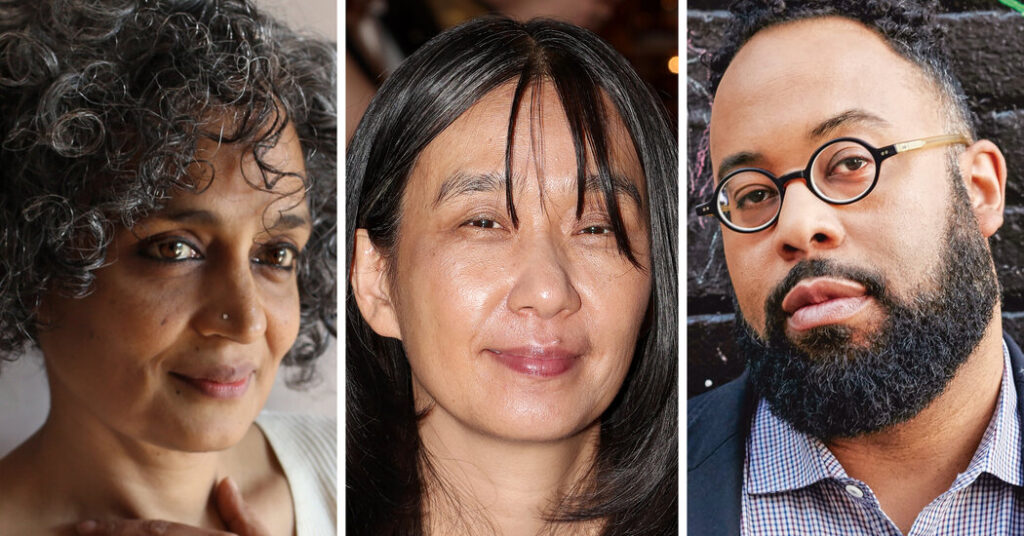
The novelist Han Kang won a National Book Critics Circle Award for fiction for “We Do Not Part,” her novel about the traumatic aftermath of the Jeju uprising and massacre in 1940s Korea.
Translated from the Korean by E. Yaewon and Paige Aniyah Morris, the novel was lauded by the fiction committee chair, Heather Scott Partington, as a “work of blinding melancholy, bleak weather, and murmuring syntax” that “lingers like an atmospheric and arresting dream.”
This is the third time in the 51 years of the awards that a translated novel has won the prize for fiction. The last time was in 2008, when “2666,” by Roberto Bolaño, translated from the Spanish by Natasha Wimmer, won the award. In 2001, the fiction winner was “Austerlitz,” by W.G. Sebald, translated from the German by Anthea Bell.
A separate prize, dedicated to works in translation, was awarded to “Sad Tiger,” by Neige Sinno — a fragmented nonfiction narrative chronicling the abuse she suffered as a child, translated from the French by Natasha Lehrer.
The nonfiction prize was awarded to the journalist Karen Hao for “Empire of AI: Dreams and Nightmares in Sam Altman’s OpenAI,” a timely and unsettling look at the rise of OpenAI and the culture of secrecy within the company.
Along with the National Book Awards and the Pulitzer Prizes, the National Book Critics Circle Awards are among the most distinguished literary prizes in the United States. Unlike with those prizes, the winners are chosen solely by book critics and review editors.
The organization, which dates to 1974, consists of more than 850 critics and editors. This year’s awards, which were announced at a ceremony on Thursday night held at the New School, recognized books published in 2025, and were open to authors whose books were published in English in the United States.
The awards also recognize the work of critics and organizations. The critic Rhoda Feng received the Nona Balakian Citation for Excellence in Reviewing, given to a National Book Critics Circle member for “exceptional critical work.” NPR and PBS were jointly awarded the Toni Morrison Achievement Award, which is given to institutions that promote the culture of books.
The service award went to the longtime literary editor of The Chicago Tribune, Elizabeth Taylor, who is a member of the organization’s board and has helped support a new generation of book critics through its Emerging Critics fellowships.
A lifetime achievement award went to the journalist and historian Frances FitzGerald, whose groundbreaking work “Fire in the Lake: The Vietnamese and the Americans in Vietnam” helped to challenge and change American readers’ understanding of the Vietnam War.
The chair of the committee, Jacob M. Appel, praised FitzGerald’s fearless confrontation of challenging subjects and difficult chapters of history: “FitzGerald has never been afraid to speak truth to power or to challenge the received wisdom.”
Below is a list of this year’s award-winning titles.
AUTOBIOGRAPHY
“Mother Mary Comes to Me,” by Arundhati Roy. Read our review.
BIOGRAPHY
“A Perfect Turmoil: Walter E. Fernald and the Struggle to Care for America’s Disabled,” by Alex Green.
CRITICISM
“Hayek’s Bastards: Race, Gold, IQ, and the Capitalism of the Far Right,” by Quinn Slobodian. Read our review.
FICTION
“We Do Not Part,” by Han Kang, translated from the Korean by E. Yaewon and Paige Aniyah Morris. Read our review.
NONFICTION
“Empire of AI: Dreams and Nightmares in Sam Altman’s OpenAI,” by Karen Hao. Read our review.
POETRY
“Night Watch,” by Kevin Young. Read our review.
GREGG BARRIOS BOOK IN TRANSLATION PRIZE
“Sad Tiger,” by Neige Sinno, translated from the French by Natasha Lehrer. Read our review.
JOHN LEONARD PRIZE (FOR THE BEST FIRST BOOK IN ANY GENRE)
“Baldwin: A Love Story,” by Nicholas Boggs. Read our review.
Alexandra Alter writes about books, publishing and the literary world for The Times.
The post Han Kang Among National Book Critics Circle Award Winners appeared first on New York Times.