President Trump has discussed turning the White House Treaty Room, historically a meeting place for diplomats and statesmen, into a guest bedroom with an en suite bath.
He has added gold flourishes to the East Room of the Executive Residence in a style similar to the gilded trimmings he installed in the Oval Office. And he has affixed “challenge coins” that celebrate his presidency — including the newest medallions in red and gold — to the walls inside the West Wing.
In recent weeks, Mr. Trump has taken new, previously unreported steps to redecorate and remodel the White House, the latest moves in one of the most significant renovations in the history of the White House, according to people with knowledge of his plans, who were granted anonymity because they weren’t authorized to discuss them.
Mr. Trump already has torn down the East Wing to make room for his $400 million, 90,000-square-foot ballroom; he remade the bathroom attached to the Lincoln Bedroom in marble and gold; he paved over the Rose Garden grass; he added marble floors and a chandelier to the Palm Room; he covered the Oval Office in gold; and he has a new, 33,000-square-foot security screening center for White House visitors in the works.
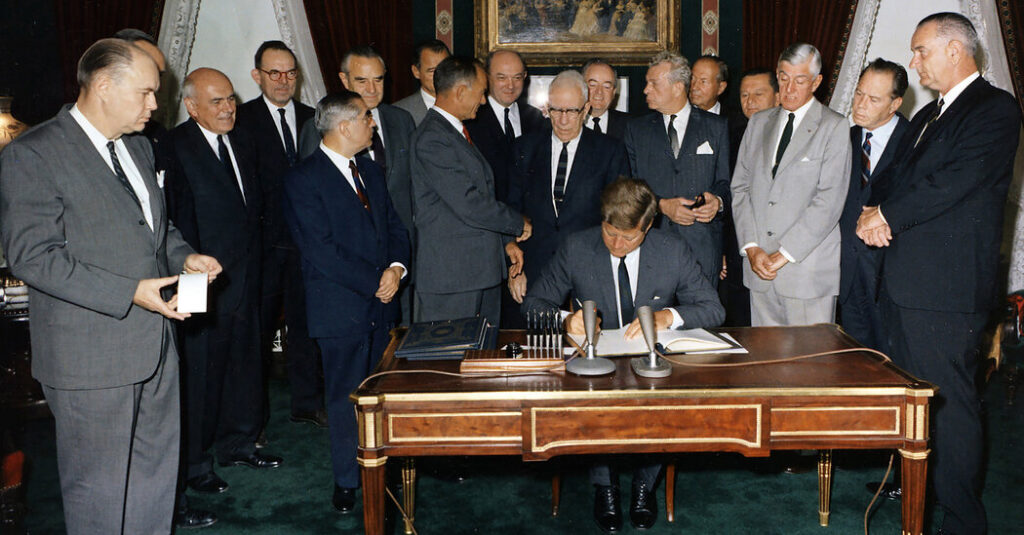
His latest plans involve the more private spaces of the White House, in the second-floor presidential residence. The Treaty Room — which is separate from the Indian Treaty Room in the Eisenhower Executive Office Building — is one of the most historic rooms in the White House. Presidents Ulysses S. Grant and William McKinley used it as a Cabinet room, and it was where the Spanish-American War peace protocol of 1898, and the nuclear test ban treaty of 1963, were signed.
Once known as the “Monroe Room,” because it was where President James Monroe worked, it also has been the setting for major wartime addresses by presidents George W. Bush and Joseph R. Biden Jr.
Asked for comment on the president’s plans, Davis Ingle, a White House spokesman, said Mr. Trump will continue to remake the White House during his term.
“President Trump is the builder-in-chief with an extraordinary eye for detail and design, and his bold vision will be imprinted upon the fabric of the America and be felt by generations to come,” Mr. Ingle said. “His successes will continue to give the White House glory it deserves.”
A Show of Hands?
Mr. Trump made his intentions for the Treaty Room known during a tour that he gave on Feb. 6 for a small group of people that included some members of the Committee for the Preservation of the White House and the Commission of Fine Arts.
And while one White House official cautioned that Mr. Trump’s plans are tentative and could change, the president spoke to the group that day about potentially turning the Treaty Room into a bedroom, according to Rodney Mims Cook Jr., the chairman of the Commission of Fine Arts, and several other people familiar with the tour who asked for anonymity to discuss a private meeting with the president.
Mr. Cook said the tour was called abruptly and he had to rush back to Washington from London in order to attend.
“He wants to add a bathroom, improve the room,” Mr. Cook said in an interview. The Treaty Room already has a bathroom, but it is small and has not been renovated in many years; its tile floor, sink and Vitrolite glass walls, in a shade of pale green, date back to the President Truman era; it’s in the same style that the bathroom in the Lincoln Bedroom was in before Mr. Trump had it remodeled.
Mr. Trump also showed the people on the tour changes he was making to the East Room, where he has already added gold flourishes to match the style he has brought to the Oval Office.
Trump Administration: Live Updates
Updated
- Lawmakers press to ban prediction bets by policymakers.
- Mortgage rates jump again, as the Iran war’s effects ripple through the U.S. housing market.
- The war will push U.S. inflation above 4 percent this year, according to a new forecast.
He discussed “the gold touches that would be on the ceiling,” Mr. Cook recalled.
The president “encouraged” the people present to vote to endorse his changes on the spot, Mr. Cook said. “But it was really just casual. We were not there as a meeting,” Mr. Cook said. Another person briefed on what took place described it as a jocular moment, and said it was not an effort to push people to formally vote on another renovation.
The preservation committee’s executive secretary, John Stanwich, a career National Park Service official who is also the liaison to the White House, was said to have left the room while Mr. Trump asked for a show of hands, according to one of the people with knowledge of what happened. The person said Mr. Stanwich was concerned about whether the president would consider it a formal vote.
Mr. Stanwich did not respond to multiple requests for comment.
Panels Packed With Trump Allies
Early in his second term, Mr. Trump appointed his allies to both the Committee for the Preservation of the White House and the Commission of Fine Arts, although both panels also include members who predate Mr. Trump.
Both committees play an advisory role, although the president can overrule their findings. The Committee for the Preservation of the White House considers changes within the White House and the Commission of Fine Arts votes on major projects outside the building, like Mr. Trump’s ballroom.
Mr. Cook was appointed by Mr. Trump to the Commission of Fine Arts, and he also sits on the Committee for the Preservation of the White House.
It is common for incoming presidents to make new appointees to the preservation committee, which was established by President Lyndon B. Johnson in 1964 with the goal of establishing a White House curator.
Early last year, Mr. Trump appointed 11 new members, a mix of political figures, historians and architects. The members, whose names were not announced by the White House at the time, are Tiffany Abernathy, James Carter, Jennifer Fischer, Dale Haney, Pamela Hughes Patenaude, Barbara A. Mathews, Richard Olsen, Sarah Perot, Margaret Pritchard, Ann Scott and Richard Walters, according to several officials.
Most of the new committee members were not present for the February tour, two people with knowledge of the plans said. They asked for anonymity to discuss the private meeting with the president.
Ms. Fischer is the vice-chair of the John F. Kennedy Center for the Performing Arts, put in that role when Mr. Trump took control of its board in 2025 and became its chairman and placed a loyalist, Richard Grenell, in charge of the organization. She was originally appointed to the Center’s board by Mr. Trump in 2020 during his first presidency, and she supported changing the arts center’s name to the Trump-Kennedy Center.
Ms. Scott is the wife of Senator Rick Scott, Republican of Florida, while there are several historians or architects, including Ms. Abernathy, a University of Notre Dame School of Architecture professor.
Contacted by email about the Treaty Room tour and Mr. Trump’s plans for that room and the East Room, Ms. Abernathy, who leads the U.S. projects team for John Simpson Architects, said that she was not “able to comment on this matter.”
She added, “More generally, I remain committed to the principles of conservation and the stewardship of historically significant public buildings, which depend upon careful process, continuity, and informed dialogue. I would be glad to contribute to a broader conversation on those themes at an appropriate time.”
Ballroom, Columbus, Colonnade
Meanwhile, Mr. Trump is continuing with his more public projects.
Mr. Trump’s planned ballroom faces a final vote of the National Capital Planning Commission next week, but his allies and employees who control the panel have already indicated their support. It also faces court challenges, including from historic preservationists who have asked a judge to halt the project.
To date, no one has succeeded in slowing down Mr. Trump’s pace of change on the White House grounds.
He installed a statue of Christopher Columbus on the White House grounds over the weekend. And he is in the process of replacing the stones in the walkway in the colonnade, which leads from the main White House mansion to the Oval Office and where Mr. Trump has hung photos of past presidents that include insulting descriptions of those he dislikes.
Mr. Trump said the new walkway would be made of black granite.
“It’s a great contrast. The white, with the black,” Mr. Trump told reporters this week. “It’s a beautiful, black granite.”
As he has with his other projects, the president said he was paying for the walkway through private donations and would not be involving Congress.
Even as Mr. Trump’s ambitions seem to grow ever more grand, the president has drawn the line a few times when it comes to redesigning the White House.
Mr. Cook said he recommended changing the columns of the White House to a Corinthian design, which he described as the highest order in classical architecture. He said Mr. Trump rejected that idea.
Luke Broadwater covers the White House for The Times.
The post Trump Eyes White House Treaty Room for Latest Renovation Project appeared first on New York Times.