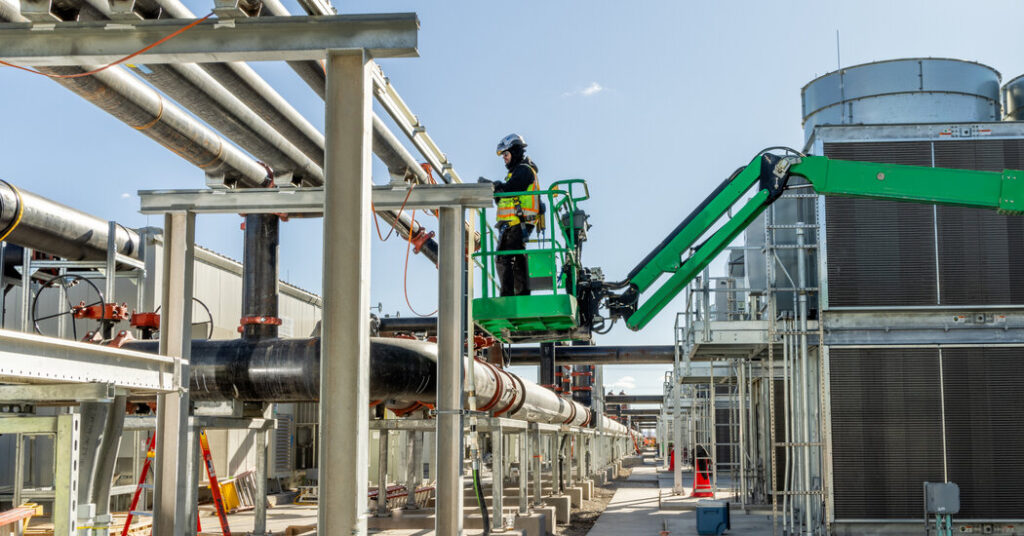
The torrential wave of data center construction for artificial intelligence has seemed unstoppable. Unconstrained by interest rates or labor costs, the biggest tech companies in the world are pouring trillions of dollars into land, electronics and new power plants. A.I. spending is now a meaningful share of American economic growth and the wind at the stock market’s back.
But lately, zoning commissions and county councils across the country have been resisting. Unnerved by the data centers’ voracious electricity demands and sprawling footprints, they are denying permits and withdrawing tax breaks at a rate that is forcing companies like Google, Microsoft and Meta to take a different tack.
And Wall Street, which has ridden high on those valuations, is starting to raise some eyebrows.
“A lot of the commitments and the build-out of data centers where it’s easy has kind of been done, so you’re getting marginally more difficult,” said Todd Castagno, a managing director at Morgan Stanley. “From a markets perspective, expectations might be, maybe not reset, but realigned with the fact that it’s hard to put a couple trillion dollars in the ground in a short time.”
About 30 percent of the S&P 500 is made up of just six companies: Apple, Meta, Alphabet, Microsoft, Nvidia and Amazon, all of which have staked their futures on the use of artificial intelligence. The building boom has also lifted equipment makers like Caterpillar and Siemens, which have enjoyed greater sales to data center projects. Much of the construction is also funded by the investors behind OpenAI and Anthropic, which are privately held.
In all, the top A.I. companies, known as “hyperscalers,” have forecast spending $710 billion on data centers across North America in 2026. And to some extent, their lofty valuations depend on their ability to deliver on those promises. But rising skepticism from neighbors, along with the major challenge of supplying gigawatts of new electricity, could put a hitch in those plans.
The calculation that brought local resistance to the attention of investors is compiled by Miquel Vila, a supply chain and political risk researcher with the A.I. safety firm 10a Labs, which started the Data Center Watch project out of curiosity. Mr. Vila, who says he has no vested or ideological interest in the progress of data centers, follows local news, local government meetings and Facebook groups to document and categorize the spread of organized resistance.
The latest number is big: At least $156 billion across 48 projects with publicly disclosed values was blocked or stalled amid coordinated local opposition in 2025. Opposition “hardened” into legislative hurdles, Mr. Vila noted, narrowing the options for data center developers looking for sites.
“The number we are all hanging our hat on is a report from Data Center Watch,” said Aniket Shah, a managing director at the investment bank Jefferies. He thinks the mounting pile of delayed and abandoned projects is a symptom of deeper resistance that could result in substantial political restrictions in the coming years, noting Pew Research’s finding that Americans are more negative about A.I. than people in any other country it has polled.
“That’s crazy,” Mr. Shah said. “I do think that works its way through the politics, and that guardrails go up in a much more significant way than most people believe.”
For the hyperscalers, procuring huge amounts of computing power as quickly as possible is essential to building A.I. models faster than their competition. Additional capacity is needed to serve the workloads of customers who want to use those products, like Google’s Gemini and Anthropic’s Claude. So far, they have had the cash to make it happen, both because of the strength of their own balance sheets and investments from private credit firms and even some of their own suppliers.
But all that construction has to happen in someone’s backyard — or, at least, on someone’s drive to work or school. Unlike a large warehouse, the projects will either create a significant new burden on the electricity grid or build power generation on site, both of which require several kinds of permits for additional infrastructure. And as conflicts over building housing and renewable energy have shown, Americans have a prodigious ability to stop things that they believe will impinge on their quality of life.
Some of the fiercest resistance has come in Virginia, which was an early leader in data centers that served cloud computing tied to the federal government. As residents are quickly learning, data centers that serve A.I. are a different breed, sucking up far more electricity and water. Virginia’s budget is currently stalled by a disagreement over whether to end the state’s tax break for data center construction, which was worth at least $1.6 billion in the 2025 fiscal year.
Proponents of ending the tax break argue that the state should not be subsidizing a business that takes up huge amounts of pastoral land and will require as-yet-unbuilt electrical substations and transmission lines. And they are becoming louder.
“You’re going to see a growing level of frustration and discontent all across the commonwealth of Virginia as the infrastructure reveals itself,” said Chris Miller, the president of the Piedmont Environmental Council of Virginia. “They’re running into the basic political philosophy of most Americans. It’s like, ‘We get to decide how our community changes.’”
As recently as 2023 and 2024, data center developers quietly bought up land and secured the necessary signoffs without much public attention, and often under nondisclosure agreements that obscured the ultimate client. That has become more difficult. Although opposition to data centers is still at a grass-roots level and quite fragmented, word travels quickly on Facebook. Universities and nonprofits are contributing to a body of research that shows how data centers can affect noise levels, water supplies and air quality.
In some cases, opposition has resulted in county or statewide moratoriums or pauses on tax incentives, which can kill projects overnight. A case in point: Andy Cvengros, a co-lead of JLL’s data center practice, said Illinois’s new biometric privacy law and a recent pause on data center tax incentives had torpedoed four of his projects in the state.
“The people who are trying to block or protest these things are much more well educated than they were before,” Mr. Cvengros said. “We’ve had a number of projects get canceled that were by very reputable groups that were coming to the table with $50, $60, $100 million contributions to local communities, and still getting shut down.”
Overall, construction is still proceeding at a rapid pace. According to the technology market intelligence firm IDC, purchases of the equipment that goes into data centers have not slowed down. Development is just following the path of least resistance.
According to the real estate brokerage CBRE, the total amount of new data center capacity under construction in the country’s largest markets decreased in the second half of 2025 for the first time since 2020. The firm attributed the slowdown to “ongoing permitting, zoning and power procurement hurdles.”
But other markets are still exploding. Having been driven out of states like Wisconsin, Oregon and Michigan, data center developers are flocking to less populated areas in states including Texas and New Mexico with a lot of available land, adequate power and friendlier politicians.
“We’ve seen a pretty significant shift over the past six to eight months, where that demand is being managed by regulation,” said John McWilliams, the head of data center insights at Cushman & Wakefield. “That certainly is a shock to the system. It’s changing the landscape of how this gets done.”
Going all in on the flat, hot states, however, is not a complete solution. For one thing, although training A.I. models can be done far from cities, the servers that do the work for users of those models need to be closer to avoid “latency” as data travels over long distances. Eventually, if America were to adopt A.I. at the scale that its boosters are banking on, data centers would need to be built closer to cities like Seattle, San Francisco and Chicago.
One possible path to doing that is renovating empty warehouses, which has become cheaper as the logistics industry has contracted. Bernie Woytek, a regional practice director with the architecture firm HKS, said he had done more warehouse-to-data-center conversions lately in big metropolitan areas like Atlanta.
“I think people would rather see an occupant in a building than it sitting vacant,” Mr. Woytek said. “It’s not nearly as invasive as doing a new ground-up building where you have to go through all those hoops.”
And of course, red states are not immune to the kind of opposition that has taken root. Gov. Greg Abbott of Texas has championed the A.I. industry, but groups are forming rapidly to fight new data centers in places like Waco and Harlingen. The Texas Republican Party passed a resolution in mid-March calling for a stop to new construction until more safeguards for water and electricity use are in place.
Miriam Cobb volunteered as the campaign manager for a Republican state senate candidate, Rena Schroeder, who ran on opposing new data centers. Although Ms. Schroeder lost the primary, Ms. Cobb is still helping to coordinate opposition across Texas that, she said, is deeply felt in conservative, rural communities.
“This isn’t a ‘save the whales’ kind of thing,” she said. “This is going to destroy the agricultural landscape of Texas if we keep letting this happen. It’s not a ‘sort of,’ it’s a ‘definite.’”
The pushback is starting to force investors to grapple with the proposition that the hyperscalers may not be able to reach the lofty goals they have set for themselves. Physical constraints on building new power infrastructure shorten the list of projects that seem likely to be completed, the investment advisory firm Janus Henderson wrote in early March.
Logan Purk, a technology industry analyst at Edward Jones, thinks that the already stretched-out construction timelines could become even more delayed and ultimately reduce the amount that is built. That would have the biggest impact on the companies that sell the gear that goes into data centers — the “picks and shovels” of the A.I. rush.
“I do think the difficulty is not fully baked in,” Mr. Purk said. “If we assume tomorrow that data center construction stops because there’s no access to new power, the ripple effects across the semiconductor industry would be pretty substantial.”
Lydia DePillis reports on the American economy for The Times. She has been a journalist since 2009, and can be reached at [email protected].
The post Local Opposition Is Slowing A.I. Data Centers. Wall Street Has Noticed. appeared first on New York Times.