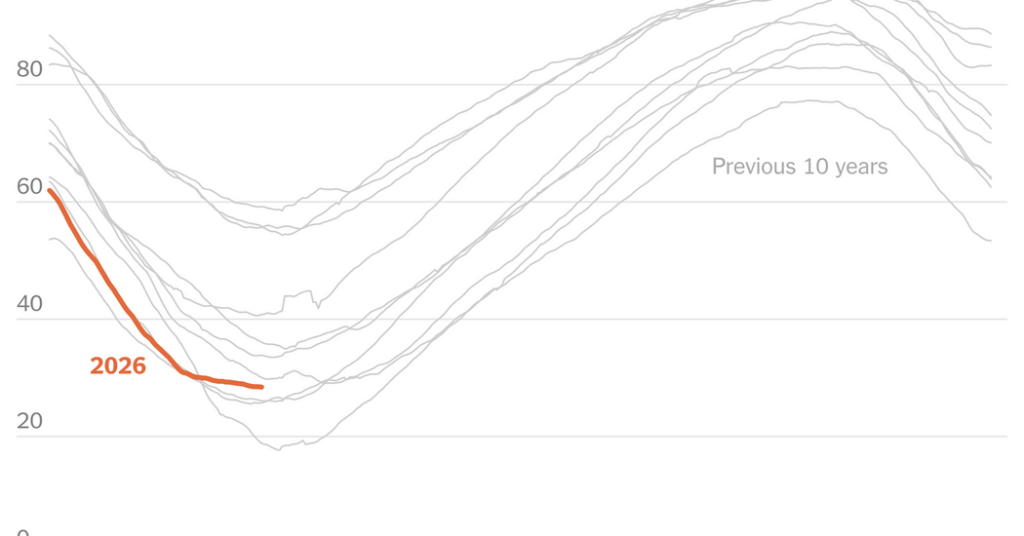
Europe is facing its second major energy shock in less than five years, and there are intensifying concerns about the region’s relatively meager stores of natural gas as prices surge during the U.S.-Israeli war in Iran.
Despite making drastic changes to its sources of energy supplies since Russia’s invasion of Ukraine in 2022, Western Europe is still heavily dependent on natural gas: It accounts for about a fifth of energy use in the European Union, and nearly a third of all households rely on gas for heating.
Although the 27-country bloc imports relatively little gas from the Middle East, the restriction of energy exports from the Gulf has pushed up prices in Europe. The region’s benchmark price of natural gas has climbed more than 70 percent since the strikes on Iran began on Feb 28.
Making matters worse, the European Union ended winter with less than 30 percent of its gas storage capacity filled, the lowest level since 2022, when imports of Russian pipeline gas plummeted.
If prices stay high, European countries will be forced to pay dearly to refill storage facilities ahead of next winter, when demand for gas is highest. That will worsen the turmoil already squeezing household budgets, hitting business profits and putting intense pressure on governments to shield their economies.
Here’s how we got here.
Europe went into winter with lower-than-usual levels of gas storage.
A relatively cold winter resulted in high demand for natural gas for heating, but the main reason gas storage levels are so low is that they began the winter that way, said Ronald Pinto, a natural gas analyst at Kpler, an industry data firm. At beginning of October, E.U. storage was at 83 percent capacity, 12 percentage points lower than the year before.
It was “not the best start,” Mr. Pinto said. On top of that, he added, the region went all winter with less gas piped in from Russia.
The European Union has pledged to stop all Russian gas imports, both from pipelines and L.N.G., in the next few years. Already, gas from Russia fell to 13 percent of the region’s import mix last year, from more than 40 percent in 2021.
Part of the reason for low storage levels was because last year the European Commission eased rules that required countries to reach gas storage levels of 90 percent capacity by the start of winter. Instead, commission officials gave governments wiggle room on the timing and amount “in case of difficult conditions.”
Why did they do that?
The usual price pattern flipped upside-down.
Normally, gas storage is filled in the summer when prices are low and withdrawn in the winter when prices are higher. But recently the usual pricing pattern has broken down. Higher prices in the summer have made storage operators more reluctant to fill up.
Europe’s pivot from Russian pipeline gas to liquefied natural gas shipped by sea from the United States and elsewhere has contributed to this inversion, said Alfred Arnborg, an analyst at Think Tank Europa.
Europe “opened itself up to the global natural gas market where the economics are different,” Mr. Arnborg said. Demand from Asia in the summer for cooling has made prices more stable throughout the year. That makes it less attractive to buy and store gas, he added.
The European policy mandating high storage levels ahead of winter also influenced prices, said Natasha Fielding, the head of gas and L.N.G. pricing at Argus Media. That raised demand for gas in the summer to meet those targets, pushing up summer prices.
The expense was part of the justification for easing storage targets last year.
“We weren’t in this kind of crisis scenario anymore, and the outlook for the global L.N.G. market was very different,” Ms. Fielding said. “There was a view that actually Europe didn’t need to completely top up its storage levels,” she said.
Last summer, the energy market was in a much stronger position. Many expected to see a big increase in supply supported by an expansion of Qatar’s massive Ras Laffan gas complex. But missile and drone strikes from Iran have throttled energy shipments through the Strait of Hormuz, and Qatar’s state-owned energy company has halted production of liquefied natural gas, cutting off about a fifth of the world’s L.N.G. supply.
Compounding the problem, gas storage cannot be easily increased. For the most part, it’s a function of geology, with gas stored in depleted oil and gas fields or salt caverns. Some countries don’t have any underground storage, like Ireland and Greece.
Now what?
The European Commission has encouraged member states to lower their start-of-winter gas storage targets to 80 percent of capacity. In a letter to the region’s energy ministers last week, Dan Jorgensen, the energy commissioner, urged them to begin filling storage early in a coordinated manner.
“This flexibility can help reduce the gas demand at times where the supply is tense and ease the pressure on gas prices in Europe,” Mr. Jorgensen wrote in the letter seen by The New York Times. “We have also learned the pitfalls of uncoordinated action.”
Officials want to avoid a repeat of 2022, when European countries competed to buy gas for storage, driving prices higher. During that summer, Germany spent nearly 8 billion euros ($9.3 billion) on gas for storage, and the Italian government spent €6.6 billion, according to Argus Media.
But there are concerns about how Europe will now refill its storage. The process typically starts in April and May, said Mr. Pinto of Kpler.
Normally, that is when there isn’t much competition from Asia for cargoes because demand there for cooling hasn’t yet picked up. But this year, as the war in Iran curtails their main Middle Eastern supply options, Asian buyers are competing with European buyers for L.N.G. from the United States and other suppliers.
Already, 11 vessels carrying L.N.G. bound for Europe have diverted to Asia, according to Kpler.
Ultimately, the economic pain generated by expensive energy may reduce demand in Asia, allowing European buyers to stock up sufficiently. But according to Mr. Pinto, this could come “at a very high price.”
Eshe Nelson is a Times reporter based in London, covering economics and business news.
The post Europe Heads for Another Energy Shock in a Vulnerable State appeared first on New York Times.