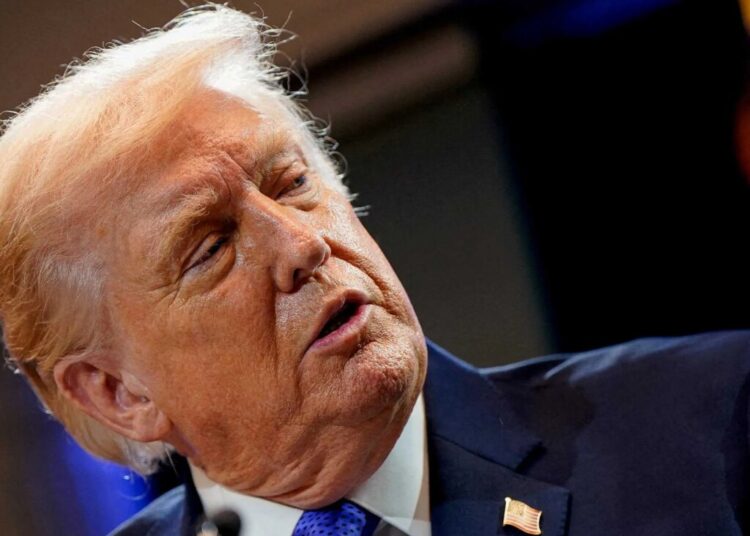
Is the U.S. winning the war with Iran? Even though President Trump claims success, it doesn’t quite feel like it — oil and gas prices are high, the Strait of Hormuz is effectively closed, and the Iranian regime is still in place. Mark Dubowitz, the chief executive of the Foundation for Defense of Democracies and a prominent Iran hawk, explains why “total victory” is within reach in spite of the cost. I pressed him on the gap between Trump’s desire for a quick deal and his desire to end the Islamic Republic.
Below is an edited transcript of an episode of “Interesting Times.” We recommend listening to it in its original form for the full effect. You can do so using the player above or on the NYTimes app, Apple, Spotify, Amazon Music, YouTube, iHeartRadio or wherever you get your podcasts.
Ross Douthat: Mark Dubowitz, welcome to “Interesting Times.”
Mark Dubowitz: Ross, thanks for having me. Honored to be here.
Douthat: We’re talking about 24 hours or a little more after President Trump postponed his professed plan to strike Iran’s power plants if they did not reopen the Strait of Hormuz.
We’re also talking in the background of conflicting reports about possible talks between the United States and the Iranian government, or elements of the Iranian government.
All of that seems very vague and nebulous at the moment, but that’s roughly where we are in the timeline right now. Given where we are, the first question, very easy one: Is the United States winning its war against the Islamic Republic of Iran?
Dubowitz: Well, the short answer is yes. The longer answer is it depends what you mean by winning.
If you mean based on what President Trump laid out as the objectives of the United States, then we are winning. Those objectives, he was very clear, were essentially to destroy the war-making capabilities of the Islamic Republic, which includes its missile program, its navy, and its nuclear capabilities.
With that in mind, it’s only been about three weeks. I think the U.S. military, along with the Israelis, have done a pretty extraordinary job of severely degrading those capabilities across all lines of power projection.
The missile program has been severely degraded, Ross. To give you a sense, they had the largest missile inventory in the Middle East before the war started. They were able to produce about a hundred new ballistic missiles every month. Their ballistic missile production rate is now zero, and their launchers have been reduced by two-thirds.
The Iranian Navy has been decimated.
The nuclear program is still to be determined, but between the 12-day war last year and Israeli strikes against nuclear facilities during the past three weeks, the program has been set back even more severely.
But there’s still the battle of Hormuz to be won or lost, and I think that’s going to be a decisive battle that will determine whether President Trump can legitimately claim a major military success at the end of all of this.
Douthat: Well, we will talk about the battle of Hormuz. Let’s just stay with military degradation for a moment. In a scenario where this conflict ended soon and those objectives were met, there’s no world where you’re going to eliminate completely the Iranian regime’s capacity to have a military unless you invade Iran and occupy it and so on. Does that mean that this military operation in its limited form is just about buying time so that we just don’t have to attack Iran again for five years or something like that?
Dubowitz: Yeah. I think what we’re trying to do is severely degrade their war-making capability and also their repression apparatus. That’s actually been the Israeli piece of the military operation.
But I think over the past three weeks, we have now gotten enough evidence from Trump himself and from the White House that they’re very much setting these objectives as: missile, navy, nuclear.
It depends on the extent to which Iran can reconstitute its navy, its missile capabilities and its nuclear capabilities.
So, it’s difficult to know exactly how far we set it back, and I think one should always be careful about those kinds of estimates.
And we also should remember that even if a U.S. president is not prepared to bomb again, as long as the U.S. president doesn’t block the Israelis from striking again. If they just keep coming back and as they call “mowing the grass,” you can keep setting back those capabilities and degrading them over and over again.
Douthat: Now let’s talk about the regime. You already gestured at this by mentioning Israeli attempts to degrade the regime’s capacities. A week ago, you co-wrote an essay for The Atlantic entitled, “Glimpsing Victory in Iran.”
I think it’s fair to say that you have a broader definition of what victory looks like than the military objectives laid out by the Trump administration.
Tell me what your vision of victory in the war is.
Dubowitz: Well, as we wrote in the piece, our vision of total victory is the end of the regime in Iran.
That’s been my longstanding position for 22 years that I’ve been working on this issue. I believe that to permanently solve this problem, you have to replace the regime in Iran.
I’ve been a longstanding supporter of boots on the ground to do that — but Iranian boots on the ground, not American boots on the ground. I really believe across broad swaths of Iranian society that the level of enmity for this regime amongst Iranians is deep and profound, and has gotten even deeper, and more profound since January of this year, when the Iranian regime killed thousands of Iranians on Jan. 8 and 9 in the face of a huge protest movement.
So, I’ve long believed that providing maximum pressure on the regime, maximum support for the Iranian people, and using a variety of overt and covert means to fracture the regime support base will ultimately lead to the end of this regime. That’s total victory. That’s how I would define it.
Douthat: In that essay and elsewhere, you’ve talked about what you describe as a three-phase process of getting there from where we are now, where the first phase is the kind of military campaign that the U.S. has embarked on, the degradation of the Iranian military.
Just talk through briefly what you think each phase would look like in a best-case scenario that ends in regime change.
Dubowitz: Phase 1 is major military operations. The Islamic Republic of Iran has been at war with America for 47 years and we’ve been fighting back against them for about three weeks.
So, there’s been some extraordinary military accomplishments. I could see this campaign lasting for another three weeks. I think it would be a big mistake to pull the plug right now, but it would also be a mistake to continue this war for months in Phase 1.
Phase 2 is very much what the Israelis are already embarking on right now, which is severely degrading the repression apparatus of the regime.
They began that on Feb. 28 with that initial strike that took out the former supreme leader, Ali Khamenei, and his top I.R.G.C. commanders, generals and advisers.
They have been systematically, methodically, patiently taking out the repression apparatus day by day. This is the I.R.G.C., the Basij, the police forces, the intelligence services, the people that are responsible for crushing Iranian opposition and did so in January. They have been eliminating those people.
I would see that, from a military point of view, continuing in sequence with Phase 1 when major military operations are over.
Douthat: You’re still going to have essentially decapitation strikes against a wide range of Iranian military and political leaders?
Dubowitz: Yeah. Now, it depends on what happens in the negotiations, which I’m sure we’re going to talk about. If there is some deal where Trump has now negotiated an agreement with this regime, there’s an open question about whether Trump would then greenlight continued Israeli military strikes, airstrikes on the regime, or would he say, “OK, those strikes are over,” but then greenlight the Israelis to continue to do what they would do covertly.
And then Phase 3 is really what I call a maximum support campaign, where you’re actually providing serious support to the opposition so that the next time they come to the streets — and they’re coming to the streets again — but this time, unlike in January, you have changed the equation.
You’ve strengthened the opposition so it’s not defenseless in the face of that repression apparatus, as it was in January, and you’ve given Iranians perhaps a fighting chance to take back their country, which as President Trump said is a once-in-a-generation opportunity.
Douthat: OK. I think that’s a good overview.
Let’s go back to where we are now in Phase 1. There’s no question, as you’ve said, that we have degraded Iran’s military.
However, it’s also clear that at the moment, the Iranians are still quite capable of firing missiles and rockets at their neighbors, menacing the infrastructure that the entire Persian Gulf depends upon — meaning not just oil and gas, but desalination plants and power plants. The number of missiles fired has gone way down, but it hasn’t dropped to zero.
And then, more importantly, the Iranians have essentially closed the Strait of Hormuz, throwing global energy markets into turmoil. What do we do about that?
Dubowitz: Before answering the question about what we do about it, I just want to touch upon something that I think gets lost in the current debate. Because I think we all are moving so quickly, things are changing so quickly, it’s worth a little bit of historical perspective on this.
If you could imagine today’s regime — not severely degraded militarily, not having lost its missile launchers and ballistic missile production capability and had its nuclear program severely degraded and lost its navy — imagine this regime, even under the Obama nuclear deal.
A regime that would pocket a trillion dollars in the life span of that agreement, a regime that, starting this year, the restrictions on the nuclear program would begin to sunset. Iran would emerge with an industrial-size nuclear program.
So, imagine this regime with nuclear arms, ICBMs, tens of thousands of missiles, a trillion dollars, its proxies still intact — Hezbollah, Hamas, the Houthis, Shiite militias.
Imagine this regime threatening the Strait of Hormuz, threatening the Gulf allies, threatening U.S. bases, U.S. embassies, Israel and the U.S. homeland. I just think it’s important for your listeners ——
Douthat: It’s good to imagine that. I don’t want to get too deep into the deeper justifications for war yet. But, I just want to say, we’re not in the Obama timeline. We’re in a timeline where the U.S. and Israel successfully delivered some significant blows to Iranian power.
And now we’ve decided to deliver another more profound one, and it is that blow that has yielded the Iranian closure of the Straits. So, that’s where we are now.
The counterfactual is important, but so is the reality that we delivered a set of blows successfully. We chose to go further. And, that has activated a really substantial Iranian response that threatens global energy markets, the global economy and the core economic and civilizational functioning of the Persian Gulf.
So, with that said, what do we do about it?
Dubowitz: Yeah. I make the point, Ross, only to say that it was inevitable that the Islamic Republic was going to close the Strait of Hormuz. The only question was: were they going to close it with nuclear weapons, ICBMs, a massive missile inventory, terror proxies that were intact and growing and becoming more deadly, and a trillion dollars in order to fortify their economy and fund their nefarious attack activities?
Or, were they going to close it, as they have, when they’ve been severely degraded along all of those lines that you’ve said?
So the battle of Hormuz was a battle that was inevitable. The only question was were we going to fight it in a way where we were stronger and they were weaker, or they were stronger and we had very limited options in order to open the Strait?
Douthat: But why was it inevitable if we were able to, again, substantially degrade both their terror proxy networks and their nuclear program? Iran was not going to close the Strait of Hormuz six months ago. It didn’t close the Strait of Hormuz in response to our bombing of Fordow.
It only closed the Strait when we went all-in — and more than going all-in on military elements when we went all-in targeting regime leadership.
I’m just going to use the U.S. and Israel interchangeably here for this campaign because I think that is accurate to what is practically going on.
In a world where we didn’t target the Iranian regime leadership, where we didn’t attempt to force regime change, where we just carried out periodic bombings of their military and so on, it’s not clear to me that you can say definitely, “Oh, well, of course eventually Iran would’ve closed the Strait.”
They closed the Strait in response to our attempted regime change. Isn’t that fair?
Dubowitz: No, I think that the Iranian strategy — and by the way, this was always the smart strategy for Khamenei and he’d still be alive to execute the strategy if he had done this — is to reconstitute. So, after the 12-day war, “I’m going to reconstitute my missile program and my nuclear program.”
It was only 12 days, and it wasn’t obliterated — despite what President Trump said. “I’m just going to work with the Chinese. The Chinese are going to send in Chinese air defenses. I’m going to rebuild my terror proxies and I’m going to wait President Trump out.”
In January 2029, Trump’s not going to be in office — and it’s a pretty good guess whoever’s president at that time, unless it’s perhaps Marco Rubio, but on the Republican side and on the Democratic side, you’re not going to find a president willing to confront Iran militarily. So at that point, Iran is home free.
If I were Khamenei, I would’ve done a deal with Trump, a two and a half year deal. I would’ve gotten hundreds of billions of dollars in sanctions relief and Trump would’ve said, “Make Iran great again” and I would’ve pocketed all that money.
I would’ve reconstituted slowly. And then once Trump was gone, I’d be off to the races and I would rebuild all those capabilities that I described earlier.
Then, I would be guessing — but it’s a pretty good calculation — that there’s no way a President Newsom or A.O.C. or Vance is going to support an Israeli strike on Iran’s nuclear and missile program.
And at that point, I’m in a position where I now control Hormuz. I don’t have to launch one drone, one rocket or one missile. I just have the mere threat of using all those deadly capabilities and I have now deterred the United States.
I now own the Gulf. I have a stranglehold over the world’s energy. And I am now a regional power. In some respects, and my control over global oil, I become a superpower. That is the Iranian trajectory.
That’s where we’re heading.
Douthat: So, essentially what has happened, in your view, is Donald Trump was the only American president capable of confronting Iran in any meaningful way, allowing Israel to confront its proxies. So in fact, it is that we have chosen to fight an inevitable battle of Hormuz now because we don’t trust our own political system to restrain Iran without an epic battle right now.
Dubowitz: We have chosen this because we saw the Iranians moving toward the end state that I described. To prevent them from moving to that end state, we would have to fight a major war.
Douthat: But again, I don’t think by your own account we would have to fight a major war. We would just need the next president to continue giving Israel permission to degrade Hamas and Hezbollah and continue to do periodic strikes. And you’re saying you don’t think any president would’ve extended even that permission.
Dubowitz: I’m doubtful that any president would’ve extended that permission. But that permission is not enough because the Israelis don’t have the capabilities to destroy deeply buried missile cities. They don’t have massive ordinance penetrators. They don’t have strategic bombers.
They don’t have Tomahawk missiles. They don’t have the capabilities that we have to do severe damage to Iran’s missile capabilities.
Douthat: So, it’s not enough for a future U.S. president to allow Israel to conduct these raids, we also have to be involved in them — that’s fair. But it just seems to me that the evidence of the last few years is that you can do a lot of damage to Iran without having a full-scale battle of the Strait of Hormuz.
But I don’t want to harp on this. Let’s get back to the war itself. We’re here and we’re going to fight the battle of Hormuz. Do we use ground troops?
Dubowitz: Well, by the way, it’s not inevitable that we’re going to fight the battle of Hormuz. We saw President Trump now do a 90-degree U-turn and start to talk about negotiations.
He actually had a comment which I found really disturbing. He said something to the effect of, well, maybe the United States and the ayatollah, we just share the Gulf, we share Hormuz.
Douthat: Yeah, he likes to talk like that.
Dubowitz: Yeah. Now, I don’t know if he’s serious or he’s just doing his usual Trumpian feint. But that’s obviously something that would terrify our Gulf Arab neighbors — and certainly should terrify the Japanese, the South Koreans, the Indians, our European allies, anyone who depends on Middle Eastern oil and natural gas.
The notion that Trump will do a deal where we’re going to share Hormuz with the Iranians, with the ayatollah, I think, should be terrifying.
Because if that is the case — and again, I just want to get back to this because I think it’s worth harping on — if Trump is gone in two and a half years and the next president is not willing to confront the Iranians, and the Israelis don’t have the capabilities to do enough damage to their war-making capabilities, then we don’t end up sharing the Strait of Hormuz with Iran.
They end up owning it and they end up owning it because they’ve created deterrence because we don’t have the ability to confront them when they have nuclear weapons capability, ICBMs, tens of thousands of missiles, a large navy and a dominant position in the Gulf.
We had to fight that war.
Douthat: Wait a minute. They’re not going to reconstitute that in two years if the military campaign has been as successful as you’ve suggested.
Dubowitz: Not in two, not in two.
Douthat: But over a longer time horizon.
Dubowitz: Over six, over eight. I’m talking about the first two terms of President A.O.C.
Douthat: OK. But in a world where Trump stays the course, and we do essentially try and find a military solution to the Strait of Hormuz, does that involve ground troops?
Dubowitz: Well, Trump hasn’t excluded that. It depends on what it means by does it involve ground troops?
Douthat: Well, to me, as an extremely amateur student of military matters at the moment, it seems very, very difficult to render the Strait safe for passage as long as the Iranian regime exercises full control over the literal physical territory on their side of the Strait.
If that’s the case — I could be wrong — but if that’s the case, then it seems like to open the Strait, you have to seize that territory. Does that seem like something that could happen?
Dubowitz: I don’t want to get into details on a public podcast, but I will just say that there are other ways to control the three key provinces that are important to the Strait, and are also critical to Iran’s energy industry.
There’s lots of ways in which you can — not even through military means, but through financial warfare and cyber — where you could do severe damage to Iran’s ability to control its own energy industry, pay its own workers, and have effective control over that territory.
Douthat: Why haven’t we done that yet?
Dubowitz: Well, again, we’re about three weeks in, Ross. There’s a lot ahead of us and there’s a lot of things we can do besides dropping bombs or sending in the Marines. Which is not to suggest that Trump may not do that, but I think there’s just a lot of ways we can take away Iran’s control of its energy industry and essentially strangle it economically.
Everybody’s talked about Kharg Island and seizing Kharg. Obviously Kharg is an important part of this energy industry — 95 percent of oil exports go through Kharg. It’s 50 percent of the state budget. It’s $78 million a year, represents three years of budget for the I.R.G.C., the Ministry of Intelligence, the security apparatus and the proxies.
So even if you, like, block Kharg now, that could be through Marines or the U.S. Navy quarantining it, but that is just actually one piece of an overall strategy where you literally could take away Iran’s entire energy industry. And you don’t need to do it necessarily with Marines. You can do it with some innovative financial warfare tools, which I’m not going to get into on an open podcast.
Douthat: That’s fine. What do you make of Iran’s capacity to do something apocalyptic to its neighbors using whatever kind of missiles and rockets remain to it?
Because this is part of what’s been going on — the president has threatened various forms of escalation and then there have been exchanges of fire that have involved natural gas, desalinization, different things, and then there’s been a kind of walkback and a sense, at least to some observers, that Iran is willing to go further up that escalatory ladder than we are.
Do you think that that’s a danger, where it’s not just Hormuz, but it’s the Iran regime saying, “If we’re going down, no one’s going to be able to drink fresh water in the Gulf for the next six months” or something like that?
Dubowitz: I think it’s important to understand, No. 1, I don’t think it’s President Trump’s objective to bring the regime down. I mean, he’s made it very clear he wants to do a deal. And we can talk about what the elements of that deal should look like.
But you’re right. I think, in an apocalyptic situation, yes, the Iranians will strike and with whatever capabilities they have left that haven’t been destroyed by the United States and Israel, they will fire whatever they have left at the Saudis, the Emiratis, the Bahrainis. They’ll go over pipelines, desalination plants, electrical grids, try to wipe out all the energy infrastructure.
They’ll have the will to do that. There’ll be an open question about whether they’ll have the capabilities. That was my point earlier about will and capability. The fact that we would ever let Iran have both a will and the capability to do that would be very, very dangerous.
They now have the will, but they don’t necessarily have the capabilities.
Douthat: But again, they have the will right now because — whether or not Trump himself is fully committed to regime change — we, in collaboration with the Israelis, have embarked on a policy of killing their leaders. That’s where the will comes from. If you existentially threaten the regime, you do give them more reasons to go higher on the escalation ladder.
Not that they would never have escalated before, not that they weren’t interested in destroying Israel or being America’s enemies before, but things like the attempt at a total destruction of the functional architecture of civilization around the Persian Gulf is something that is more plausible to them today because we, the Israelis, however you want to cut it, have been killing their leadership.
Surely, that obviously changes their escalation calculus, just as an inevitable matter. And then we have to figure out what to do about it.
Dubowitz: Well, my point is that they have been escalating against us and against Israel and against their neighbors for decades. You’re right, they continue to go up the escalation curve as they’re prepared to take more and more risk against us.
It’s often, with the Iranians, that they back down when they believe that the United States of America is committed to taking down their regime.
Now, that was under Khamenei. That was always his calculus because he always understood that the only country in the world who could bring down his regime was not Israel, it was the United States.
And I can give you lots of examples of how Khamenei made that decision to back down when the United States of America even sent a hint that they were willing to take down his regime.
But I think the current leadership — Ghalibaf is the kind of man who understands that after losing Khamenei and losing Larijani and losing many of his closest commanders and friends and colleagues over many, many years — has a choice.
He has a fundamental choice with President Trump. And the choice is either to do a deal and end this, or the United States of America is going to adopt the Israeli strategy of regime change. And when America intervenes and adopts that strategy, I think at the end of the day, we will bring down that regime.
And I think, for that reason, they have to be very careful about going way up the escalation curve. By the way, as they go up the escalation curve, not only are we and the Israelis going up, so are the Saudis and the Emiratis.
So, they have to be thinking after this war is over, did they go so far up the escalation curve that they risk regime change? They also risk ending up in a permanent state of hostilities with their Gulf Arab allies — and that is not a position this regime wants to end up in going forward.
Douthat: Meanwhile, there are some risks to the United States as well here. There are risks associated with having the Strait of Hormuz closed and there are risks involved in — again, I know you’re not explicitly calling for this — sending in ground troops and getting involved in a ground war in Iran.
All of those risks, from a domestic American political perspective, seem incredibly substantial. They all, to me, seem like reasons why I completely expect the president to want to cut a deal. Isn’t a deal here just absolutely the Trumpian thing to do?
Dubowitz: Absolutely. Absolutely. And I’ve said, all the risks that you outlined are risks I acknowledge. Those are risks that I would also put up against the risks of inaction.
My view is the risks of not doing something were much greater than the risk of doing something. However, the risks that you’ve outlined are substantial, and I completely agree with you that Trump wants a deal. By the way, Trump has wanted a deal since his first term with the Iranians. Trump always wants a deal. I agree that that’s probably where we’re heading.
If the Iranians are smart, they’ll take a deal. And if they do, then I think we move to Phase 2 and Phase 3 of what I described earlier.
I think Phase 2 and Phase 3 of maximum pressure on the regime, maximum support for the Iranian people and continued fracturing of the support base is something that can be done.
The Israelis can lead with American support and much of it — not all of it — can be done not from the air by dropping bombs, but through other instruments of American and Israeli power, which I’m happy for you and I to talk about. I think that is the strategy there.
Douthat: But why would Iran make a deal at a moment when they have closed the Strait, the global economy is beginning to freak out, and their own leadership class is being killed?
I think they keep the Strait closed and invite us to send in the Marines. Because if your professed goal is not a deal, but killing their leadership and replacing their regime, why aren’t they going to go apocalyptic?
I just struggle with that calculus.
Dubowitz: But Ross, that’s my ultimate goal. And there’s a difference. It may not sound like there is, but there’s a difference between me and President Trump.
Douthat: No, I know. I know there is. But it still seems to me that, again, by allying with Israel in a campaign of decapitation, we have already committed to regime change. That’s what we’ve done. What would be different about a world where Iran keeps the Straits closed and Trump says, all right, that’s it, now we’re going for full regime change. What would the U.S. be doing differently?
Dubowitz: Well, the first thing is we too would be bombing the regime. Not just taking out its military capabilities. We’d be joining Israel in that. We would be committing to do that over a sustained period of time. And we would basically say, we are not going to finish this until the regime goes down.
And then we can do other things, which I think are things we should do anyway. And I’m not sure we will, and I’m not sure the next president would either. That is actually join the Israelis in this maximum support, maximum fracturing campaign, where ultimately the goal is to get millions of Iranians on the streets and we provide them with weapons. And we’re not just arming the Kurds and the northwest of Iran, but we’re arming all ethnic groups and the Persians and we’re going after 20 major cities and we’re flooding in weapons. And we are ultimately going to back the Iranian people to bring down the regime, and we’re going to do it to the hilt.
The United States of America has not made that commitment. Israelis want to go there, and they have certain capabilities to do it, but they can’t go all the way without American support. So if I’m an Iranian —
Douthat: I just don’t understand the realism of this vision. And again, I understand that you’re not speaking for President Trump, and this is not what he personally wants to do.
But I just want to say honestly that I have been somewhat confused from the beginning by the administration’s stated justifications for the war, which have had the military component that you’ve described, but have also shifted around — sometimes have involved regime change, sometimes have not.
I don’t think that there has been a through line in the administration’s arguments.
And I’m actually, in certain ways, almost more confused by your articulation of your vision.
Because it seems like in some moments you’re saying, “Well, it is all going according to plan.” And then in other moments you’re saying, “Well, it’s going according to plan, except that the president might change the plan completely and make an unwise deal.”
Is there, from your perspective, any kind of planning inside the administration that is close to your own views? Like, how do you think your vision fits together with what the administration actually thinks it’s doing?
Dubowitz: Maybe I haven’t articulated this well enough, and shame on me ——
Douthat: There’s no shame in podcasting.
Dubowitz: There’s no shame in podcasting?
Douthat: There’s no shame.
Dubowitz: Well, let me just try to do a slightly better job, I hope, of doing this. I have a vision for success. I have a vision for significant success, and I have a vision for total success.
I think that my vision for success is consistent with the administration’s articulation of their military objectives. If we do severe damage to the war-making capabilities of the Islamic Republic, as defined by nuclear, missile and military, then I think we have succeeded.
Douthat: And that holds true even if Trump makes a political deal now in order to reopen the Strait and bring military operations to an end? You would say it’s a success, but it’s just a limited success?
Dubowitz: Well, it depends on the deal. If it’s a good deal that strips Iran of its remaining war-making capabilities, then yes, that’s a success. Because then we, through military means and negotiations, have stripped Iran of its ability to wage war against the United States and our allies. That’s a success to me.
There would be a greater success, and total success, if we then move to the next stages that we’ve discussed through Phase 2 and Phase 3, and we are able to do severe damage to the repression apparatus, open up space, and one day there are millions of Iranians who come to the streets and we’ve provided them with support and they take back the country and we have an Iran that is peaceful and stable and not at war with the United States and our allies.
That’s total success.
But I would be happy with partial success. I would be happy with significant success. And I would be elated with total success.
President Trump is not a disciplined speaker. He certainly didn’t do an address to the nation, which maybe he should have. He couldn’t do it before, but he should have done it after, where he really laid it out very clearly.
But I think that he is not committed to regime change. And even when he says, Iranians can then take back their country, it’s a once-in-a-generation opportunity, he means what I essentially have articulated — which is, over time, providing support to Iranians to come back to the streets.
I think he has defined the military objectives in a limited way, and I think that the military is on its way to achieving that. It has only been three weeks. My sense — and I’m not being read into briefings by the Pentagon ——
Douthat: Neither am I.
Dubowitz: I don’t know exactly what they need, but there is talk about three more weeks and having this thing end April 9 or something. I guess at that point, the United States and Israel have done, in their assessment, severe damage to these capabilities.
If that happens with a deal that continues to defang these capabilities, then I think that the president can then rightly declare victory.
I think the United States can’t afford to lose the battle for Hormuz. We’ve talked about what losing means. But that, I think, the president would rightly be able to defend as, “We had a six-week war. We had weeks and months of diplomacy. But at the end of the day, I am leaving to my successor a severely weakened Islamic Republic that will take years to reconstitute its nuclear missile and military capabilities, and no longer represents a threat to the United States, our interests and our allies.”
I think that would be a good ending for President Trump, and it’s certainly an ending that I would consider to be a significant, yet partial, success.
Douthat: I think people listening to this conversation can tell that I’m confused by the entire strategic approach of both the Trump administration and people like yourself who support the Trump administration up to a point but want it to go further.
But I’m also confused by the state of U.S.-Israel alignment right now.
Is it a problem that there is this difference between what the United States is committed to and what its military partner is committed to? Does that matter?
Dubowitz: Well, I think it could matter if the Americans and Israelis were not coordinated. If they were not well coordinated, then you could see problems emerging. But I think they are very well coordinated, and I think for President Trump, the Israelis are a very useful point of leverage against the Iranians.
In any negotiation, President Trump could essentially say, “I’ve got this mad pit bull on a leash, and I can let it go. And if I let it go, they will continue to do what they’ve been doing to you, and I will just let them do it. Or, you can negotiate with me and here are my terms.”
I mean, we haven’t even talked about the terms that the president has laid out are. They actually are, from an Iranian perspective, they should be pretty reasonable terms. I don’t think they’re reasonable because I don’t think they’re enough.
But the president has laid them out and the president has said, here are my terms: No enrichment capability. You don’t need enrichment. The only reason you’ve ever wanted enrichment is to build nuclear weapons. I’m not going to give you enrichment capability. The H.E.U., give it back to me.
He said something about missiles, which wasn’t clear. He was not that articulate on it, but it was sort of like he said they should be “low key” on missiles.
I don’t know what that means.
Douthat: That’s a great Trumpian phrase. I also want the world to be low-key on missiles.
Dubowitz: Yes, so low-key on missiles. I don’t know what that means, but presumably there’s a certain amount of flexibility there for the Iranians to retain a missile program, but be low-key, not be high-key.
And then a few other demands about sharing Hormuz with the ayatollah and some other things.
Douthat: If that’s the list of demands, then he’s looking for a deal. But you just said that you don’t think that’s a good deal. Israel doesn’t think that’s a good deal. Israel has more maximalist war aims, which is why its actions are geared more towards regime change.
Is Israel a pit bull on a leash? Like, is Israel actually on the American leash? Is it just the case that if the U.S. says, “We’re done fighting Iran” and then some future President Gavin Newsom becomes even more conciliatory toward Iran, that Israel just accepts that?
Dubowitz: Well, I think under President Trump for two and a half years, they’re very much on President Trump’s leash. Yes.
Douthat: OK.
Dubowitz: I think that absolutely. I think, as the June war demonstrated, as soon as Trump said 12 days and it’s over and ordered Netanyahu to order the Israeli Air Force back to its bases just as the Israeli Air Force was about to drop bombs and kill a thousand members of the Basij — of course the prime minister is going to listen to President Trump.
Now, what happens in two and a half years’ time with an anti-Israel president or a president who’s more conciliatory toward Iran? Do I think they’ll be on that leash? Certainly, that leash will not be as tight and will not be as effective. But for two and a half years, absolutely.
And from a negotiating perspective, it really helps President Trump to have the pit bull on the leash to say to the Iranians, “Look, you have a choice. You agree or I’m going to unleash them. And by the way, I’m not going to just unleash them. I’m going to join them. And therefore, take your pick. And when I join them and they’re unleashed, there is a risk that we’re going to bring down your regime.”
Douthat: Do you think Israel takes it for granted that this will be the last pro-Israel president that the United States is likely to have?
Dubowitz: No, I don’t think they take it for granted. I think there’s a possibility that Marco Rubio becomes president of the United States. There’s a possibility — I’m not sure, I’m not a political analyst — that maybe Josh Shapiro wins the Democratic nomination.
Or that a normal president emerges who says, “Look, we have a complicated relationship with our Israeli ally. They’re a difficult ally. But not only do we believe in their right to exist, but we believe that they’re an important partner and we’re going to work with them. We have disagreements with them on the West Bank and settlers, and we have disagreements on this and that.”
I think we can get a normal president who has that kind of relationship with Israel because we’ve had those kinds of presidents in modern American history, and I think there’s a possibility we still will.
I do think the Israelis are deeply worried that we are going to get a president in the White House who is hostile to them, who either doesn’t believe in their right to exist or believes they are more of an adversary than an ally.
Douthat: Do you think there’s any risk of this being essentially a self-fulfilling prophecy? Because, again, it just seems to me that the world we were in a few months ago was a world where Israel had achieved a lot of political and military objectives at a real cost in terms of public opinion in the United States, especially around the Gaza war, and what’s happening now is a much bigger gamble.
And if it’s perceived in the United States as essentially a failed war — and I think that could happen under conditions where Trump cuts bait and makes a deal and, I think, under the scenarios that you’re outlining of a longer commitment with substantial economic pain — in both of those scenarios, it seems to me, and I am a political analyst of some kind, that there’s a world where Israel is already more unpopular than it’s been at any point in my lifetime in the United States. Certainly my adult lifetime.
I think it’s very easy to see a world where the fruits of this war are a profound American alienation from Israel. And maybe it’s the end of the alliance. And, I just wanted to put that scenario to you and get your thoughts on it.
Dubowitz: I think you’re right. I think there is absolutely that risk. I think if the war goes very badly, that yes, there will be people on the left and right who blame Israel — I think incorrectly, unfairly, but that doesn’t matter because that’ll be the narrative. I don’t think President Trump was dragged into war with Iran by Israel.
If you’ve been listening to Trump, he has been obsessed with the threat from the Islamic Republic and the feckless American response for many, many years. He has talked about denying Iran a nuclear weapon for many, many years.
So, the notion that Bibi Netanyahu somehow manipulated Donald Trump to go into a war with Iran, I think is fanciful.
But I think you’re right. I think that’ll be the conspiracy theory on both the left and the right. I think the Israelis took the risk.
Douthat: Isn’t it possible not that Netanyahu manipulated Trump into war, but that Netanyahu, among others, not just him, sold Trump on the idea that regime change could happen faster? You’ve given me a story of regime change happening as a result of this war over a two-year time horizon.
Doesn’t it seem like Trump looked at Venezuela and thought, “I punch Iran hard and in six weeks there’s a new regime” — and maybe the Israelis were happy to flatter that delusion?
Dubowitz: I know there’s been some reporting in your paper about this. I don’t think the Israelis told Donald Trump that the Iranians will be on the streets while we’re dropping bombs on Iran and that there’ll be regime change in a few weeks.
I think it’s absurd to allege that it happened because we know that Iranians would not come to the streets while bombs are dropping. They didn’t in June; it took them six months to come to the streets.
And President Trump, in the first couple of days of the war, maybe even the first day, told Iranians to stay home because bombs were dropping. So, I don’t think the Israelis told them that. I think, again, President Trump has made that decision.
I think he believed that he could go to war with a very capable partner. But I think you’re right, I think that will be the narrative and I think it’ll be very difficult for Israel to defend against such a narrative.
I think the only reason the Israelis decided to take that risk is when they looked at the past couple of years, when they looked at Oct. 7, I think they decided that leaving the Iranians with the kind of war-making capabilities and the possibility of developing nuclear weapons was an existential threat to the survival of the state of Israel.
And if Oct. 7 was not a wake-up call for them, no one and nothing would be. They had to, within at least two to three years while Trump was president, do as much damage to those capabilities that the regime has to destroy the state of Israel.
Then they would deal with the knock-on effects of this politically over the coming years.
Douthat: But what you’re saying then is that there is this fundamental gap between Israel’s goals and the United States’ — because Israel’s goal, in that description, has to be regime change at almost any cost. And I live in the United States of America. I know what even very pro-Israel people think in the United States of America. And that’s just not going to be the American position, regime change at all costs.
Dubowitz: I agree with you. Of course it’s not the American position, nor should it. It should not be the American position. We have oceans, we’re a superpower, we’ve got major commitments. We’ve got the Chinese, the Russians. We’ve got massive commitments that cannot be at all costs.
I think it could be at certain costs. Americans are already saying it’s not worth it — because we’re around week 3 — because gasoline’s gone up around 40 percent .
I don’t want to speak to that. It’s a difficult question for each individual American to have to assess, but I think as an American, I am furious that the Islamic Republic of Iran has been killing, maiming, torturing, kidnapping Americans from 1979. And we’ve done very little about that, Ross.
And if it means paying more for gasoline and it means putting up with the inflationary impact and if it means Republicans losing the House or losing the Senate — that’s not for me to decide. That’s for the president to decide. That’s his calculation politically. Maybe he’s made the calculation that it is worth it and maybe he’ll be proven right and maybe he’ll be proven wrong.
But you’re absolutely right. We should be prepared to pay some price against an an American enemy that would’ve developed a nuclear warhead carrying intercontinental ballistic missiles that threatened the American homeland. And with that, they would’ve had a stranglehold on Hormuz — not for three weeks, not for six weeks, but effectively forever.
Then we would’ve been susceptible to this nuclear-armed regime that had a stranglehold on the global economy. I think it was worth pre-empting that and stopping that and weakening the regime and not ever getting into that end state.
By the way, we spent a little time, but not enough time, talking about the fact that there are 80 percent of Iranians, about 70 million Iranians, who despise this regime and have been on the streets repeatedly year after year after year, who’ve been brutalized, tortured, killed, taken prisoner.
I’ll say one other thing because it’s worth remembering, this regime launched chemical weapons attacks against Iranian schoolgirls in 2023 to break the back of the Woman, Life, Freedom movement. So, at some point — I’m not saying we go to war for the Iranian people, but the Iranian people are maybe prepared to go to war against their own regime.
Maybe the least we can do is provide them with material support to succeed.
Douthat: All right, let’s leave it there. Mark Dubowitz, thank you so much for joining me.
Dubowitz: A great honor. Thanks, Ross.
Thoughts? Email us at [email protected].
This episode of “Interesting Times” was produced by Sophia Alvarez Boyd, Victoria Chamberlin and Emily Holzknecht. It was edited by Jordana Hochman. Mixing and engineering by Isaac Jones and Efim Shapiro. Cinematography by Marina King and Nick Midwig. Video editing by Julian Hackney and Kristen Williamson. The supervising editor is Jan Kobal. The postproduction manager is Mike Puretz. Original music by Isaac Jones, Sonia Herrero, Pat McCusker and Aman Sahota. Fact-checking by Kate Sinclair and Mary Marge Locker. Audience strategy by Shannon Busta, Emma Kehlbeck and Andrea Betanzos. The executive producer is Jordana Hochman. The director of Opinion Video is Jonah M. Kessel. The deputy director of Opinion Shows is Alison Bruzek. The director of Opinion Shows is Annie-Rose Strasser. The head of Opinion is Kathleen Kingsbury.
The Times is committed to publishing a diversity of letters to the editor. We’d like to hear what you think about this or any of our articles. Here are some tips. And here’s our email: [email protected].
Follow the New York Times Opinion section on Facebook, Instagram, TikTok, Bluesky, WhatsApp and Threads.
The post How Far Will Trump Go in Iran? appeared first on New York Times.