When a rocket exploded in Nina Andriivna’s garden in late 2022, the blast sent shrapnel through her walls, shattered her windows and knocked her unconscious. Since then, she has suffered from anxiety, high blood pressure and other ailments that are all too common among older Ukrainians.
“This war has caused such damage to my home and to my health,” said Ms. Andriivna, 85, who lives alone in Ivanivka, a remote village in northeastern Ukraine.
Four years of full-scale war has created a national health crisis. In rural parts of Ukraine, where nearly a third of the population lives, the fighting has ravaged clinics, ambulance services and other health care infrastructure, especially in isolated communities near the front lines.
As of last summer, Russian attacks had damaged more than 2,400 health care facilities and destroyed more than 300, mostly in the countryside and near the front, according to Ukraine’s Health Ministry. The World Health Organization reported that Russian strikes on health care infrastructure and workers were up by nearly 20 percent last year.
Life in wartime has caused a surge in cardiovascular disease, according to the W.H.O., which says a quarter of Ukrainians have dangerously high blood pressure. Eighty percent of Ukrainians cannot get medicine they need, the agency says.
And in rural areas, where most residents are older, impoverished and ailing, fuel shortages and damage to roads have increasingly cut off access to those public health services that do exist. The winter that just ended, one of the coldest in over a decade, made matters worse.
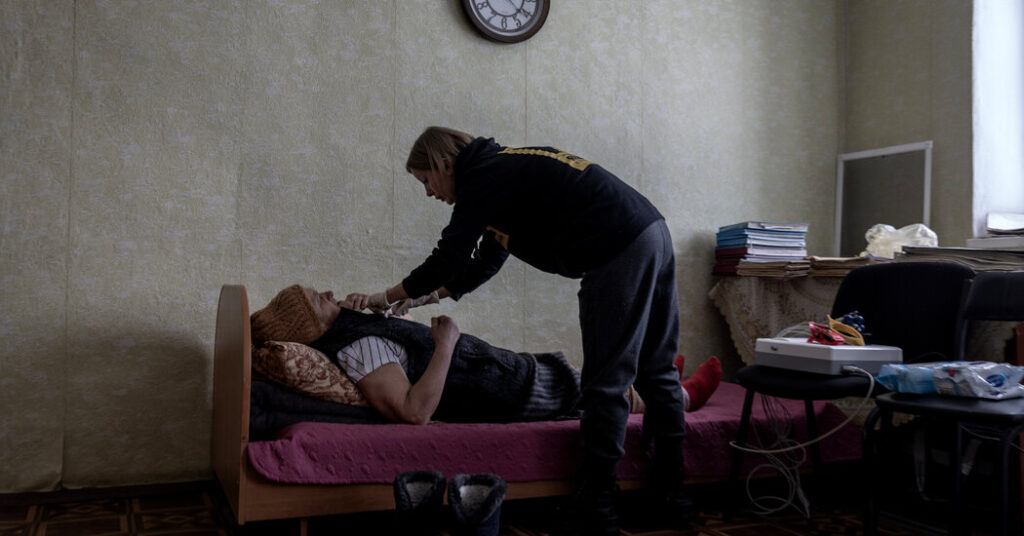
Ms. Andriivna’s concussion from the 2022 explosion left her with neuralgia, sharp pains caused by nerve damage. But there is no clinic or pharmacy in her village, where icicles hung like daggers last month from the eaves of ramshackle houses. Instead, she relies on monthly visits from a charity that provides free consultations and medicine.
That charity, the International Rescue Committee, sends mobile units consisting of a doctor, a nurse and a psychologist to isolated villages. During a February outing in the northeastern region of Kharkiv, the roads were glazed with ice. Fields of dead sunflowers, capped with snow, bent under the weight of winter.
Along main roads, work crews installed mile after mile of anti-drone netting as soldiers with shotguns watched the sky. Other soldiers used metal detectors to sweep for mines and unexploded ordnance. Nearby were trees splintered by explosions, their branches crusted in ice.
The brutal weather had led to a rise in pneumonia and other respiratory illnesses. “In winter, illnesses are more acute and chronic conditions are aggravated due to the cold,” said Dr. Oleg Marchenko of the I.R.C., who fled the occupied city of Mariupol early in the war.
“Logistics are also worse in winter, especially this winter, with extreme cold and the military activity getting closer,” Dr. Marchenko added.
As they approached Nyzhnii Burluk, a village of just over 100 people, the I.R.C. team was skirting the edge of the “kill zone” within 16 miles of the front line, where anything moving is a potential target for the Russian drones often heard buzzing overhead.
Explosions rumbled in the distance as the team unloaded medicine at a dilapidated administrative building, where a custodian stoked a furnace to heat the rooms. A soldier with a radio warned that a drone was nearby. A dozen villagers wearing hats and bulky coats huddled inside, waiting to see the doctor.
Oleksandr Lyudovik, a 65-year-old former railway worker, had hitched a ride with a neighbor to this makeshift clinic. The doctor examined his bulging disc and gave him medicine for his stomach and his knee pain.
“It’s very difficult for everyone here,” Mr. Ivanovic said of the hamlet, which had no shops or pharmacy and was close to the fighting. “Sometimes the houses are shaking from explosions.”
Many people have abandoned their homes. Nelia Kravchenko, 68, lived until recently in Malinivka, a village in the Donetsk region just two miles from the Russian lines.
“It’s between Russian and Ukrainian positions, so artillery and bombs are always flying over our houses,” Ms. Kravchenko said. In late February, she was moved to a transit center in the city of Lozova, where people with homes near the front await relocation to safer places.
Ms. Kravchenko, who has high blood pressure and legs swollen from poor circulation, said she had not seen a doctor in four years. A few months after the 2022 invasion, she said, her 42-year-old daughter died from complications related to Covid, diabetes and epilepsy. It had taken an ambulance almost a day to reach their village.
For a year before she moved, Ms. Kravchenko had gone without electricity, gas, humanitarian aid deliveries or access to shops. She survived by drawing water from a well and eating homegrown vegetables cooked on a wood-burning stove.
In February, a Russian glide bomb went off two houses from hers, blowing her doors and windows out and tearing off parts of her roof. She said she survived because she had stepped outside to check on her German shepherds.
“Every third home in the village is destroyed, the roads are destroyed, it really looks like a horror movie,” Ms. Kravchenko said. “Right now, I have no idea if my home even still exists.” When she last saw her street, as neighbors drove her away, it was being hit by rockets, she said.
Even in larger towns, health care can be hard to get. Svetlana Strabova, 78, who has lung cancer, lived until recently in Druzhkivka, a town in Donetsk that was slowly being surrounded by Russian forces.
She underwent two rounds of outpatient chemotherapy there. But when it was time for her third, taxi drivers refused to take her to the hospital in Kramatorsk, about 20 minutes away, because of the constant threat of drones. Ms. Strabova eventually found a ride to a hospital in another city, only to find the doors locked and the building empty.
“I realized there would be no treatment, no doctors, nothing,” she said from a bed at the Lozova transit center. “I was really healthy one year ago, but now it has all changed.”
The Health Ministry said last year that it would cost about $19 billion over a 10-year period to rebuild the health care system, citing World Bank and European Union estimates. But Mr. Ivanovic, the former railway worker, said people’s needs were simple.
“We need health and peace,” he said. “That’s all we need.”
The post In Rural Ukraine, Basic Health Care Is a Casualty of War appeared first on New York Times.