Among the rarities preserved in the Archivum Romanum Societatis Iesu, an expansive Jesuit archive in Rome, are several hundred prized books from as far back as the 1500s that were used by missionaries who carried Christianity and Western scientific thought to China.
Sometime between 1999 and 2002, investigators say, about 40 of those Chinese-language books — mostly scientific treatises on topics like astronomy, anatomy and engineering — were stolen by thieves looking to sell them to antiquarian collectors.
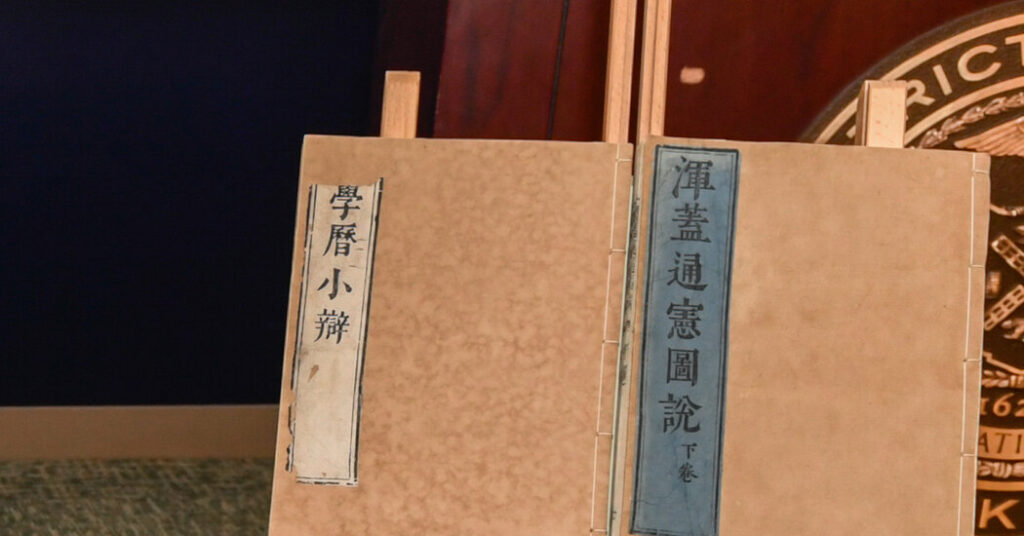
This week in Manhattan, six of the books were returned to Italian officials after a multinational investigation that stretched from the Vatican, which oversees the archive, to Hong Kong, and from there to the University of Notre Dame. All told, the books were appraised at $400,000, officials said.
“This is obviously an important and prestigious recovery due to their historical, artistic and scientific value,” said Antonio Petti, a brigadier general who commands the cultural heritage protection force for the Italian national police. He had traveled to New York to retrieve the books and other items from the Manhattan district attorney’s office, which had helped secure their return.
The texts had been on loan to Notre Dame from a Chinese collector who bought them in an online auction more than two decades ago, investigators said. They said officials at the university were unaware the books had been stolen and readily surrendered them when they were approached last year.
Investigators declined to identify the man who bought the books or the auction house that sold them because they said their investigation was continuing.
The books date from a period between 1582 to 1773 when the Jesuits were essential to the church’s efforts to establish a foothold in Asia. The Jesuit clerics trekked to Beijing along the Silk Road land route, carrying with them from Europe dozens of Latin treatises on astronomy, mathematics, cartography and other scientific subjects alongside their gospel texts.
The clerics learned to speak and write Chinese and, on arriving, ingratiated themselves with the emperor and his court by offering to trade their treatises for information on Chinese history, science and culture, including the philosophy of Confucius and others. The Jesuits sent what they learned back to the Vatican as part of a process that was a pioneering effort in the exchange of knowledge between the East and the West.
Using Chinese woodblock printing, they created translations of works by Galileo and other Western scientists and presented them to the emperor and his counselors. The recovered books bear titles like “Illustrated Explanation of the Sphere and the Astrolabe,” “Abridged Theory of the Measures of the Sky” and “Explanation of the Telescope.”
The Chinese intelligentsia embraced the new expertise they were securing in fields like the movements of celestial bodies and the predictability of weather cycles, as well as instructions on the use of fine measuring instruments and mechanical clocks, scholars say. One result was that the Jesuits were granted latitude to evangelize in China until their expulsion in 1773.
Scholars say about 120 scientific books, as well as 330 or so religious texts, were produced by the Jesuits for China’s imperial library, while duplicate copies were dutifully sent back to Rome as evidence that the Jesuits were fulfilling their mission. The books, which often included geometric diagrams and woodcut depictions of the solar system, became foundational education tools that were copied and disseminated in Japan, Korea and other Asian nations, scholars say.
“They are very rare, and we don’t have many copies at all,” said Marten Soderblom Saarela of the Ricci Institute for Chinese-Western Cultural History at Boston College, who has studied the texts extensively. “They were very influential in their own time.”
The Jesuits first learned that the books were missing in 2002, after several clerics and book dealers noticed a surge of Chinese Jesuit texts entering the online auction market, including the six returned to Italy this week, which were sold that same year.
As the chatter about the unexpected sales items spread, several clerical scholars decided to inventory the Chinese collection held at the archives.
After comparing what remained in the archives against inventories that were finished in the 1990s, the investigators counted about 42 missing books, investigators said. They began raising the alarm to church officials and the Italian police, but officials said pursuit of the matter was bogged down by bureaucratic delays and a lack of investigative resources.
Early last year, however, the Italian police approached the Manhattan district attorney’s antiquities trafficking unit and asked its chief, Matthew Bogdanos, to investigate. In an interview, Mr. Bogdanos said his office was able to research past online auctions and identify who had sold and bought the six books. His office also received tips from antiquarian dealers who had scoured scholarly databases and noticed that the books in question were listed as on loan at Notre Dame.
“Once we contacted the buyer, he surrendered them willingly,” said Mr. Bogdanos, whose unit is continuing to search for the other stolen books. He said several antiquarian booksellers troubled by illicit dealings had assisted with the case.
At the ceremony where the books were returned to Italian officials, Manhattan investigators also handed over about a dozen other items they had identified as looted, including several seized from the Metropolitan Museum of Art.
The Met objects included two Greek ceramic drinking cups from about 500 B.C., a pair of Roman silver drinking cups from around the first century and a pair of gold earrings from the fifth century B.C.
In a statement, the Met credited the district attorney’s office with identifying the illicit items and said it had an “ongoing commitment to responsible collections stewardship.”
Italy’s culture minister, Alessandro Giuli, attended the repatriation ceremony and also met this week with officials at the Met in advance of the museum’s upcoming exhibition, “Raphael: Sublime Poetry,” which will feature works by the Renaissance artist on loan from Italy.
“Italy has long been one of the Met’s most valued partners, and our collaboration with Italian museums and cultural institutions continues to flourish,” the Met’s director, Max Hollein, said in a statement.
The post Rare Books Stolen From a Jesuit Archive in Rome Are Returned to Italy appeared first on New York Times.