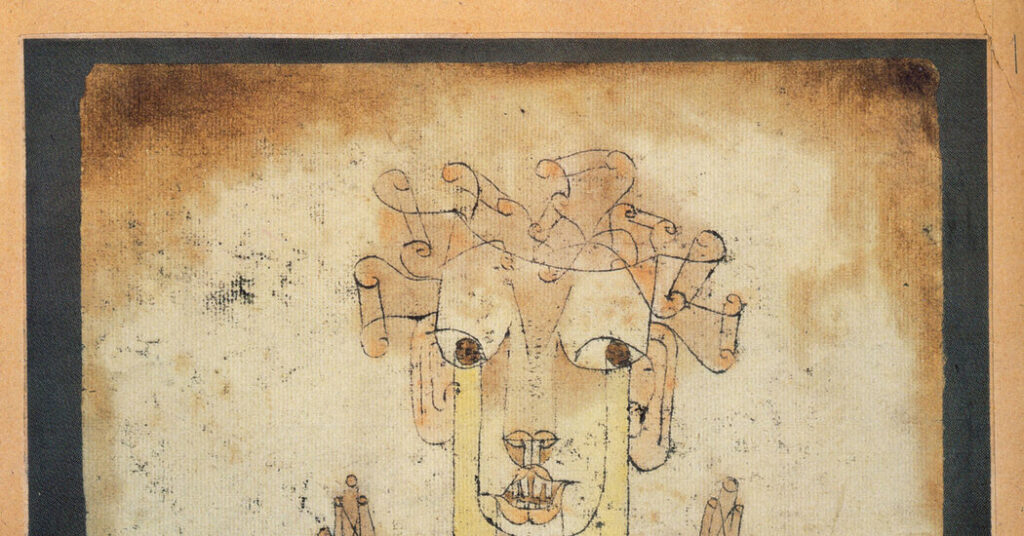
When the Jewish Museum in New York previewed a landmark exhibition highlighting the Modernist painter Paul Klee earlier this year, it singled out one featured piece: a small print from 1920 called “Angelus Novus.”
“More than any other work by Klee,” the official exhibition text states, “‘Angelus Novus’ has become immortalized.”
“Paul Klee: Other Possible Worlds,” which opened on Friday and runs through July 26, was to show the extremely light-sensitive drawing, an oil transfer and watercolor on paper, for the first time in North America.
But as of this week, the “Angelus Novus” is not in New York. It remains at its home, the Israel Museum in Jerusalem, unable to be transported because of the war in the Middle East that started when the United States and Israel attacked Iran.
Visitors to the exhibition are greeted by an authorized facsimile of the “Angelus Novus” and a note stating, “Due to current conditions affecting international transport, the shipment of the original artwork has been temporarily delayed.”
James S. Snyder, the director of the Jewish Museum, said in an interview that the Israel Museum’s loan remains operative. The Jewish Museum expects to receive “Angelus Novus” when the time is right. “We knew we had to be prudent and patient and to wait until conditions were appropriate,” he said.
The authorized facsimile of “Angelus Novus” was already scheduled to replace the fragile original work during the second and third months of the exhibition’s four-month run, Snyder said. The show already contains nearly 100 loans from around the world.
A spokesman said the Israel Museum does not discuss the shipping of artwork.
“Angelus Novus” is renowned not just in its own right, but for what its most famous owner made of it. Barely larger than a standard notebook sheet, it was purchased in Munich in 1921 by the German-Jewish writer Walter Benjamin, Klee’s friend and a titanic figure in 20th-century letters.
In a 1940 essay titled, “Theses on the Philosophy of History,” Benjamin reconceived the print’s central figure as the “Angel of History,” who is blown into the future even as he views the past, which he perceives as “one single catastrophe which keeps piling wreckage and hurls it in front of his feet.” Benjamin’s vision rhymed ominously with his own fate: In 1940, shortly after writing the “Theses,” he tried to escape France, which the Germans had invaded. After failing to cross the border into Spain, Benjamin died from swallowing an overdose of morphine.
The current war has disrupted art and architecture. Airstrikes have damaged historic sites in Tehran and Isfahan, according to Iran’s Ministry of Heritage and Culture. Art galleries in the United Arab Emirates have closed. At the Tel Aviv Museum of Art, shipments from New York and Vienna and outgoing ones to Wuppertal, Germany, have been postponed, and an exhibition was dismantled and moved to an auditorium and its backstage rooms, said Mira Lapidot, the chief curator.
Some of the Dead Sea Scrolls — ancient papers that include the earliest known copies of most books of the Hebrew Bible — were returned to Israel during the war under security escort so they could be stored for conservation, a spokeswoman for the Israel Antiquities Authority said.
From the early 1930s, the Nazis hounded Klee as a Jew (which he was not) and “degenerate.” The Jewish Museum’s show focuses on the darker turn his work took during fascism’s rise, while including earlier works to contextualize his tonal shift. He died from illness in 1940 in Bern, Switzerland, where he had been living in recent years.
“As you look at his work from ’33 to ’40, you see these angels depicted as struggling figures,” said Snyder. “There’s an important work from 1939 called, ‘Angel Applicant,’ where it’s a dark angel with dark eyes, in a way crashing. If you just look at ‘Angelus Novus,’ this ascendant angel, and ‘Angel Applicant,’ you see that rise and fall.”
It was during Klee’s and his own final year that Benjamin wrote of the ascendant angel’s being blown relentlessly “into the future to which his back is turned” by a storm that, Benjamin concluded, “is what we call progress.”
Before attempting his escape, Benjamin had left “Angelus Novus” with the French writer Georges Bataille, a friend, who hid it in the French National Library in Paris. After the war, it was sent to Benjamin’s colleague, Theodor Adorno, in the United States. However, Benjamin was found to have left the work to the philosopher Gershom Scholem, who received it in Jerusalem and bequeathed it to the Israel Museum.
Marc Tracy is a Times reporter covering arts and culture. He is based in New York.
The post A Klee Angel’s American Debut Is Delayed by the Mideast War appeared first on New York Times.