Control of Congress may well run through California’s Central Valley.
A massive expanse of cow pastures, citrus and almond trees and large pickup trucks speeding down open highways through the middle of the state, it is one of the largest farming communities in the country.
Its electorate is also increasingly Latino, as the children and grandchildren of Mexican immigrants have become voting citizens. For years, Democrats saw the region as pivotal to their success, believing that eventually — inevitably — it would cement their power in the state.
The 2024 election proved how wrong that calculus was. Just as they did across the country, Latino voters in the agricultural heart of California shifted toward Republicans. GOP leaders celebrated the multiracial coalition they called the beginning of a political revolution.
Now, there are signs that support could be swinging away from the Republicans once again. This year’s midterm election — in California and beyond — may show that the Latino rebuke of political parties can cut both ways.
“Our two-party system is just broken,” said Vincent Martinez, a conservative city councilman in Wasco, one of the small communities that dot the valley. “We have a president who is out of control, but too many Republicans just want to turn a blind eye to that.”
Mr. Martinez, 47, voted for President Trump in 2024 but has since soured on him and much of the Republican Party, complaining that their focus on immigration and foreign policy has replaced more urgent concerns about the economy. He is especially incensed about the war in Iran.
“The only way we’re going to accomplish anything is with boots on the ground, and it’s going to be another Vietnam,” he said.
In many ways, the Central Valley, which stretches 450 miles up and down the middle of the state, is a microcosm of a larger political shift taking place across the country. In recent months, Hispanic voters have fueled important wins for Democrats in Virginia, New Jersey and Texas elections.
And they will be one of the most important swing groups helping to determine control of Congress this fall. Across the country, they make up at least 20 percent of the population in a majority of the most competitive congressional districts, which means that losing them by wide margins could cost Republicans control of the House. Latino voters also make up a sizable chunk of voters in North Carolina and Georgia, two states with crucial Senate races.
In California, a Central Valley House race where an incumbent Republican is facing significant headwinds will test the depths of Latino discontent.
House Speaker Mike Johnson acknowledged the challenge recently, saying that Republicans had “a little hiccup with some Latino and Hispanic voters for certain.” He blamed the problem on the perception of the administration’s immigration enforcement as “overzealous” and added that the party is “in a course correction mode right now.”
But the party’s struggles with Hispanic voters are not limited to immigration. Many are deeply frustrated with the economy and high cost of living — expressing some of the same resentment that drove them to vote for President Trump in 2024. Public polling shows that their anger has not abated.
A recent national survey of Hispanics by the Pew Research Center found deep pessimism: 68 percent said that the situation for Hispanics in the United States has worsened in the past year. It was the first time in two decades of the survey that the majority said things had gotten worse. Nearly eight in 10 respondents said that the Trump administration’s policies harm them, and 55 percent said they have serious concerns about their place in the United States with Mr. Trump as president.
In dozens of interviews in the Central Valley, Latino voters repeatedly said they were more concerned about the economy than immigration policy, but in some ways the issues are one and the same. The region’s farms and its entire economy remain heavily reliant on undocumented immigrants. Many Latino voters were unconcerned — even enthusiastic — about President Trump’s promise to deport criminals but now say they are infuriated by the aggressive tactics employed by federal agents.
The first immigration raid of the new era of enforcement took place in the Central Valley, just before Mr. Trump took office last year.
It was widely seen as a test run for enforcement tactics that have since become standard across the country. But after the American Civil Liberties Union sued, accusing the agency of racial profiling and coercing immigrants to accept “voluntary departure,” a federal judge limited how Border Patrol could stop residents in the region.
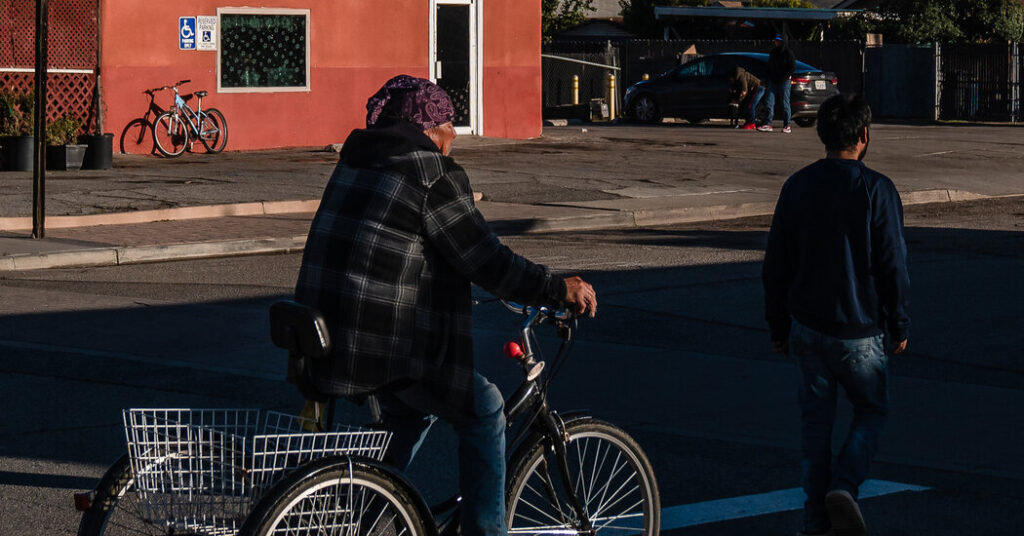
As a result, there are now relatively few local raids, especially compared to Los Angeles, just 100 miles to the south. But residents say the ripple effects of that 2025 action are still felt more than a year later. Farm workers regularly send each other panicked texts on WhatsApp, warning of unfamiliar SUVs patrolling the area. Many small Mexican restaurants and businesses say customers are reluctant to come as often as they once did. Playgrounds and parks sit emptier than usual at this time of year, before the temperatures reach into the triple digits. Some residents carry a passport everywhere they go, worried that they may be asked to prove their citizenship.
“Last year brought the fear of God in the community and changed our lives,” said Joe Garcia, 61, who runs a farm labor contracting company and voted twice for Mr. Trump. “We didn’t see this kind of thing in the first Trump administration. I am all for immigration enforcement, but I am not for terrorizing people.”
Others believe such fears are overblown. “I have friends whose husbands are illegal, and I tell them people have to make a choice now, said Mercy Peña, 60, a billing administrator who won a seat on a local school board in 2024 after running a campaign for more “parental rights” and improving bilingual education. “If they leave on their own, there still might be a chance to move back.”
Some of the discontent can be heard just outside El Rey supermarket in Hanford, a small city north of Bakersfield. Jose Rivera, a 24-year-old delivery worker, walked out of the store recently with a plastic bag filled with chips, apples, carrots, canned beans and deli meat.
“Everything goes up except my pay,” he said, adding that he was particularly angry that Mr. Trump was focused on other parts of the world and willing to start another war. He voted for Mr. Trump in 2024, the first time he had ever cast a ballot. “That’s not what this president promised. He sold us a great dream.”
Mr. Rivera said he doubted he would vote at all this year.
Frances Fernandez, 53, takes care of several grandchildren and said she was especially worried for them and her children, because it was getting more difficult to buy a home and create the kind of life she and her husband have.
“I shouldn’t have listened,” she said, recalling when her husband and other friends urged her to vote for Mr. Trump. “There is still so much to worry about, and we just aren’t willing to face all that.”
All of this will be on the minds of voters and candidates in this year’s midterm elections.
Across California’s seven competitive congressional districts, at least one in five people are Latino. And nowhere is their power more potent than in the 22nd District, an area of the Central Valley that has long been represented by David Valadao, a Republican.
Mr. Valadao, the son of Portuguese immigrants who came to the region as dairy farmers, has been popular in part because he is a moderate who sometimes bucks his party leadership. He was one of 10 House Republicans who voted to impeach President Trump after the Jan 6. insurrection.
First elected in 2012, he lost his seat in 2018 and returned to the House in 2020. Cathy Abernathy, a longtime Republican strategist in Bakersfield, is confident that he will prevail this fall. She noted that Mr. Valadao has been seen as one of the most vulnerable candidates in nearly every House race he’s run in.
“They’ve been predicting this flip for years, and it never comes true — we see the opposite happening,” she said.
But interviews with voters, strategists, community leaders and elected officials make it clear Mr. Valadao has a serious battle on his hands this year.
Prognosticators at the Cook Political Report recently switched their assessment of the district, which Democratic leaders redrew last year and made slightly more favorable to Democrats, from “leans Republican” to “tossup.”
Voters will go to the polls in June for a nonpartisan primary. Mr. Valadao is expected to sail on to the November ballot, but will then face a difficult battle, no matter which Democrat he faces. It is seen as one of the most competitive districts in the country.
Democrats have criticized Mr. Valadao for being largely silent about the Trump administration’s deportation tactics. His critics have put up yard signs attacking him for his vote on the president’s massive bill that cut $1 trillion from Medicaid and other programs for the poor. That line of attack could be especially salient in the district, where roughly two-thirds of residents rely on Medi-Cal, the state’s Medicaid program. Mr. Valadao declined to be interviewed for this story.
Most of all, Latino voters say, they are eager for officials in Washington to pay attention to their pleas for help.
A decade ago, Mr. Garcia created the California Farmworker Foundation with the help of agricultural leaders in the region, to provide workers with health and education programs. When Mr. Trump first took office in 2017, industry leaders were hopeful they could reach an agreement on immigration reform that would allow their workers to stay in the country without the threat of deportation.
Now, he said, those same leaders have grown frustrated because White House officials and members of Congress have mostly ignored them. Last year, Trump administration officials suggested they would avoid targeting agricultural areas, but that has done little to calm nerves.
“We always say we feed the world, but we can’t get anyone to really listen to us,” said Mr. Garcia, who blames both Republicans and Democrats for failing to overhaul immigration laws or lower the cost of living. “We just have a lot of fear and frustration. We continue to ask on a weekly basis: ‘what’s the plan, what’s the plan’ and nobody can tell us.”
Jennifer Medina is a Los Angeles-based political reporter for The Times, focused on political attitudes and demographic change.
The post Latino Support for Trump Is Fading in California Farm Country appeared first on New York Times.