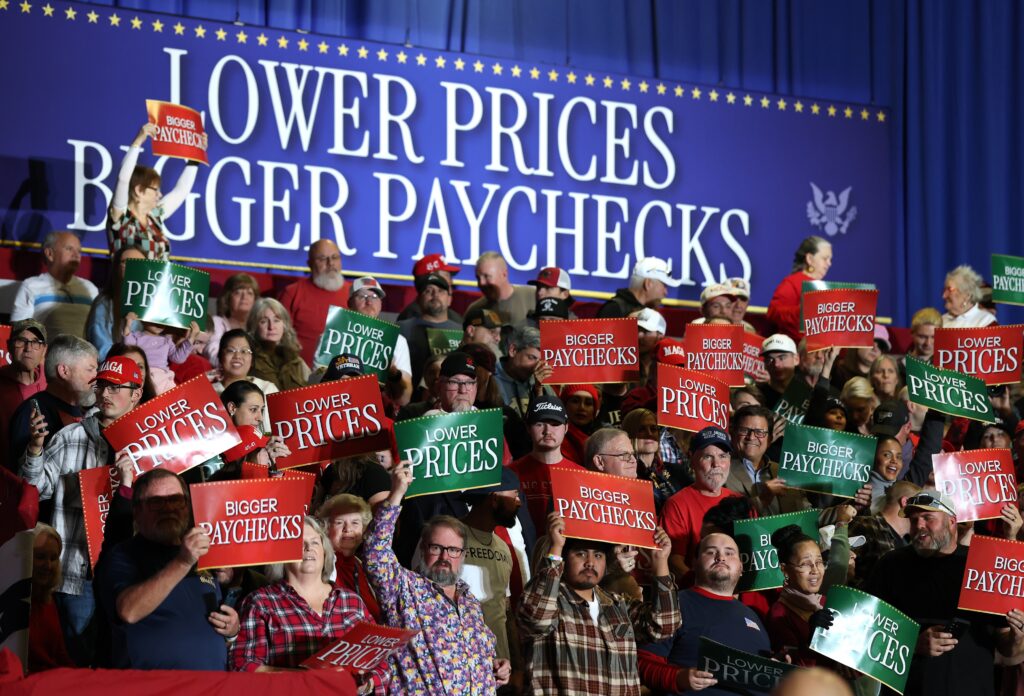
Both Republicans and Democrats have put forward a flurry of ideas to tackle America’s affordability problem, but economists don’t particularly like most of what’s on offer.
Republicans have floated capping credit card interest rates and stretching out mortgages to 50-year terms. A GOP law has ended taxes on tips, car-loan interest and overtime pay.
Democrats, meanwhile, have proposed freezing rents and utility rates and capping the price of groceries. Some also want to suspend the gas tax and cut seniors’ property taxes.
And although there is not much bipartisan brainstorming, it’s possible that both parties could come together to force certain institutional investors out of the housing market.
Many economists are appalled by all of it.
“You can come up with a laundry list of these things that are very attractive to normal humans but that repulse economists,” said Scott Lincicome, vice president of general economics at the libertarian Cato Institute.
The problem, as many economists view it, is that despite voters’ desires for relief from the rising cost of living, it’s fundamentally difficult to bring down prices. And when politicians try creative ways to do it, they often cause other problems.
“Prices are stubborn and sticky. Companies, once they raise prices, are quite loath to lower them,” Lincicome said.
Price caps and freezes “are eternally seductive, because they communicate to a political audience that you are stopping the price increases,” he said. But price controls can lead to shortages or hoarding or other bad outcomes. Subsidies can end up driving prices higher for everybody.
“If you try to push down grocery prices, you could actually start reducing supply. People might start going out of business, or grocery stores close,” said Josh Bivens, chief economist of the liberal Economic Policy Institute. He added: “That price obsession has led to a lot of policy ideas that are just not going to work very well. I am sort of frustrated with where it’s going.”
Politicians, activists and others in the wide world beyond economics seminars often gravitate toward the positive aspects of policies that might help people who are struggling as costs soar.
“What policymakers are doing is scrambling around to show they care about this, in individual markets,” said Ryan Bourne, Cato’s chair for the public understanding of economics. “And that is leading to a lot of bad policy and a lot of confused policy.”
Rent control, for instance, is favored by leaders and advocates in many cities to protect people from being priced out of their homes as landlords raise rates. New York Mayor Zohran Mamdani is among its most prominent proponents at the moment. But imposing rent controls can discourage landlords from investing in their properties, staying on top of maintenance issues or even renting out those apartments at all. The result can be depleted or degraded housing stock and diminished supply, further compounding the housing crisis.
The proposals to freeze seniors’ property taxes? Those could end up raising other people’s tax bills to compensate.
Capping credit card interest rates? Some economists predict that rather than saving customers money, that would lead companies to reject credit card applications from low-income customers.
Some strands of economic theory would suggest that rather than focus on prices, governments would do better to try to raise people’s incomes, so that they can afford price increases.
“There are a lot of people who have trouble affording enough food on a regular basis. But I think that’s more a problem of they’re not getting enough income from the labor market,” Bivens said. He favors several approaches to raising incomes, including monetary policy aimed at reducing unemployment and labor laws that strengthen unions.
Harvard economist Jason Furman, who led President Barack Obama’s Council of Economic Advisers, concurred that raising wages is a better goal than tamping down prices — but said that income growth has actually been good recently. When adjusting for inflation, Americans’ average weekly wages fell during the inflation spike of 2022 but have been modestly growing since then. In non-adjusted terms, wages are up more than 2 percent since the beginning of 2025.
“I do wish the debate was a little more about what could be done to increase wage growth rather than slow price growth,” Furman said. But “it’s hard to imagine real wages growing that much faster than how they’re growing now.”
He said that removing certain restrictions on housing construction would help tamp down price increases (though the Senate’s plan to block private equity companies from owning rental housing could reduce the supply of rentals and, thus, raise prices). Some health care policies might also help improve costs. But in many areas, he said, the government shouldn’t intervene.
“I think we are seeing more bad economic ideas than before, and I think some of it is because people are trying to solve a problem that doesn’t have a solution,” Furman said.
As one example, he mentioned a recent proposal from the left-leaning Center for American Progress for a voluntary cap on certain grocery prices. “Floating any form of price controls for groceries, to me, is the epitome of that,” he said. “It’s a hard thing in politics to say not everything has a solution.”
Neera Tanden, a top Biden adviser who runs the Center for American Progress, noted that the grocery idea is based on a successful 2022 policy in Mexico. “People should look at what works or not. That plan has worked,” she said.
But she said she agreed that politicians’ attempts to meddle with free markets are a problem. She expressed outrage at President Donald Trump’s tariffs and interventions in companies, including Intel and Nvidia. “I haven’t seen, in my lifetime, a president use the powers of the federal government to interfere with the market more than Trump,” she said.
The post Politicians are trying to make life cheaper. Economists are appalled. appeared first on Washington Post.