Not long after Mayor Zohran Mamdani took office, one of his campaign vows to change Police Department protocol seemed poised to become reality.
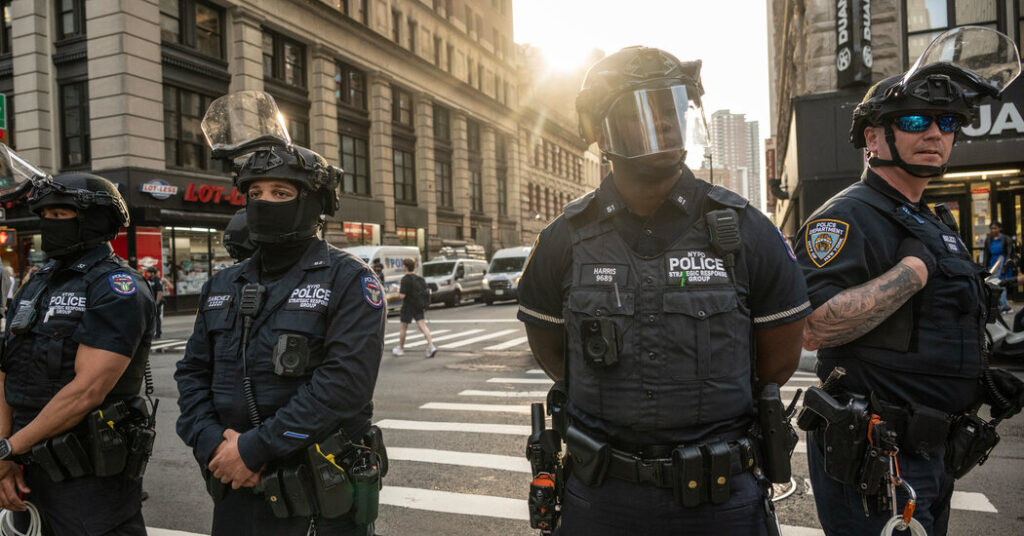
A like-minded colleague, Chi Ossé, the democratic socialist councilman from Brooklyn, was set to take another crack at forcing the department to shackle its Strategic Response Group, a specialized unit charged with maintaining order during large-scale demonstrations, which has been a source of extensive controversy for its aggressive tactics.
But Mr. Ossé backed off after the area outside of Mr. Mamdani’s mayoral residence in Manhattan became the scene of an alleged terrorist act earlier this month. Two men were arrested after one was seen hurling a homemade bomb into an already tense, anti-Muslim protest close to Gracie Mansion. Police officers, including S.R.G. members, quickly responded; the bomb did not detonate, and no one was injured.
Now Mr. Ossé is planning to resurrect his bill, the so-called CURB Act, on Thursday. It would ban the unit from responding to “First Amendment-protected” activities, like protests or parades, for purposes of crowd control and formally end the use of more draconian crowd management methods by the Police Department.
Mr. Ossé said the attack outside Gracie Mansion had been a frightening but isolated incident that had no real bearing on the bill he was putting forward.
He noted that the officers who arrested the two would-be bombers were not assigned to the Strategic Response Group and said he did not believe the unit was “particularly necessary” at the event. And he added that he pulled the bill earlier this month because he had not wanted the legislation to be “convoluted and mistaken” for what had happened at Gracie.
“I think flooding demonstrations with S.R.G. officers doesn’t make New Yorkers safer from targeted attacks,” Mr. Ossé said.
Donna Lieberman, the executive director of the New York Civil Liberties Union, which has partnered with Mr. Ossé on the bill, went a step further, saying the legislation was as critical as ever. “An aberrational violent act should not be leveraged as pretext for militarizing and targeting peaceful protest activity,” she said in a recent interview.
Mr. Ossé has introduced the CURB Act twice before but has not garnered enough support to advance it. This time, the circumstances would appear more favorable: The bill has at least 22 co-sponsors, and the mayor supports the general idea behind it.
But the attack this month may still complicate the bill’s passage.
The police commissioner, Jessica S. Tisch, is dubious about the measure, nor does the Council speaker, Julie Menin, support it, according to a person familiar with the speaker’s thinking. Ms. Menin has concerns about how the Police Department would respond to attacks like the one at Gracie Mansion this month or a shooting in Midtown Manhattan last summer that left four dead if the S.R.G. is constrained.
The Police Department declined to comment on Wednesday, citing an inability to review the language of the new bill.
Bill Bratton, the former police commissioner under Bill de Blasio, announced the unit’s creation in 2015, as he watched other global cities, including Paris and Mumbai, contend with terrorist attacks. In an interview on Wednesday, he said that it would be a “tragic mistake” to dismantle the unit and turn over its portfolio to officers with less specialized training, especially at a time when conflicts abroad are increasing tensions here in New York City.
“Shame on the City Council, shame on the mayor, if they in fact attempt to do away with it, modify it in some significant way,” Mr. Bratton said. “Because the rest of the department is not trained, equipped to deal with large-scale demonstrations.”
Sam Raskin, a spokesman for the mayor, said this week that Mr. Mamdani remained committed to disbanding the unit and that he looked forward to reviewing the bill.
The mayor has so far embraced a cautious approach to police reform. Earlier this month, Mr. Mamdani announced the creation of a Community Safety Office to overhaul how the city responds to some 911 calls, taking an initial step toward honoring his signature public safety campaign policy. But the office is a pared-down version of the full-fledged agency Mr. Mamdani had planned, with a smaller budget than promised.
The mayor, a democratic socialist, vowed during his campaign to disband the S.R.G., which he said had “cost taxpayers millions in lawsuit settlements + brutalized countless New Yorkers.”
But since taking office, he has rarely mentioned the unit and has taken no visible steps toward eliminating it. In the days after the Gracie Mansion protest, Mr. Mamdani insisted he was still discussing ways to disband the S.R.G., but the nature of those conversations was not immediately clear.
To that end, Mr. Ossé’s bill could provide a degree of political cover for the mayor on an issue that may unsettle the city’s more moderate voters.
The S.R.G. has been a topic of intense debate since the summer of 2020, when it came under fire for its heavy-handed response to the racial justice protests that convulsed the city after the death of George Floyd in Minnesota.
The unit, which was established in part after a terrorist attack at a French satirical magazine in Paris, responds to high-intensity protests, along with shootings, bank robberies and other “significant events,” according to the Police Department. Since its inception, critics have argued that the unit’s counterterrorism roots have led its officers to take a militarized approach to policing, bringing aggressive tactics to bear on peaceful protesters.
During the protests of 2020, officers charged at demonstrators, hit them with batons and boxed them into enclosed areas without cause, a tactic called “kettling.” Those episodes resulted in a settlement between the New York attorney general, Letitia James, and the Police Department in which the department agreed to limit its use of the S.R.G. to respond to protests. (Mr. Ossé’s bill looks to further codify portions of that settlement into law.)
But police advocates say the specially trained unit is essential to keeping New Yorkers safe during civil unrest. The department said that the S.R.G. is already governed by Ms. James’s settlement and that the group is only deployed during specific high-level episodes. Of the more than 4,000 First Amendment activities that the police responded to in 2025, the S.R.G. was only involved in 1 percent of them, the department said.
City Hall and police officials have said that the mayor and Commissioner Tisch are still actively in conversation about the S.R.G., and Mr. Mamdani’s administration has said it is still examining ways to shut down the unit operationally.
“The administration is currently working with the Police Department on how to do so in a manner that both improves safety for New Yorkers and protects First Amendment rights,” Mr. Raskin, the City Hall spokesman, said.
Mr. Ossé said on Tuesday that he had not spoken directly to the mayor about the legislation, but that he had been in contact with his administration. The two have had a somewhat rocky relationship after Mr. Mamdani took the unusual step of intervening to block the councilman from launching a primary challenge against Representative Hakeem Jeffries, the House Democratic leader.
Personal feelings aside, Mr. Ossé acknowledged there was “a lot of work left to do” for the bill to become law.
“I’m committed to that work,” he said. “And I have a coalition behind me that is also committed to getting this bill passed the finish line.”
Maia Coleman is a reporter for The Times covering the New York Police Department and criminal justice in the New York area.
The post Battle Over a Contentious Police Unit Re-emerges in New York City appeared first on New York Times.